Pearl River channels
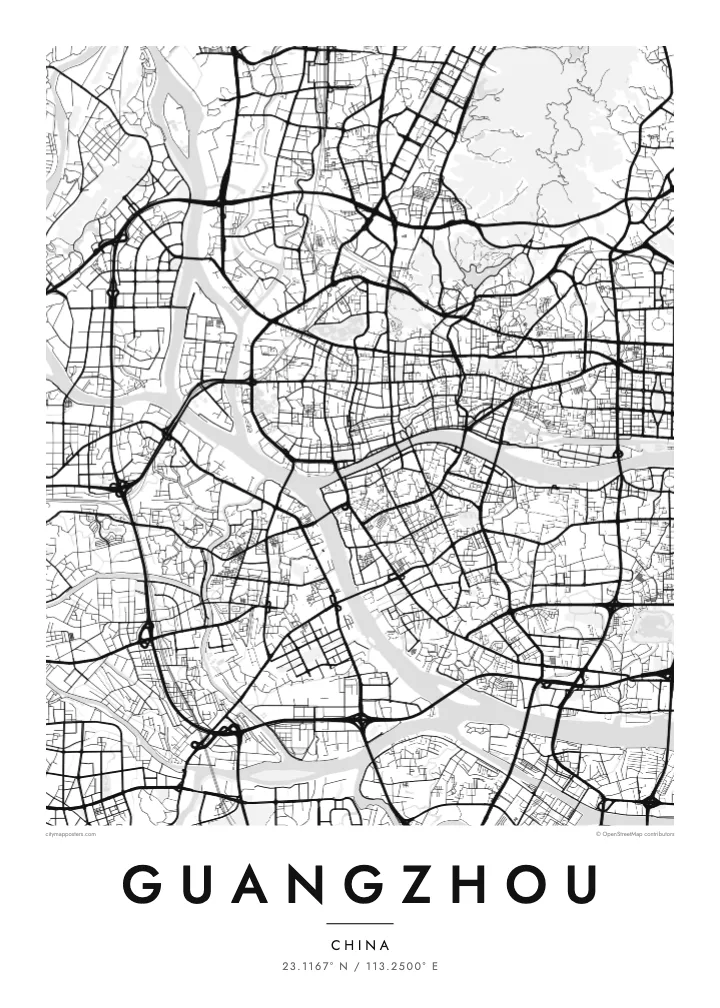
The river splits and rejoins as it crosses the city, leaving islands and peninsulas between its branches. These ribbons of water give the poster its main structure and divide north from south.
Pōhita mape faigofie · China
23.1167° N / 113.2500° E
A dense river city where the Pearl River splits around islands, with the slopes of Baiyun Mountain holding back the streets to the north


Taone e tahi, lagona e lima
Pa'i se ata ke va'ai ai i luga o te pā. E tutusa te tau o ata uma — i lomiga, fakapipi'i i faleata, pe ko faila HD.
 Pixels mo'i · Faila lomiga 24 × 36″
Manino mo te lomiga
Ko se kupega 100% mai te faila lomiga mo'i. Poster uma — pe lomiina, fakapipi'i i faleata, pe download-ina — e fakaatagia i luga o a matou setula i te 300 DPI, e oo atu ki te 7,200 × 10,800 pixels, ina ia mautinoa e ma'ai pea auala tuai foki i luga o se lomiga 24 × 36″.
I luga o te pa


Te mape
Guangzhou is organised around water. The Pearl River runs through the city from west to east, and its channels divide the urban area into distinct banks and islands. Haizhu, on the south side, is a district entirely wrapped by river branches, and further downstream the delta begins to widen toward the sea. On a map, bridges cross these channels at close intervals, stitching the halves of the city together.
The older districts of Liwan and Yuexiu hold the historic core, with an irregular, closely packed street pattern. Small Shamian Island, once a foreign concession, appears as a neat elongated shape on the river’s edge. To the east, Zhujiang New Town lays down a wide, formal axis that faces the Canton Tower across the water, and the long ridge of Baiyun Mountain closes off the north.
The city, historically known in the West as Canton, has been a trading port for more than two thousand years and was an early hub of maritime trade with Southeast Asia and beyond. The Canton Fair, held here since 1957, remains one of the largest trade fairs in China. A Guangzhou map poster captures that river-bound, commercial character in a single frame.
The river splits and rejoins as it crosses the city, leaving islands and peninsulas between its branches. These ribbons of water give the poster its main structure and divide north from south.
A small island on the river bank in Liwan, laid out with a tidy grid of tree-lined streets. Its regular plan stands out clearly against the tighter lanes of the surrounding old town.
A broad central axis of parks and plazas runs north to south through the business district and continues across the river toward the Canton Tower, giving the modern city a clear ceremonial line.
Fai mo koe
Fakaopoopo he aho, he igoa pe he upu a koe, hui te faiga, te lahi pe te tūlaga.
Ko te va'aiga e leai se totogi e maualalo tona resolution ma iai se fakailoga vai. E fakaatagia lomiga ma faila HD i te 300 DPI, e oo atu ki te 7,200 × 10,800 px, e aunoa ma se fakailoga vai.
Aiheā Guangzhou
Guangzhou tends to belong to people with a real connection to it, whether through family in Guangdong, years spent studying there or regular trips to the Canton Fair. The river divides the frame into strong shapes, so the poster reads well from across a room.
The title, subtitle and coordinates line are all editable, so the print can carry a name, a district or the date you moved there. Pick one of five styles, Classic black & white, Noir, Paper, Blueprint or Sand, to match the room it will hang in.
Oka te poster Guangzhou| Lahi o te lomiga | Manino | Faila |
|---|---|---|
| 30 × 40 cm11.8 × 15.7″ | 3,543 × 4,724 px | PNG · PDF |
| 29.7 × 42 cm (A3)11.7 × 16.5″ | 3,508 × 4,961 px | PNG · PDF |
| 42 × 59.4 cm (A2)16.5 × 23.4″ | 4,961 × 7,016 px | PNG · PDF |
| 45.7 × 61 cm18 × 24″ | 5,400 × 7,200 px | PNG · PDF |
| 50 × 70 cm19.7 × 27.6″ | 5,906 × 8,268 px | PNG · PDF |
| 61 × 91.4 cm24 × 36″ | 7,200 × 10,800 px | PNG · PDF |
Mo te fakatatau, ko te fakaakoakoga e hē totogi e 900 px te lautele, e ihi te fakailoga ma mo te lau komipiuta. Ko nā faila HD e oko ki te 8× te manino i itū taki tahi ma e lomia lelei i te lahi kātoa o te pōhita.
Filifili se ata i te pito i luga o te itulau, ona filifili lea o te Poster Lomiina — se lapoa ma, ka manako ai koe, se faleata — pe ko Faila HD Fakaonaonaina. E tasi te laasaga o te ōkaina, ma ka fakafou loa lau itulau ōkaina pe a mae'a te totogi.
E lomiina i luga o se pepa matte kaliki maualuga e 200 gsm, i se tasi o ni lapoa e ono, mai le 30 × 40 cm ki te 24 × 36″. E kamata te tau o poster lomiina mai le $39, aofia ai te uta.
Ioe. Filifili se faleata lakau malō i te lanu uli, tea, oki masani pe lakau pouli. E aumai fakatasi mo se tioata e le gagamu ma ua sauni ke tautau. E kamata te tau o poster fakapipi'i i se faleata mai le $99, aofia ai te uta.
E tuku uma te uta ki fenua e 60+. Ko te pepa takitasi e lomi e te tasi o a matou paaga lomi i fenua e 30+, ka tae mai i aso galue e 3–7. E mafai ke e maimoa ki te tulaga mo te tulitaki i lalo o Taku Fakatonuga. E lauiti nei fenua e 2–5 wiki, ka ko nei fenua e le o tuku atu ai, e fakamatala atu e te weepisi i mua o te totogi.
Auina mai se ata pikitia i loto o te 14 aso mai te taimi na oo mai ai, ka toe lomiina e matou e leai se totogi pe toe totogi atu lau tupe.
Ioe. I te mea fakasa'o i luga o lenei itulau, sui te ulutala, te ulutala lalo ma te laina fakamaoniga tulaga ki so se mea e manako ai koe, ona filifili lea o se ata ma se lapoa. Okaina lomiina, fakapipi'i i faleata, ma fakaonaonaina e fakaaogā uma i tau ata tonu.
Mo le $9 e maua e koe ni faila PNG 300 DPI ma PDF sauni-mo-lomiga i lapoa e ono uma, e aunoa ma se fakailoga vai, ke lomiina i so se mea. E le'i mautinoa? Download muamua se va'aiga fakailoga vai e leai se totogi.
Latalata
