A refugee-era grid
The neighbourhoods laid out for Asia Minor refugees in the 1920s give Níkaia a tight, regular street pattern that stands apart from the looser, older layouts elsewhere in Attica.
Pōhita mape faigofie · Greece
37.9667° N / 23.6500° E
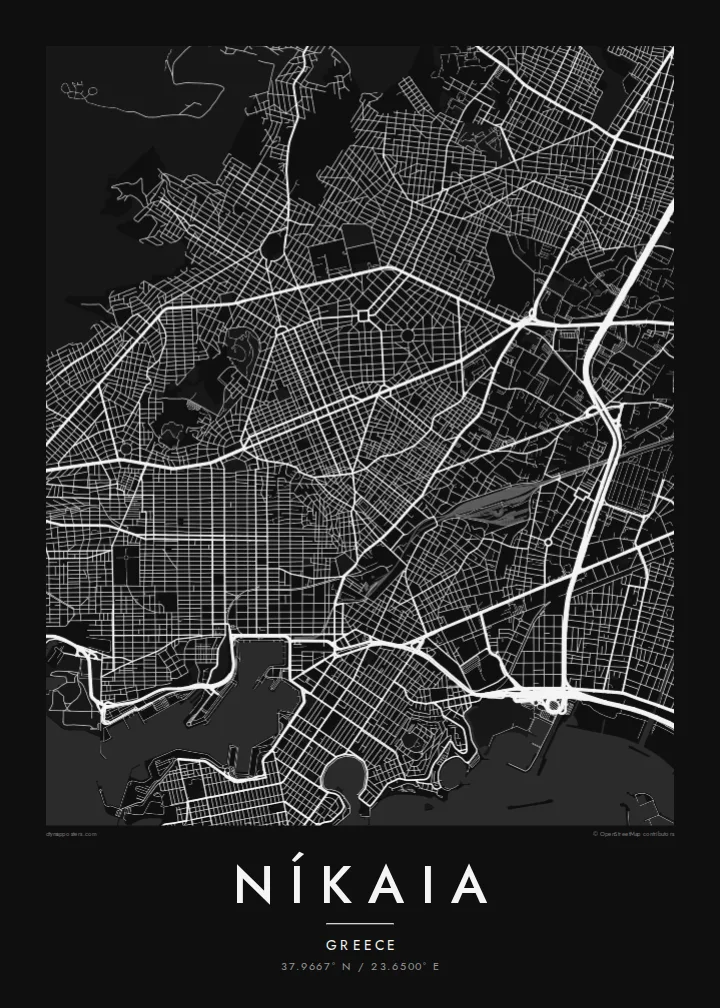
A dense, gridded refugee suburb pressed between Piraeus and the Aigaleo hills, its blocks packed tight against the port city.



Taone e tahi, lagona e lima
Pa'i se ata ke va'ai ai i luga o te pā. E tutusa te tau o ata uma — i lomiga, fakapipi'i i faleata, pe ko faila HD.
 Pixels mo'i · Faila lomiga 24 × 36″
Manino mo te lomiga
Ko se kupega 100% mai te faila lomiga mo'i. Poster uma — pe lomiina, fakapipi'i i faleata, pe download-ina — e fakaatagia i luga o a matou setula i te 300 DPI, e oo atu ki te 7,200 × 10,800 pixels, ina ia mautinoa e ma'ai pea auala tuai foki i luga o se lomiga 24 × 36″.
I luga o te pa


Te mape
Níkaia sits just inland of Piraeus, in the western part of the Athens basin. From above it reads as one of the densest pieces of the whole conurbation: short blocks, narrow streets and very few gaps, running uphill from the flat land near the port toward the lower slopes of the Aigaleo range. Its edges with its neighbours are hard to see on the ground, and on a map they vanish entirely.
The town was built in the 1920s by refugees from Asia Minor after 1922, and it takes its name from Nicaea, the Anatolian city now called İznik. That origin still shows in the plan. The streets are more regular than in older Attic towns and were laid out quickly to house a large population, so the grid is tighter and more even than the hillside would suggest.
A Níkaia map poster shows a place defined by density rather than by monuments. The ink is heaviest in the residential core, lighter where arterial roads cut through toward Piraeus and central Athens, and it thins out on the rising ground to the north. It suits anyone with family roots in the Asia Minor diaspora, or anyone who grew up on these crowded, orderly streets.
The neighbourhoods laid out for Asia Minor refugees in the 1920s give Níkaia a tight, regular street pattern that stands apart from the looser, older layouts elsewhere in Attica.
To the south, the town's blocks run straight into Piraeus with no visible break, which makes it clear on paper how closely Níkaia is tied to the port.
Toward the Aigaleo slopes the grid loosens and the streets start to follow the contours, a gentle change in texture you can see across the upper part of the frame.
Fai mo koe
Fakaopoopo he aho, he igoa pe he upu a koe, hui te faiga, te lahi pe te tūlaga.
Ko te va'aiga e leai se totogi e maualalo tona resolution ma iai se fakailoga vai. E fakaatagia lomiga ma faila HD i te 300 DPI, e oo atu ki te 7,200 × 10,800 px, e aunoa ma se fakailoga vai.
Aiheā Níkaia
People hang Níkaia for the story it carries: a town built from nothing by displaced families, named after a city they had left behind. For descendants of those refugees, the map is a quiet record of where a family started over.
You can personalise the title, subtitle and coordinates line, for example with a family name or the year someone arrived, and choose from five styles: Classic black & white, Noir, Paper, Blueprint or Sand. It is available as a $9 HD digital file or as a printed poster.
Oka te poster Níkaia| Lahi o te lomiga | Manino | Faila |
|---|---|---|
| 30 × 40 cm11.8 × 15.7″ | 3,543 × 4,724 px | PNG · PDF |
| 29.7 × 42 cm (A3)11.7 × 16.5″ | 3,508 × 4,961 px | PNG · PDF |
| 42 × 59.4 cm (A2)16.5 × 23.4″ | 4,961 × 7,016 px | PNG · PDF |
| 45.7 × 61 cm18 × 24″ | 5,400 × 7,200 px | PNG · PDF |
| 50 × 70 cm19.7 × 27.6″ | 5,906 × 8,268 px | PNG · PDF |
| 61 × 91.4 cm24 × 36″ | 7,200 × 10,800 px | PNG · PDF |
Mo te fakatatau, ko te fakaakoakoga e hē totogi e 900 px te lautele, e ihi te fakailoga ma mo te lau komipiuta. Ko nā faila HD e oko ki te 8× te manino i itū taki tahi ma e lomia lelei i te lahi kātoa o te pōhita.
Filifili se ata i te pito i luga o te itulau, ona filifili lea o te Poster Lomiina — se lapoa ma, ka manako ai koe, se faleata — pe ko Faila HD Fakaonaonaina. E tasi te laasaga o te ōkaina, ma ka fakafou loa lau itulau ōkaina pe a mae'a te totogi.
E lomiina i luga o se pepa matte kaliki maualuga e 200 gsm, i se tasi o ni lapoa e ono, mai le 30 × 40 cm ki te 24 × 36″. E kamata te tau o poster lomiina mai le $39, aofia ai te uta.
Ioe. Filifili se faleata lakau malō i te lanu uli, tea, oki masani pe lakau pouli. E aumai fakatasi mo se tioata e le gagamu ma ua sauni ke tautau. E kamata te tau o poster fakapipi'i i se faleata mai le $99, aofia ai te uta.
E tuku uma te uta ki fenua e 60+. Ko te pepa takitasi e lomi e te tasi o a matou paaga lomi i fenua e 30+, ka tae mai i aso galue e 3–7. E mafai ke e maimoa ki te tulaga mo te tulitaki i lalo o Taku Fakatonuga. E lauiti nei fenua e 2–5 wiki, ka ko nei fenua e le o tuku atu ai, e fakamatala atu e te weepisi i mua o te totogi.
Auina mai se ata pikitia i loto o te 14 aso mai te taimi na oo mai ai, ka toe lomiina e matou e leai se totogi pe toe totogi atu lau tupe.
Ioe. I te mea fakasa'o i luga o lenei itulau, sui te ulutala, te ulutala lalo ma te laina fakamaoniga tulaga ki so se mea e manako ai koe, ona filifili lea o se ata ma se lapoa. Okaina lomiina, fakapipi'i i faleata, ma fakaonaonaina e fakaaogā uma i tau ata tonu.
Mo le $9 e maua e koe ni faila PNG 300 DPI ma PDF sauni-mo-lomiga i lapoa e ono uma, e aunoa ma se fakailoga vai, ke lomiina i so se mea. E le'i mautinoa? Download muamua se va'aiga fakailoga vai e leai se totogi.
Latalata
