Rustaq Fort
The fort stands at the centre of the old settlement, a solid block on the map with houses, lanes and palm gardens gathered around it.
Pōhita mape faigofie · Oman
23.3908° N / 57.4244° E
An oasis town at the foot of Oman's Hajar mountains, where palm groves, wadis and a great fort shape the map


Taone e tahi, lagona e lima
Pa'i se ata ke va'ai ai i luga o te pā. E tutusa te tau o ata uma — i lomiga, fakapipi'i i faleata, pe ko faila HD.
 Pixels mo'i · Faila lomiga 24 × 36″
Manino mo te lomiga
Ko se kupega 100% mai te faila lomiga mo'i. Poster uma — pe lomiina, fakapipi'i i faleata, pe download-ina — e fakaatagia i luga o a matou setula i te 300 DPI, e oo atu ki te 7,200 × 10,800 pixels, ina ia mautinoa e ma'ai pea auala tuai foki i luga o se lomiga 24 × 36″.
I luga o te pa


Te mape
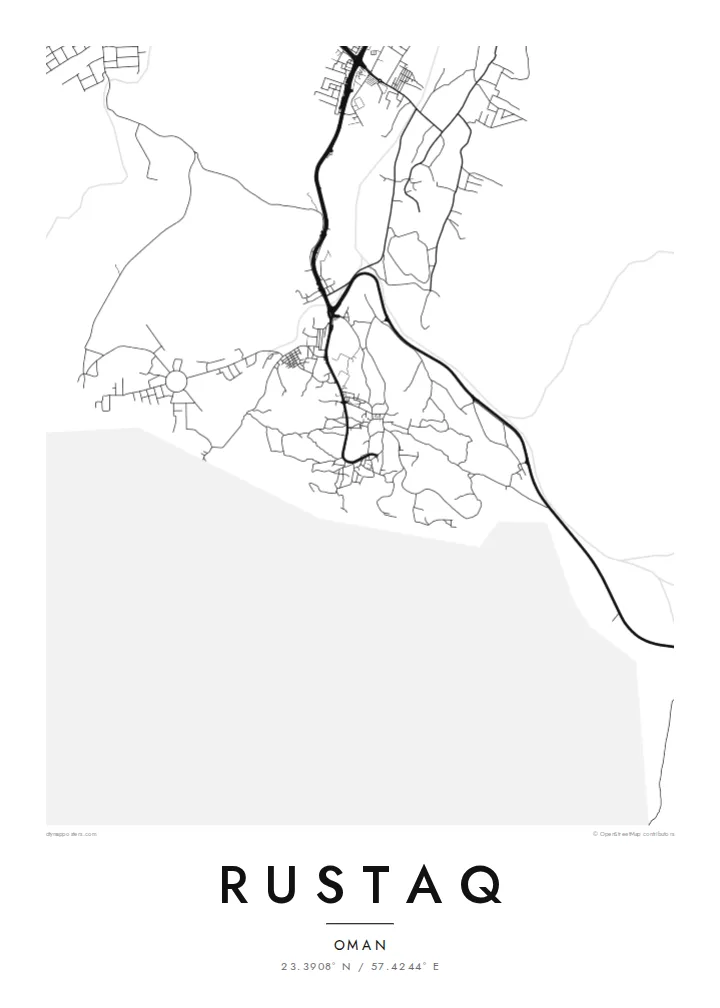
Rustaq lies on the inland side of the Batinah plain, where the Western Hajar mountains begin to rise. From above, it is less a single compact town than a spread of settlements among date palm gardens, linked by roads that follow the wadis down from the hills. On the map, the groves show as open spaces between clusters of streets and houses.
The town has a long history as a seat of power. The origins of Rustaq Fort are often dated to before the Islamic era, and the fort was substantially rebuilt in later centuries. In the seventeenth century, under the Ya'ariba dynasty, Rustaq served as a capital of Oman. There are hot springs nearby, and the traditional falaj channels that carry water to the date gardens are still part of daily life.
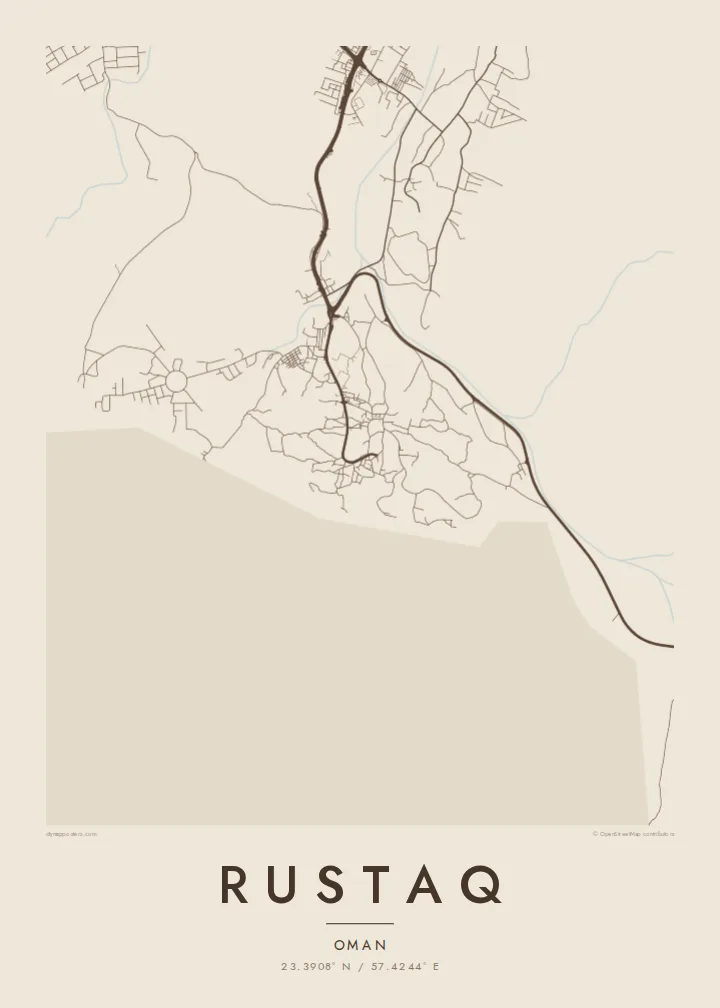
A Rustaq map poster sets the soft, scattered forms of the oasis against the hard edge of the mountains beyond. Roads curve along dry riverbeds, the fort is a strong central mark, and the settlement fans out wherever there was water. The composition is shaped far more by geography than by planning.
The fort stands at the centre of the old settlement, a solid block on the map with houses, lanes and palm gardens gathered around it.
Date groves irrigated by falaj channels fill the spaces between settlements. They leave broad open areas that give the print a light, airy texture.
Roads follow the dry riverbeds that come down from the Hajar range, drawing gentle curved lines from the mountains toward the plain.
Fai mo koe
Fakaopoopo he aho, he igoa pe he upu a koe, hui te faiga, te lahi pe te tūlaga.
Ko te va'aiga e leai se totogi e maualalo tona resolution ma iai se fakailoga vai. E fakaatagia lomiga ma faila HD i te 300 DPI, e oo atu ki te 7,200 × 10,800 px, e aunoa ma se fakailoga vai.
Aiheā Rustaq
For Omanis from Rustaq and residents of the Batinah region, the map is a portrait of home shaped by water and mountains. Visitors who came for the fort, the springs or the mountain drives will recognise it too.
Set your own title, subtitle and coordinates, and choose Classic black & white, Noir, Paper, Blueprint or Sand. The $9 digital HD files come as 300 DPI PNG and print-ready PDF, or you can order a printed poster, framed or unframed.
Oka te poster Rustaq| Lahi o te lomiga | Manino | Faila |
|---|---|---|
| 30 × 40 cm (11.8 × 15.7″) | 3,543 × 4,724 px | PNG · PDF |
| 29.7 × 42 cm (A3, 11.7 × 16.5″) | 3,508 × 4,961 px | PNG · PDF |
| 42 × 59.4 cm (A2, 16.5 × 23.4″) | 4,961 × 7,016 px | PNG · PDF |
| 45.7 × 61 cm (18 × 24″) | 5,400 × 7,200 px | PNG · PDF |
| 50 × 70 cm (19.7 × 27.6″) | 5,906 × 8,268 px | PNG · PDF |
| 61 × 91.4 cm (24 × 36″) | 7,200 × 10,800 px | PNG · PDF |
Mo te fakatatau, ko te fakaakoakoga e hē totogi e 900 px te lautele, e ihi te fakailoga ma mo te lau komipiuta. Ko nā faila HD e oko ki te 8× te manino i itū taki tahi ma e lomia lelei i te lahi kātoa o te pōhita.
Filifili se ata i te pito i luga o te itulau, ona filifili lea o te Poster Lomiina — se lapoa ma, ka manako ai koe, se faleata — pe ko Faila HD Fakaonaonaina. E tasi te laasaga o te ōkaina, ma ka fakafou loa lau itulau ōkaina pe a mae'a te totogi.
E lomiina i luga o se pepa matte kaliki maualuga e 200 gsm, i se tasi o ni lapoa e ono, mai le 30 × 40 cm ki te 24 × 36″. E kamata te tau o poster lomiina mai le {printFrom}, aofia ai te uta.
Ioe. Filifili se faleata lakau malō i te lanu uli, tea, oki masani pe lakau pouli. E aumai fakatasi mo se tioata e le gagamu ma ua sauni ke tautau. E kamata te tau o poster fakapipi'i i se faleata mai le {framedFrom}, aofia ai te uta.
E fua noa te uta i te lalolagi katoa. Poster ta'itasi e lomiina e te pāketiha lomiga pili mai i lo matou 30+ atunu'u, ma e masani ona oo mai i loto i te 3–7 aso gāluega. E mafai ona ke va'aiina te tulaga o lau okaina i lalo ifo o My Orders.
Auina mai se ata pikitia i loto o te 14 aso mai te taimi na oo mai ai, ka toe lomiina e matou e leai se totogi pe toe totogi atu lau tupe.
Ioe. I te mea fakasa'o i luga o lenei itulau, sui te ulutala, te ulutala lalo ma te laina fakamaoniga tulaga ki so se mea e manako ai koe, ona filifili lea o se ata ma se lapoa. Okaina lomiina, fakapipi'i i faleata, ma fakaonaonaina e fakaaogā uma i tau ata tonu.
Mo le $9 e maua e koe ni faila PNG 300 DPI ma PDF sauni-mo-lomiga i lapoa e ono uma, e aunoa ma se fakailoga vai, ke lomiina i so se mea. E le'i mautinoa? Download muamua se va'aiga fakailoga vai e leai se totogi.
Latalata
