Scattered farmhouses
Homesteads dot the plain at fairly even intervals, each marked by a small cluster of lines. The rhythm they create is shared by very few places in Japan.
Pōhita mape faigofie · Japan
36.6205° N / 136.9432° E
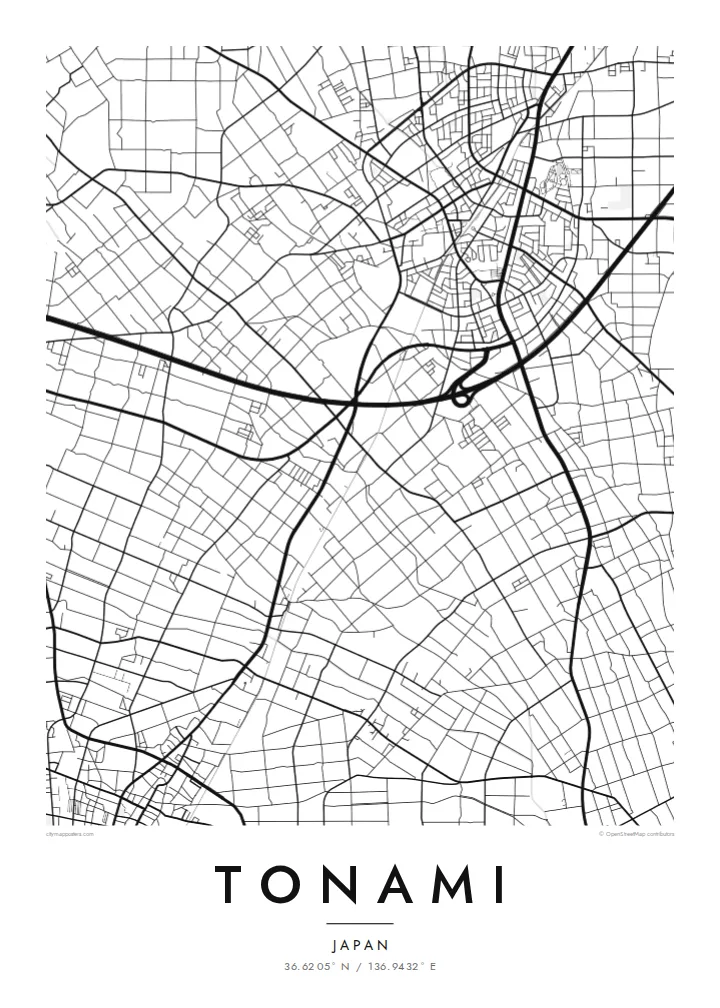
A city spread across the Tonami plain, where farmhouses stand alone among rice fields, each inside its own ring of trees.


Taone e tahi, lagona e lima
Pa'i se ata ke va'ai ai i luga o te pā. E tutusa te tau o ata uma — i lomiga, fakapipi'i i faleata, pe ko faila HD.
 Pixels mo'i · Faila lomiga 24 × 36″
Manino mo te lomiga
Ko se kupega 100% mai te faila lomiga mo'i. Poster uma — pe lomiina, fakapipi'i i faleata, pe download-ina — e fakaatagia i luga o a matou setula i te 300 DPI, e oo atu ki te 7,200 × 10,800 pixels, ina ia mautinoa e ma'ai pea auala tuai foki i luga o se lomiga 24 × 36″.
I luga o te pa


Te mape
Tonami lies on the broad Tonami plain in western Toyama, an alluvial fan built by the Shō river as it leaves the mountains. The plain is known for a rare settlement pattern called sankyoson. Instead of being gathered into villages, farmhouses are scattered one by one across the rice fields, and each is surrounded by its own planted windbreak of trees.
On a map this looks unusual. Instead of one dense centre fading into countryside, Tonami has a compact urban core inside a wide field of evenly spaced homesteads, linked by a lace of narrow farm roads and irrigation channels. The Shō river runs along the eastern side of the city, a broad channel set against the paddies.
Tonami is also known for tulips. The area is one of Japan's main tulip-growing regions, and each spring the Tonami Tulip Fair fills a park near the centre with flowers. A Tonami map poster, though, is mostly about that patient agricultural pattern, a landscape that people have shaped house by house over generations.
Homesteads dot the plain at fairly even intervals, each marked by a small cluster of lines. The rhythm they create is shared by very few places in Japan.
The river that built the plain runs along the eastern edge of the city. Its wide channel and gravel bars frame the farmland on one side.
Irrigation channels and farm lanes divide the rice fields into a fine, regular mesh, which gives the whole poster a delicate woven texture.
Fai mo koe
Fakaopoopo he aho, he igoa pe he upu a koe, hui te faiga, te lahi pe te tūlaga.
Ko te va'aiga e leai se totogi e maualalo tona resolution ma iai se fakailoga vai. E fakaatagia lomiga ma faila HD i te 300 DPI, e oo atu ki te 7,200 × 10,800 px, e aunoa ma se fakailoga vai.
Aiheā Tonami
People from Toyama recognise the pattern of Tonami at once, and visitors rarely forget it. A map on the wall keeps the quiet order of scattered houses and fields, whether it marks a family home or a spring trip to see the tulips.
Personalise the title and subtitle with a family name, a year or a line of your own, and adjust the coordinates. Paper and Sand bring out the farmland and Classic black & white keeps it crisp, while Noir and Blueprint give a bolder look.
Oka te poster Tonami| Lahi o te lomiga | Manino | Faila |
|---|---|---|
| 30 × 40 cm (11.8 × 15.7″) | 3,543 × 4,724 px | PNG · PDF |
| 29.7 × 42 cm (A3, 11.7 × 16.5″) | 3,508 × 4,961 px | PNG · PDF |
| 42 × 59.4 cm (A2, 16.5 × 23.4″) | 4,961 × 7,016 px | PNG · PDF |
| 45.7 × 61 cm (18 × 24″) | 5,400 × 7,200 px | PNG · PDF |
| 50 × 70 cm (19.7 × 27.6″) | 5,906 × 8,268 px | PNG · PDF |
| 61 × 91.4 cm (24 × 36″) | 7,200 × 10,800 px | PNG · PDF |
Mo te fakatatau, ko te fakaakoakoga e hē totogi e 900 px te lautele, e ihi te fakailoga ma mo te lau komipiuta. Ko nā faila HD e oko ki te 8× te manino i itū taki tahi ma e lomia lelei i te lahi kātoa o te pōhita.
Filifili se ata i te pito i luga o te itulau, ona filifili lea o te Poster Lomiina — se lapoa ma, ka manako ai koe, se faleata — pe ko Faila HD Fakaonaonaina. E tasi te laasaga o te ōkaina, ma ka fakafou loa lau itulau ōkaina pe a mae'a te totogi.
E lomiina i luga o se pepa matte kaliki maualuga e 200 gsm, i se tasi o ni lapoa e ono, mai le 30 × 40 cm ki te 24 × 36″. E kamata te tau o poster lomiina mai le {printFrom}, aofia ai te uta.
Ioe. Filifili se faleata lakau malō i te lanu uli, tea, oki masani pe lakau pouli. E aumai fakatasi mo se tioata e le gagamu ma ua sauni ke tautau. E kamata te tau o poster fakapipi'i i se faleata mai le {framedFrom}, aofia ai te uta.
E leai se totogi o te ave i te lalolagi katoa. Ko te pepa ata taki tasi e lomi e te hoa lomi e latalata mai ki a matou i atunuku e 30+, ma e masani ona aulia i aso galuega e 3–7. E mafai ke e mulimuli i te tulaga ma te ala o tau poloaiga i lalo o Aku Poloaiga. E nai atunuku e 2–5 vaiaso te umi, ma i te mea e le i ave ai matou, e fakailoa atu e te initeneti a e le i totogi koe.
Auina mai se ata pikitia i loto o te 14 aso mai te taimi na oo mai ai, ka toe lomiina e matou e leai se totogi pe toe totogi atu lau tupe.
Ioe. I te mea fakasa'o i luga o lenei itulau, sui te ulutala, te ulutala lalo ma te laina fakamaoniga tulaga ki so se mea e manako ai koe, ona filifili lea o se ata ma se lapoa. Okaina lomiina, fakapipi'i i faleata, ma fakaonaonaina e fakaaogā uma i tau ata tonu.
Mo le $9 e maua e koe ni faila PNG 300 DPI ma PDF sauni-mo-lomiga i lapoa e ono uma, e aunoa ma se fakailoga vai, ke lomiina i so se mea. E le'i mautinoa? Download muamua se va'aiga fakailoga vai e leai se totogi.
