Sultanate quarter
The historic heart of the Ouaddaï capital, with an irregular web of lanes around the old palace and mosque sites. It is the densest, least geometric part of the map.
Pousita mape faigofie · Chad
13.8292° N / 20.8324° E
A low, sprawling Sahelian town of sandy lanes and walled compounds, crossed by seasonal wadis on the eastern Chadian plain


Taone e tasi, lagona e lima
Pau te tapaki o se style ke lavea i luga i te puipui. E tutasi te tau o style takitasi — telotele mo faaki, e aunoa io me fai ki faila HD.
 Pixel tonu · faila lolomi 24 × 36″
Manino ki te lomiga
Tenei se 100% mai te faila lolomi tonu. Poster takitasi — telotele, faaki io me download — e faite i luga i a matou server i te 300 DPI, e oko atu ki 7,200 × 10,800 pixel, ko ala e maofio ei mo maiga vaega foliki i luga i te lolomi 24 × 36″.
I te pakitala


Te mape
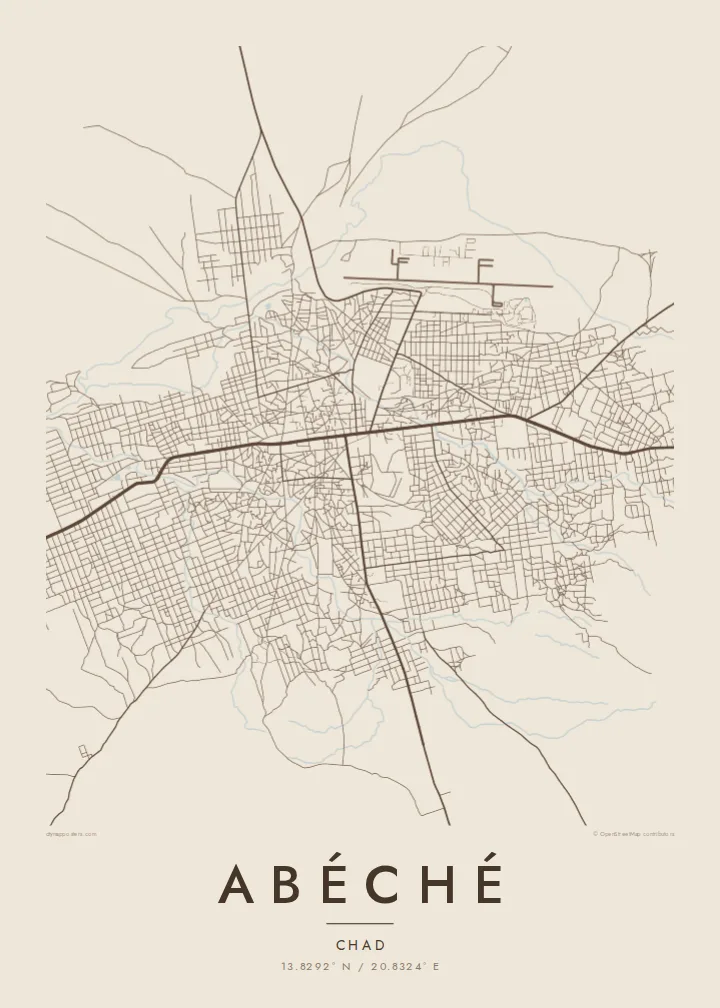
Abéché is the main city of eastern Chad and the capital of Ouaddaï province. It stands on a dry plain far from the sea, and on a map it spreads out loosely rather than climbing upward. Lanes run between walled family compounds, and a handful of wider roads head out toward the rest of the region. Sandy wadis flow here only after the rains.
The town has a long political history. In the mid-nineteenth century it became the capital of the Ouaddaï Sultanate, one of the powerful Sahelian states of the region, and remains of the sultans' residence and old mosques still stand in the historic core. More recently Abéché has served as a logistics base for humanitarian operations in eastern Chad.
An Abéché map poster shows a city that does not follow a strict grid. The oldest quarters are made of irregular blocks, while the newer districts sit in looser rectangles farther out. The airport runway forms a clean, straight line on the edge. The result is an honest picture of a desert-edge town whose shape comes from climate, trade routes and centuries of regional power.
The historic heart of the Ouaddaï capital, with an irregular web of lanes around the old palace and mosque sites. It is the densest, least geometric part of the map.
Dry riverbeds wind through and around the town. They are drawn as soft, meandering bands that carry water only briefly during the rainy season.
A long, straight runway sits beside the built-up area. Its hard geometry contrasts with the organic street pattern and acts as a strong graphic anchor.
Fai ke fakatau ki a koe
Fakaopoopo se aso, se igoa io me se fuaiupu o koe, sui te sitaila, te lasi io me te tuuga.
Te preview fua e maulalo te malamalama kae iai se watermark. Poster telotele mo faila HD e faite i te 300 DPI, e oko atu ki 7,200 × 10,800 px, aunoa mo se watermark.
Kaia a Abéché
Abéché is a place people carry with them: aid workers, researchers and families from Ouaddaï often have a lasting tie to it. A map poster keeps that connection in a calm, understated form that works in almost any room.
Add a personal title, the years you spent there or the coordinates, and choose from Classic black & white, Noir, Paper, Blueprint or Sand. Sand and Paper suit the dry, earthen character of the city especially well.
Otaina te poster Abéché| Lasi o te lomiga | Manino | Faila |
|---|---|---|
| 30 × 40 cm11.8 × 15.7″ | 3,543 × 4,724 px | PNG · PDF |
| 29.7 × 42 cm (A3)11.7 × 16.5″ | 3,508 × 4,961 px | PNG · PDF |
| 42 × 59.4 cm (A2)16.5 × 23.4″ | 4,961 × 7,016 px | PNG · PDF |
| 45.7 × 61 cm18 × 24″ | 5,400 × 7,200 px | PNG · PDF |
| 50 × 70 cm19.7 × 27.6″ | 5,906 × 8,268 px | PNG · PDF |
| 61 × 91.4 cm24 × 36″ | 7,200 × 10,800 px | PNG · PDF |
Ke fakatusa, a te ata fakataitai fua e 900 px te lautele, mo te fakailoga kae mo lau lavea i luga i te komipiuta. A faila HD e oko ki te 8× te manino i itu katoa kae lomi faka‵lei i te lasi katoa o te pousita.
Filifili se style i te pito i luga o te itulau, kae filifili Poster Telotele — se lasi mo se faaki manafai e manako koe — io me Faila Digital HD. E tasi te sitepu mo te checkout, kae ka fakafou te itulau o tau ota i te taimi e mafai ei te totogi.
E telotele i luga o te pepa vali gali 200 gsm i se tasi mai lasi e ono, mai te 30 × 40 cm ki te 24 × 36″. E kamata te poster telotele mai i te $39, kae aofia ei te uta.
Ioe. Filifili se faaki lakau maoli i te kulokula, tea, oak maoli io me lakau pogisa. E oo mai ki tioata e se malepe kae toka ke tautau. E kamata te poster faaki mai i te $99, kae aofia ei te uta.
E tuku fua ki fenua e 60+. A poloaiga taki tasi e ta ne te tauhaga e latalata mai i a matou tauhaga ta i fenua e 30+, kae e masani o aunoa i aso galue e 3–7. E mafai o salasala te tulaga mo te sukesuke i lalo o Aku poloaiga. I nisi fenua e 2–5 vaiaso, kae i mea e seki tuku atu ei matou, e fakailoa atu e te mea tafaoga i mua o te totogi.
Auina mai se ata i loto i te 14 aso mai te taimi e oko ei kae ka toe telotele fua ne matou io me toe totogi atu tau tupe.
Ioe. I te editor i te itulau tenei, sui te ulutala, te ulutala lalo mo te laina o coordinate ki so se mea e manako koe, kae filifili se style mo se lasi. Oga telotele, faaki mo digital e faigana katoa i tau tusiga tonu.
Mo te $9 ka maua ne koe faila PNG 300 DPI mo PDF fakatoka lolomi i lasi e ono katoa, aunoa mo se watermark, ke lolomi i so se koga. E se mautinoa koe? Download muamua se preview fua e iai te watermark.
