Close-knit lanes
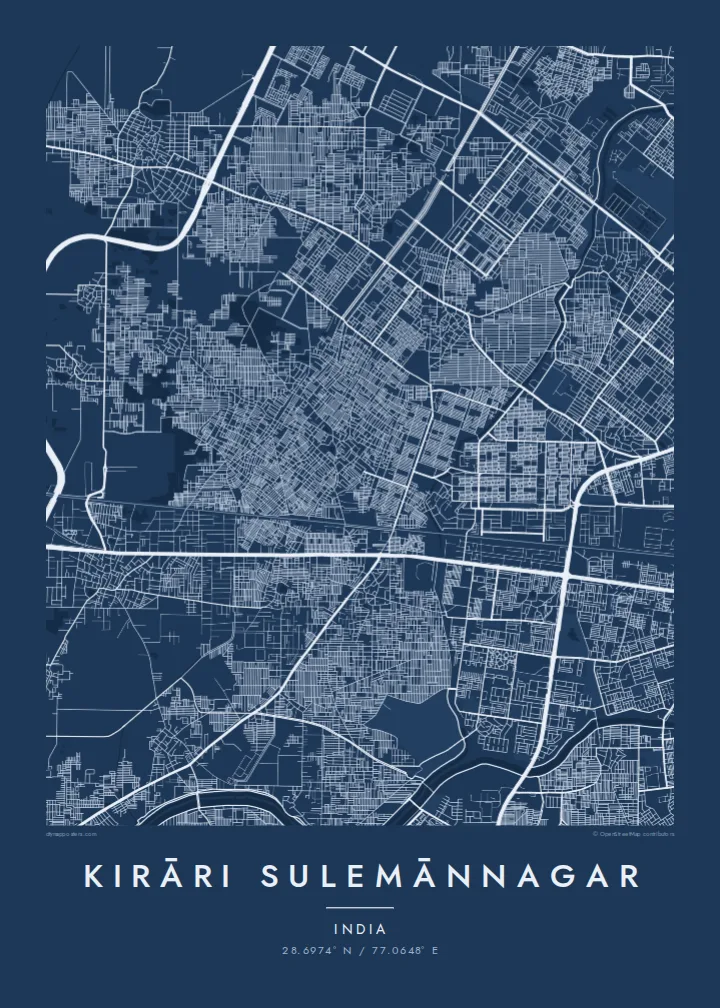
The dominant feature is the density of narrow residential lanes. On the poster they merge into a fine mesh, with small open plots and courtyards appearing as occasional pale spaces.
Qeeqabak kaartah poster · India
28.6974° N / 77.0648° E
A dense, finely grained settlement on Delhi's western edge, where tight lanes fill almost every gap between the main roads.



Inki magaala, konoy gaba
Qande inkih tibbixeeh derre baguley table. Kulli qande missoowa caagid—daabbisimta, dirbaabu-le kaadu HD fayla akah.
 Cagalah pixels · 24 × 36″ daabbi fayla
Maxxaacah qeeqa
Tama usuk cagalah daabbi faylak 100% qambaala. Kulli poster — daabbisimta, dirbaabu-le kaadu download geytimta — ni-server-ittal 300 DPI-l ederimta, 7,200 × 10,800 pixels fanah, tokkel iyyi ellee catoy 24 × 36″ daabbi baxsi bahisak raaqu.
Gidarih


Kaarta
Kirāri Sulemānnagar is a census town in the North West Delhi district, toward the outer edge of the capital. On a map it looks very different from the planned colonies of central Delhi. Instead of wide avenues and roundabouts, it is made of short, closely packed lanes that grew plot by plot, producing a texture so dense that at small scale it reads almost as solid shading.
The settlement expanded rapidly in recent decades as people arrived from across northern India looking for affordable housing within reach of Delhi's jobs. Much of that growth happened faster than formal planning, which is exactly what gives the street pattern its character: lanes change direction, end abruptly or bend around older plot boundaries rather than following a single grid.
A Kirāri Sulemānnagar map poster is a portrait of a place built by its residents rather than by planners. Seen in black and white, the few longer roads act as spines, and the neighbourhoods between them resolve into intricate patterns that reward a close look. For many families it is also the map of a first home in the capital.
The dominant feature is the density of narrow residential lanes. On the poster they merge into a fine mesh, with small open plots and courtyards appearing as occasional pale spaces.
A handful of longer roads cut through the settlement and link it to neighbouring parts of West and North West Delhi. They give the dense map its structure and its sense of direction.
In places the lanes run at slight angles to their neighbours, a common trace of colonies laid out piece by piece on former farmland. These shifts give the map an unusual patchwork quality.
Kok tanim ab
Ayro, migaq hinnay kok tan xagar osis; gaba, ballaqa hinnay xiqa soorris.
Free preview qansarissi kee watermark-le. Daabbisimtaan kee HD fayla 300 DPI-l, 7,200 × 10,800 px fanah, watermark maleh ederimta.
Macah Kirāri Sulemānnagar
This is a map for people who know the place from the inside: families who built homes here, those who grew up in its lanes, and anyone who has since moved on but still thinks of it as where life in Delhi started. It records a neighbourhood that rarely appears on souvenirs.
Add a family name, a block or the year you arrived to the title and subtitle, and keep or edit the coordinates line. The design comes in five styles, including Classic black & white and Sand, as digital HD files for $9 or as a printed poster shipped from partners in over 30 countries.
Kirāri Sulemānnagar poster orme| Maxxaacah ballaqa | Qeeqa | Faylal |
|---|---|---|
| 30 × 40 cm11.8 × 15.7″ | 3,543 × 4,724 px | PNG · PDF |
| 29.7 × 42 cm (A3)11.7 × 16.5″ | 3,508 × 4,961 px | PNG · PDF |
| 42 × 59.4 cm (A2)16.5 × 23.4″ | 4,961 × 7,016 px | PNG · PDF |
| 45.7 × 61 cm18 × 24″ | 5,400 × 7,200 px | PNG · PDF |
| 50 × 70 cm19.7 × 27.6″ | 5,906 × 8,268 px | PNG · PDF |
| 61 × 91.4 cm24 × 36″ | 7,200 × 10,800 px | PNG · PDF |
Tabbaltah, limo-wayta xaqqa-le ablo 900 px ballaqa le, asta le, iskiriinih keh tan. HD faylal gexsoh inkih addal 8× fanah qeeqa le, poster ballaqa inkih addal meqeh maxxaacimta.
Baxxaqqa qari le qandiy dooriy, tohuk lakal Daabbisimtah Poster — kutuk kee, faxximek, dirbaabu — hinnay HD Digital Fayla dooru. Checkout inki wagitti geytima, kaadu ku-orme page keenih adissa akke waqdi caagoy kummite.
Usuk 200 gsm-le catam kutuk warqatal, lica katiy caagitte $39-ik hane ayta 30 × 40 cm-ik 24 × 36″ fanah, xaagu keenil warreeh.
Ee. Sarrah-le dirbaabu doori — bad, gudduc, oak-le hinnay bad-madabuy. Usuk finqisiimam ellee sange qarab-le kaadu qari umukku iyya keenih taagu. Dirbaabu-le poster $99-ik hane, xaagu keenil warreeh.
Dirsa 60+ baaxoh bilsa. Poster kasa 30+ baaxoh nel print kaadu yan kee dirgeh kaxxa kee tanah printa, kee 3–7 xaqu ayyaamah yaaxigeeh. Xaaloo kee tracking "Ac Order" gexsitam. Kaadu baaxo 2–5 isbuuc yaaxigeeh, nanu dirsi yanin baaxoh sajiitah site ku kalah tekkeh.
Geytimeek 14 ayróy addal foto naah rubbaay, cisab-le daabbisiynah hinnay ku-lacay gacisnaah.
Ee. Tama page-l edito addal, migaaq, subtitle kee coordinates sarrah faxxem fanah badal, kaadu qande kee katiy doori. Daabbisimtah, dirbaabu-le kaadu digital orme inkih ku-design cagalah yekkelen.
$9 bacisak 300 DPI PNG kee daabbisimtah adissime PDF fayla lica katiy inkih, watermark maleh, ayyi meki daabbisimtah geeytitta. Cisab makkoysemty ana? Awqak, watermark-le free preview download-eh.
Xayyo
