The Neisse border
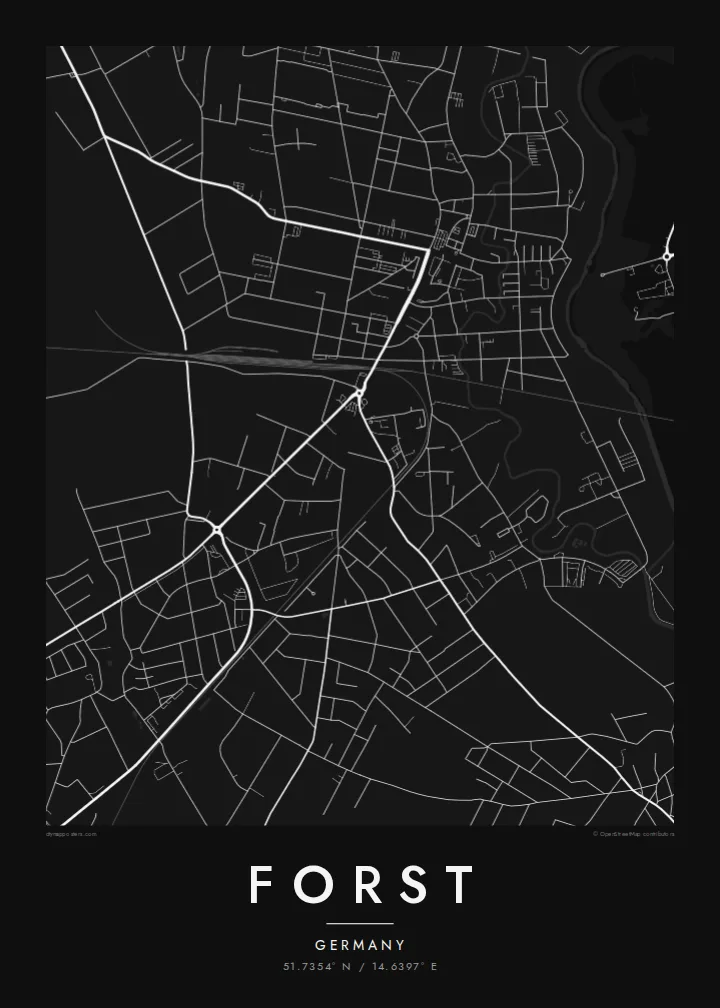
The Lusatian Neisse forms the eastern edge of the town and the frontier with Poland. It gives the map one strong vertical line, with the bridges crossing it clearly marked.
Minimalistiskt kortplakat · Týskland
51.7354° N / 14.6397° E
A textile town pressed against the Neisse, its streets stopping at the river that marks the Polish border



Ein býur, fimm stemningar
Trýst á ein stíl fyri at síggja hann á veggnum. Allir stílar kosta tað sama — sum prent, í ramma ella sum HD-fílur.
 Veruligar pixlar · 24 × 36″ prentfíla
Prentskarpt
Hetta er ein 100% útskurður av teirri veruligu prentfíluni. Hvør plakat — prentað, í ramma ella niðurhalað — verður gjørd á okkara ambætarum við 300 DPI, upp til 7,200 × 10,800 pixlar, so eisini tær smæstu gøtur halda seg skarpar á einum 24 × 36″ prenti.
Á veggnum


Kortið
Forst sits in Lower Lusatia on the west bank of the Lusatian Neisse. From above the river is the town's most defined edge: it runs north to south along the eastern side, and across the water lies Poland. The streets fan out westward from the river in a loose, uneven layout. That layout owes more to a century of industrial growth than to any one plan, and the river keeps the whole map oriented.
For much of the nineteenth and early twentieth centuries Forst was a centre of cloth production, known then as a German Manchester. The mills needed rail sidings, long factory plots and workers' housing close by, and that industrial past still shows in the size of the blocks. Some districts have large, regular parcels. Others are tighter, where terraced housing filled the space between works.
The town's best-known green space is the East German Rose Garden, laid out near the river in the early twentieth century and still one of the larger rose gardens in the country. On a Forst map poster it appears as a patch of curving paths set against the straighter streets around it. The eye tends to settle there, between the town's grid and the river.
The Lusatian Neisse forms the eastern edge of the town and the frontier with Poland. It gives the map one strong vertical line, with the bridges crossing it clearly marked.
The East German Rose Garden adds a cluster of curved walks and beds near the river, a softer pattern than the streets and industrial plots that surround it.
Large parcels left by the cloth industry sit beside denser housing streets. The result is a clear contrast in scale across the town that works well in black and white.
Ger tað til títt
Legg ein dag, eitt navn ella egnan tekst afturat, skift stíl, stødd ella snið.
Ókeypis forskoðanin er í lágari upploysing og hevur vatnmerki. Prent og HD-fílur verða gjørdar við 300 DPI, upp til 7,200 × 10,800 px, uttan vatnmerki.
Hví Forst
People from Forst often want a map that shows how close the town and the border are, with the river running right past the old streets. It also suits anyone with family ties to Lusatia's textile past, or to both sides of the Neisse.
Add a title, a family name or a meaningful date, and choose from Classic black & white, Noir, Paper, Blueprint or Sand. The digital files cost $9 and cover six print sizes. Printed posters on matte paper, with an optional wooden frame, ship from partners in more than 30 countries.
Panta Forst-plakatið| Prentstødd | Upploysn | Fílur |
|---|---|---|
| 30 × 40 cm (11.8 × 15.7″) | 3,543 × 4,724 px | PNG · PDF |
| 29.7 × 42 cm (A3, 11.7 × 16.5″) | 3,508 × 4,961 px | PNG · PDF |
| 42 × 59.4 cm (A2, 16.5 × 23.4″) | 4,961 × 7,016 px | PNG · PDF |
| 45.7 × 61 cm (18 × 24″) | 5,400 × 7,200 px | PNG · PDF |
| 50 × 70 cm (19.7 × 27.6″) | 5,906 × 8,268 px | PNG · PDF |
| 61 × 91.4 cm (24 × 36″) | 7,200 × 10,800 px | PNG · PDF |
Til samanberingar er ókeypis forsýningin 900 px breið, við vatnmerki og ætlað til skerm. HD-fílurnar hava upp til 8 ferðir so høga upploysn í hvørja átt og verða prentaðar reint í fullari plakatstødd.
Vel ein stíl ovast á síðuni, og vel síðani Prentað Plakat — eina stødd og, um tú vil, eina ramma — ella Digital HD-Fílur. Tað tekur bara eitt stig at ganga til kassa, og pantanarsíðan tín dagførist so skjótt sum gjaldið er gjøgnumført.
Tað verður prentað á 200 gsm matt kvalitetspappír í einari av seks støddum, frá 30 × 40 cm til 24 × 36″. Prentaðar plakatir byrja á {printFrom}, sending íroknað.
Ja. Vel eina ramma av massivum træi í svørtum, hvítum, natúrligum eik ella dekkum træi. Hon kemur við glassi, sum ikki brotnar, og er klár at hongja upp. Plakatir í ramma byrja á {framedFrom}, sending íroknað.
Sending er ókeypis um allan heimin. Hvør plakat verður prentað av tí næstu av okkara prentpartnarum í 30+ londum og kemur vanliga innan 3–7 arbeiðsdagar. Tú kanst fylgja við støðu og sporing undir Mínar Pantanir.
Send okkum eitt mynd innan 14 dagar eftir móttøku, og vit prenta tað umaftur ókeypis ella endurgjalda tær.
Ja. Í ritlinum á hesi síðu kanst tú broyta heitið, undirheitið og koordinatlinjuna til hvat sum helst, og velja stíl og stødd. Prentaðar, ramma- og digitalar pantanir brúka allar sama honnun, sum tú hevur gjørt.
Fyri $9 fært tú 300 DPI PNG- og prentklárar PDF-fílur í øllum seks støddum, uttan vatnmerki, so tú kanst prenta hvar sum helst. Ikki vís enn? Halda niður eina ókeypis forskoðan við vatnmerki fyrst.
