Wadi Hanifa
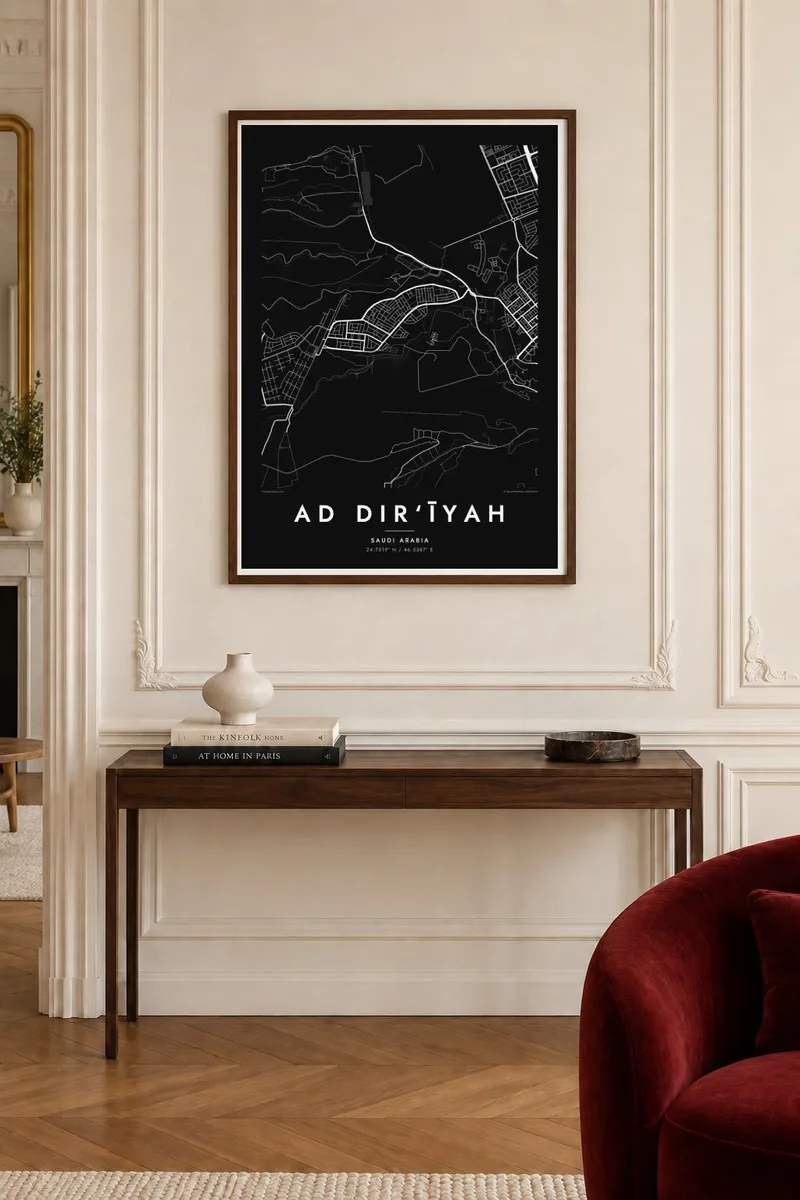
A long valley winds north to south through the town. Farms and palm groves follow its floor, which appears as a soft, curving band across the map.
Fakatino mape mukamuka · Saudi Arabia
24.7519° N / 46.5387° E
A town along the green bed of Wadi Hanifa on Riyadh's northwest edge, with mud-brick ruins above the palm groves


Taha e taone, lima e onoonoaga
Tapaki e taha puhala ke kitia ai ki luga he puipui. Kua tatai e totogi he tau puhala oti — pete he lolomi, poloka, po ke faila HD.
 Tau pikselo mooli · faila lolomi 24 × 36″
Maama mitaki ke lolomi
Ko e 100% e fahi mooli mai he faila lolomi. Ko e tau poster oti — pete kua lolomi, poloka, po ke utu hifo — kua taute ke he ha mautolu a tau tokoluga (server) ke he 300 DPI, hokotia ke he 7,200 × 10,800 piksela, ke maeke ai e tau ala ikiiki tote ke maaliali fakamitaki he lolomi 24 × 36″.
He Pā


Ko e mape
Ad Dir‘īyah sits on the northwestern edge of Riyadh, where Wadi Hanifa cuts a winding valley through the plateau. On a map the wadi is the main line. It is a curving channel lined with palm groves and farms, and it stands out clearly against the regular streets of the surrounding suburbs. The older settlement grew along its banks.
On the western side of the wadi is At-Turaif, the mud-brick district that was the seat of the first Saudi state. Its tight, irregular pattern of walls and lanes looks very different from the modern grid. Across the valley is the Bujairi quarter, and between them the wadi floor is laid out with paths and planted areas.
An Ad Dir‘īyah map poster marks the place where the Saudi state began in the eighteenth century. At-Turaif was added to the UNESCO World Heritage list in 2010. The area is now being restored and redeveloped on a large scale. Drawn in line, the old core, the wadi and the newer streets show how the town has changed over time.
A long valley winds north to south through the town. Farms and palm groves follow its floor, which appears as a soft, curving band across the map.
The historic mud-brick quarter sits above the wadi's western bank. Its dense, irregular lanes stand out clearly from the modern street plan around it.
The Bujairi quarter faces At-Turaif across the wadi. Together they frame a narrow stretch of valley that forms the heart of the old town.
Taute ke ha hau
Lafi e aho, taha higoa po ke taha kupu haau, hiki e fakatino, lahi po ke tuaga.
Ko e kitiaaga nakai totogi kua tote e maaliali mo e fakamailoga vai. Ko e tau lolomi mo e tau faila HD kua taute ke he 300 DPI, hokotia ke he 7,200 × 10,800 px, nakai fai fakamailoga vai.
Ko e ha Ad Dir‘īyah
The map suits people from Riyadh and anyone interested in the history of the Arabian Peninsula. It also works for visitors who have walked through At-Turaif at dusk. The winding wadi gives it a clear, calm composition.
Set your own title, subtitle and coordinates. You could add the name in Arabic script, a family name or a meaningful date. The poster comes in five styles: Classic black & white, Noir, Paper, Blueprint and Sand.
Talaage e poster Ad Dir‘īyah| Lahi he lolomi | Maama | Tau faila |
|---|---|---|
| 30 × 40 cm11.8 × 15.7″ | 3,543 × 4,724 px | PNG · PDF |
| 29.7 × 42 cm (A3)11.7 × 16.5″ | 3,508 × 4,961 px | PNG · PDF |
| 42 × 59.4 cm (A2)16.5 × 23.4″ | 4,961 × 7,016 px | PNG · PDF |
| 45.7 × 61 cm18 × 24″ | 5,400 × 7,200 px | PNG · PDF |
| 50 × 70 cm19.7 × 27.6″ | 5,906 × 8,268 px | PNG · PDF |
| 61 × 91.4 cm24 × 36″ | 7,200 × 10,800 px | PNG · PDF |
Ke fakatatai, ko e fakatino noa kua 900 px e laulahi, fai fakamailoga mo e mo e tau mata komipiuta ni. Ko e tau faila HD kua ato hoko ke he 8× e maama ke he tau faahi takitaha mo e lolomi mitaki he lahi katoa he fakatino.
Fifili e taha puhala i luga he kupega, ti fifili e Poster Lolomi — e lahi mo e, kaeke ke manako ai koe, taha poloka — po ke Tau Faila HD Fakaeletonika. Ko e fakaotiaga totogi ko e taha gahua ni, ti ko e kupega he hau a talaaga ka fakafou fakahaga i mua he fakaotiaga e totogi.
Kua lolomi ai ke he pepa mitaki 200 gsm matte he taha he tau lahi ono, mai he 30 × 40 cm ke hoko ke he 24 × 36″. Kamata e tau poster lolomi mai he $39, kua putoia ai e utaaga.
E. Fifili e poloka akau malolō ke he lanu uli, tea, akau oki mooli, po ke akau pouli. Kua fakalataha mo e sioga malolō nakai malepe ti kua mautali ke tautau. Kamata e tau poster poloka mai he $99, kua putoia ai e utaaga.
Nakai totogi e fakafano ke he motu 60+. Ko e fakatino taha kua lolomi he fenoga lolomi ha mautolu kua tata mo e tau motu 30+, kua hoko mai he tau aho gahua 3–7. Maeke ia koe ke kikite e tuaga mo e fakamuitua he lalo he Haku Tau Fakatonu. Ke he falu motu kua 2–5 e tau tapu, ti ka nakai fakafano a mautolu ki ai, to fakaha he api tupe ia ki mua he totogi.
Fakafano mai e taha ata ki a mautolu he loto he 14 e tau aho tali mai he hokoaga, ti to lolomi foki e mautolu nakai totogi po ke liu atu e totogi ki a koe.
E. He editor i luga he kupega nei, hikihiki e matakupu, e matakupu lalo mo e laini coordinates ke he taha mena kua manako a koe ki ai, ti fifili e puhala mo e lahi. Ko e tau talaaga lolomi, poloka mo e fakaeletonika oti kua fakaaoga tonu e hau a fakatino.
Ma e $9 ka moua e koe e tau faila PNG 300 DPI mo e PDF kua mautali ke lolomi he tau lahi ono oti, nakai fai fakamailoga vai, ke lolomi i fe mena. Nakai maopoopo agaia? Utu hifo fakamua e kitiaaga nakai totogi ne fai fakamailoga vai.
Tata mai
