Imperial Palace
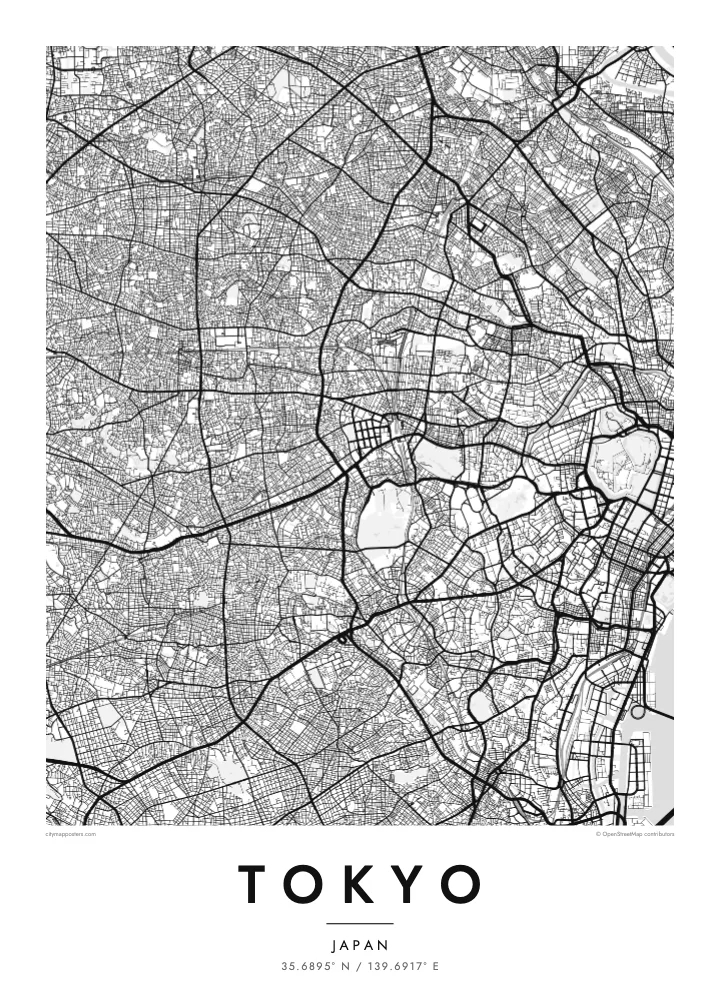
The former site of Edo Castle sits at the heart of the city, its moats and gardens forming a large open shape right beside the business district around Tokyo Station.
Fakatino mape mukamuka · Japan
35.6895° N / 139.6917° E
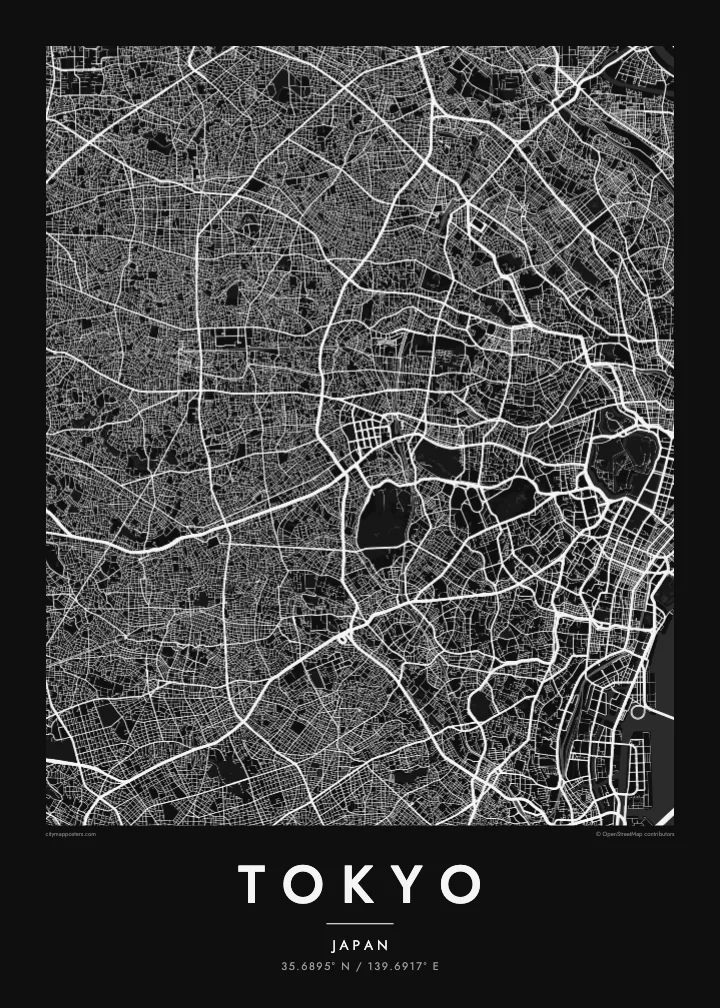
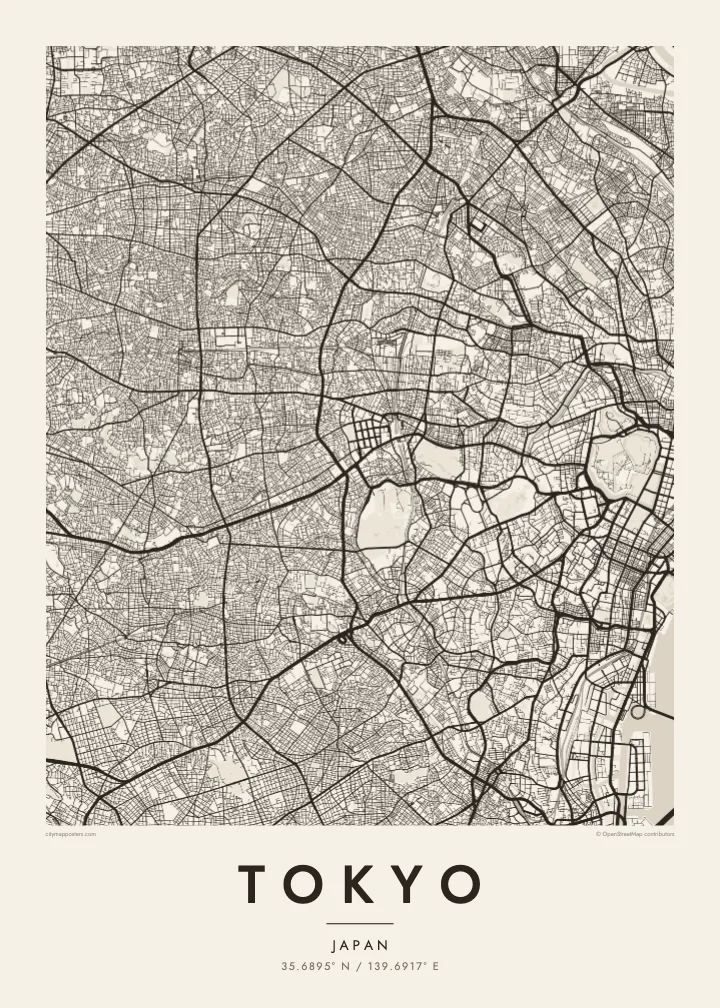
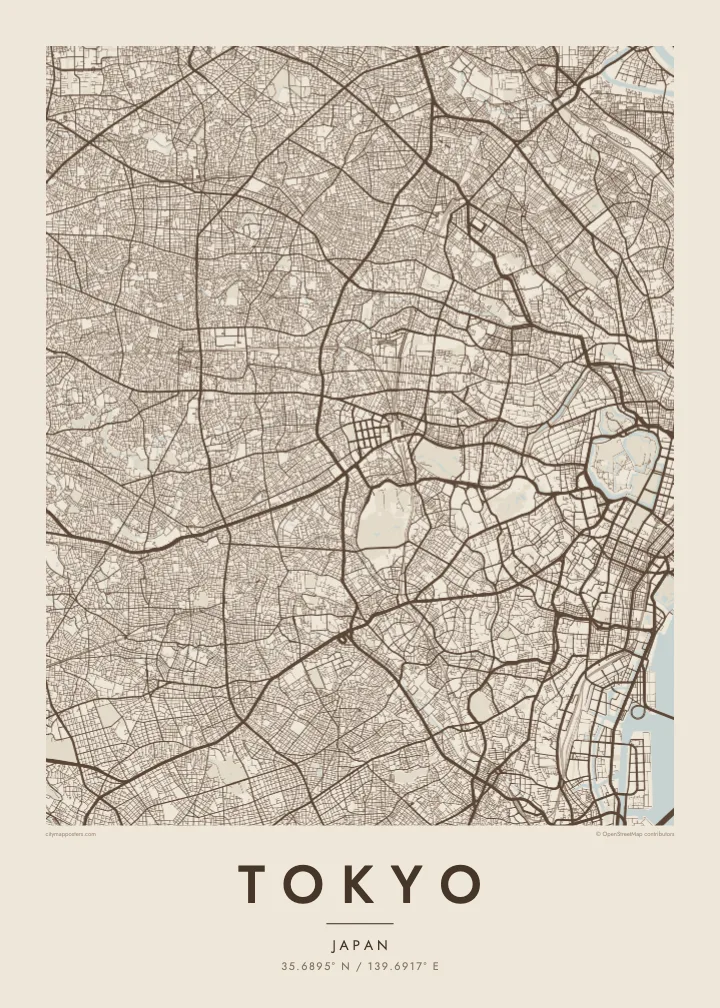
A vast, fine-grained city spreading from the moated grounds of the Imperial Palace to the reclaimed edges of Tokyo Bay.

Taha e taone, lima e onoonoaga
Tapaki e taha puhala ke kitia ai ki luga he puipui. Kua tatai e totogi he tau puhala oti — pete he lolomi, poloka, po ke faila HD.
 Tau pikselo mooli · faila lolomi 24 × 36″
Maama mitaki ke lolomi
Ko e 100% e fahi mooli mai he faila lolomi. Ko e tau poster oti — pete kua lolomi, poloka, po ke utu hifo — kua taute ke he ha mautolu a tau tokoluga (server) ke he 300 DPI, hokotia ke he 7,200 × 10,800 piksela, ke maeke ai e tau ala ikiiki tote ke maaliali fakamitaki he lolomi 24 × 36″.
He Pā


Ko e mape
Tokyo has no single downtown, and from above it looks more like a field of fine grain than a city with a centre. Yet there is a still point: the Imperial Palace, set within the moats and walls of the former Edo Castle, a broad, calm shape surrounded by some of the densest streets on earth. The city was called Edo until 1868.
Around the palace, the Yamanote Line draws a loop that links Shinjuku, Shibuya, Ikebukuro, Ueno and Tokyo Station, each a cluster of tight blocks and crossing rail lines. Most streets here have no names; addresses follow numbered districts and blocks instead, which is why the map looks like countless small cells rather than long, named avenues.
To the east, the Sumida River runs down to Tokyo Bay, where centuries of land reclamation have squared off the shoreline into artificial islands, docks and piers, Odaiba among them. A Tokyo map poster captures the contrast between the organic interior and the ruler-straight waterfront, with the wooded grounds of Meiji Shrine and Ueno Park as rare open patches.
The former site of Edo Castle sits at the heart of the city, its moats and gardens forming a large open shape right beside the business district around Tokyo Station.
Much of the waterfront is reclaimed land, and on the map it shows as a series of straight-edged artificial islands and wharves, a geometric fringe unlike anything further inland.
Between Harajuku and Yoyogi, a dense planted forest surrounds the shrine dedicated to Emperor Meiji, and together with neighbouring Yoyogi Park it forms one of the largest quiet spaces in central Tokyo.
Taute ke ha hau
Lafi e aho, taha higoa po ke taha kupu haau, hiki e fakatino, lahi po ke tuaga.
Ko e kitiaaga nakai totogi kua tote e maaliali mo e fakamailoga vai. Ko e tau lolomi mo e tau faila HD kua taute ke he 300 DPI, hokotia ke he 7,200 × 10,800 px, nakai fai fakamailoga vai.
Ko e ha Tokyo
Tokyo tends to leave precise memories: a particular station exit, a small bar in a narrow lane, the view from a train window over endless rooftops. A map of the city gives those fragments a place, whether you lived there for work, studied there, or visited once and have wanted to return ever since.
Write your own title and date on the poster, perhaps a neighbourhood, a name or the year you arrived. Then choose from five styles: Noir for the city after dark, Classic black & white for its fine detail, or Paper, Blueprint and Sand if you want it to sit more gently in a room.
Talaage e poster Tokyo| Lahi he lolomi | Maama | Tau faila |
|---|---|---|
| 30 × 40 cm11.8 × 15.7″ | 3,543 × 4,724 px | PNG · PDF |
| 29.7 × 42 cm (A3)11.7 × 16.5″ | 3,508 × 4,961 px | PNG · PDF |
| 42 × 59.4 cm (A2)16.5 × 23.4″ | 4,961 × 7,016 px | PNG · PDF |
| 45.7 × 61 cm18 × 24″ | 5,400 × 7,200 px | PNG · PDF |
| 50 × 70 cm19.7 × 27.6″ | 5,906 × 8,268 px | PNG · PDF |
| 61 × 91.4 cm24 × 36″ | 7,200 × 10,800 px | PNG · PDF |
Ke fakatatai, ko e fakatino noa kua 900 px e laulahi, fai fakamailoga mo e mo e tau mata komipiuta ni. Ko e tau faila HD kua ato hoko ke he 8× e maama ke he tau faahi takitaha mo e lolomi mitaki he lahi katoa he fakatino.
Fifili e taha puhala i luga he kupega, ti fifili e Poster Lolomi — e lahi mo e, kaeke ke manako ai koe, taha poloka — po ke Tau Faila HD Fakaeletonika. Ko e fakaotiaga totogi ko e taha gahua ni, ti ko e kupega he hau a talaaga ka fakafou fakahaga i mua he fakaotiaga e totogi.
Kua lolomi ai ke he pepa mitaki 200 gsm matte he taha he tau lahi ono, mai he 30 × 40 cm ke hoko ke he 24 × 36″. Kamata e tau poster lolomi mai he $39, kua putoia ai e utaaga.
E. Fifili e poloka akau malolō ke he lanu uli, tea, akau oki mooli, po ke akau pouli. Kua fakalataha mo e sioga malolō nakai malepe ti kua mautali ke tautau. Kamata e tau poster poloka mai he $99, kua putoia ai e utaaga.
Nakai totogi e fakafano ke he motu 60+. Ko e fakatino taha kua lolomi he fenoga lolomi ha mautolu kua tata mo e tau motu 30+, kua hoko mai he tau aho gahua 3–7. Maeke ia koe ke kikite e tuaga mo e fakamuitua he lalo he Haku Tau Fakatonu. Ke he falu motu kua 2–5 e tau tapu, ti ka nakai fakafano a mautolu ki ai, to fakaha he api tupe ia ki mua he totogi.
Fakafano mai e taha ata ki a mautolu he loto he 14 e tau aho tali mai he hokoaga, ti to lolomi foki e mautolu nakai totogi po ke liu atu e totogi ki a koe.
E. He editor i luga he kupega nei, hikihiki e matakupu, e matakupu lalo mo e laini coordinates ke he taha mena kua manako a koe ki ai, ti fifili e puhala mo e lahi. Ko e tau talaaga lolomi, poloka mo e fakaeletonika oti kua fakaaoga tonu e hau a fakatino.
Ma e $9 ka moua e koe e tau faila PNG 300 DPI mo e PDF kua mautali ke lolomi he tau lahi ono oti, nakai fai fakamailoga vai, ke lolomi i fe mena. Nakai maopoopo agaia? Utu hifo fakamua e kitiaaga nakai totogi ne fai fakamailoga vai.
Tata mai
