Lake Amatitlán
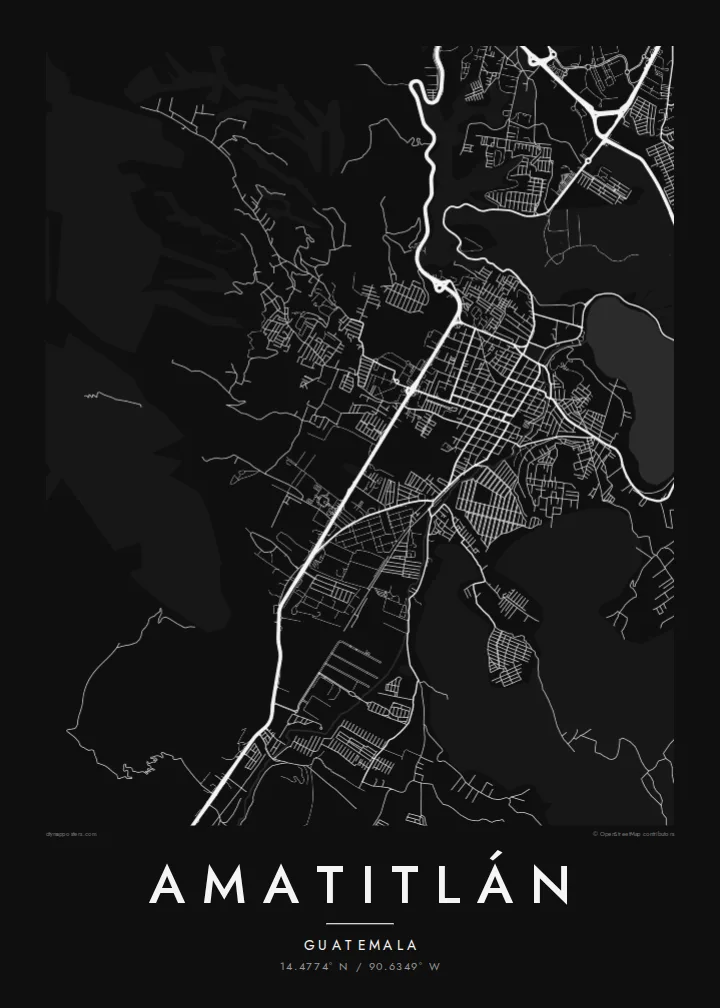
The lake's elongated body of water dominates the composition. Its shoreline curves and bays form a large, calm shape against which the streets read clearly.
Fakatino mape mukamuka · Guatemala
14.4774° N / 90.6349° W
A lakeside town at the edge of Lake Amatitlán, its streets meeting the water with volcanic slopes rising beyond



Taha e taone, lima e onoonoaga
Tapaki e taha puhala ke kitia ai ki luga he puipui. Kua tatai e totogi he tau puhala oti — pete he lolomi, poloka, po ke faila HD.
 Tau pikselo mooli · faila lolomi 24 × 36″
Maama mitaki ke lolomi
Ko e 100% e fahi mooli mai he faila lolomi. Ko e tau poster oti — pete kua lolomi, poloka, po ke utu hifo — kua taute ke he ha mautolu a tau tokoluga (server) ke he 300 DPI, hokotia ke he 7,200 × 10,800 piksela, ke maeke ai e tau ala ikiiki tote ke maaliali fakamitaki he lolomi 24 × 36″.
He Pā


Ko e mape
Amatitlán sits on the shore of the lake that shares its name, in a volcanic basin south of Guatemala City. The lake fills most of any wider map of the area. Its long, curving outline is the first thing the eye follows, and the town's streets approach it from the land side. The capital lies a short drive to the north, close enough that the lake has long served as a place for weekend escapes.
The water drains out through the Río Michatoya, which leaves the basin and runs south toward the Pacific lowlands. To the south, the ground rises toward Pacaya, one of the most active volcanoes in Central America. On a map these features frame the town: water on one side, rising contours on another, and a road network stretching back toward the city.
The older part of Amatitlán keeps the compact block pattern found in many towns of colonial origin in Guatemala. Beyond it, newer neighbourhoods follow the terrain more loosely. An Amatitlán map poster combines both scales, with the tight town centre and the wide sweep of the lake, so that the town's relationship to its water stays in focus.
The lake's elongated body of water dominates the composition. Its shoreline curves and bays form a large, calm shape against which the streets read clearly.
The river leaving the lake is a thin line heading south. It is a small detail that shows how the basin connects to the lowlands below.
A tight grid of blocks marks the historic core near the shore. It contrasts with the looser streets that climb the surrounding slopes.
Taute ke ha hau
Lafi e aho, taha higoa po ke taha kupu haau, hiki e fakatino, lahi po ke tuaga.
Ko e kitiaaga nakai totogi kua tote e maaliali mo e fakamailoga vai. Ko e tau lolomi mo e tau faila HD kua taute ke he 300 DPI, hokotia ke he 7,200 × 10,800 px, nakai fai fakamailoga vai.
Ko e ha Amatitlán
The map works well for people who grew up by the lake, spent family weekends there, or trace their roots to the Guatemala City region. Change the title to Amatitlán or Lago de Amatitlán, add a year in the subtitle, and keep the coordinates for a quiet, exact touch.
Blueprint shows the lake as a deep field with fine white lines around it. Classic black & white keeps things simple and graphic. Each $9 download includes 300 DPI PNG and print-ready PDF files in six sizes. A framed matte print ships from partners in more than 30 countries.
Talaage e poster Amatitlán| Lahi he lolomi | Maama | Tau faila |
|---|---|---|
| 30 × 40 cm11.8 × 15.7″ | 3,543 × 4,724 px | PNG · PDF |
| 29.7 × 42 cm (A3)11.7 × 16.5″ | 3,508 × 4,961 px | PNG · PDF |
| 42 × 59.4 cm (A2)16.5 × 23.4″ | 4,961 × 7,016 px | PNG · PDF |
| 45.7 × 61 cm18 × 24″ | 5,400 × 7,200 px | PNG · PDF |
| 50 × 70 cm19.7 × 27.6″ | 5,906 × 8,268 px | PNG · PDF |
| 61 × 91.4 cm24 × 36″ | 7,200 × 10,800 px | PNG · PDF |
Ke fakatatai, ko e fakatino noa kua 900 px e laulahi, fai fakamailoga mo e mo e tau mata komipiuta ni. Ko e tau faila HD kua ato hoko ke he 8× e maama ke he tau faahi takitaha mo e lolomi mitaki he lahi katoa he fakatino.
Fifili e taha puhala i luga he kupega, ti fifili e Poster Lolomi — e lahi mo e, kaeke ke manako ai koe, taha poloka — po ke Tau Faila HD Fakaeletonika. Ko e fakaotiaga totogi ko e taha gahua ni, ti ko e kupega he hau a talaaga ka fakafou fakahaga i mua he fakaotiaga e totogi.
Kua lolomi ai ke he pepa mitaki 200 gsm matte he taha he tau lahi ono, mai he 30 × 40 cm ke hoko ke he 24 × 36″. Kamata e tau poster lolomi mai he $39, kua putoia ai e utaaga.
E. Fifili e poloka akau malolō ke he lanu uli, tea, akau oki mooli, po ke akau pouli. Kua fakalataha mo e sioga malolō nakai malepe ti kua mautali ke tautau. Kamata e tau poster poloka mai he $99, kua putoia ai e utaaga.
Nakai totogi e fakafano ke he motu 60+. Ko e fakatino taha kua lolomi he fenoga lolomi ha mautolu kua tata mo e tau motu 30+, kua hoko mai he tau aho gahua 3–7. Maeke ia koe ke kikite e tuaga mo e fakamuitua he lalo he Haku Tau Fakatonu. Ke he falu motu kua 2–5 e tau tapu, ti ka nakai fakafano a mautolu ki ai, to fakaha he api tupe ia ki mua he totogi.
Fakafano mai e taha ata ki a mautolu he loto he 14 e tau aho tali mai he hokoaga, ti to lolomi foki e mautolu nakai totogi po ke liu atu e totogi ki a koe.
E. He editor i luga he kupega nei, hikihiki e matakupu, e matakupu lalo mo e laini coordinates ke he taha mena kua manako a koe ki ai, ti fifili e puhala mo e lahi. Ko e tau talaaga lolomi, poloka mo e fakaeletonika oti kua fakaaoga tonu e hau a fakatino.
Ma e $9 ka moua e koe e tau faila PNG 300 DPI mo e PDF kua mautali ke lolomi he tau lahi ono oti, nakai fai fakamailoga vai, ke lolomi i fe mena. Nakai maopoopo agaia? Utu hifo fakamua e kitiaaga nakai totogi ne fai fakamailoga vai.
Tata mai
