Staff housing colony
Rows of government residential buildings stand in a regular layout with internal roads and courtyards. They form a planned pattern that stands out from the organic streets around them.
Fakatino mape mukamuka · Bangladesh
23.7298° N / 90.3854° E
An old Dhaka neighbourhood of dense lanes, government housing blocks and a large graveyard near the university.

Taha e taone, lima e onoonoaga
Tapaki e taha puhala ke kitia ai ki luga he puipui. Kua tatai e totogi he tau puhala oti — pete he lolomi, poloka, po ke faila HD.
 Tau pikselo mooli · faila lolomi 24 × 36″
Maama mitaki ke lolomi
Ko e 100% e fahi mooli mai he faila lolomi. Ko e tau poster oti — pete kua lolomi, poloka, po ke utu hifo — kua taute ke he ha mautolu a tau tokoluga (server) ke he 300 DPI, hokotia ke he 7,200 × 10,800 piksela, ke maeke ai e tau ala ikiiki tote ke maaliali fakamitaki he lolomi 24 × 36″.
He Pā



Ko e mape
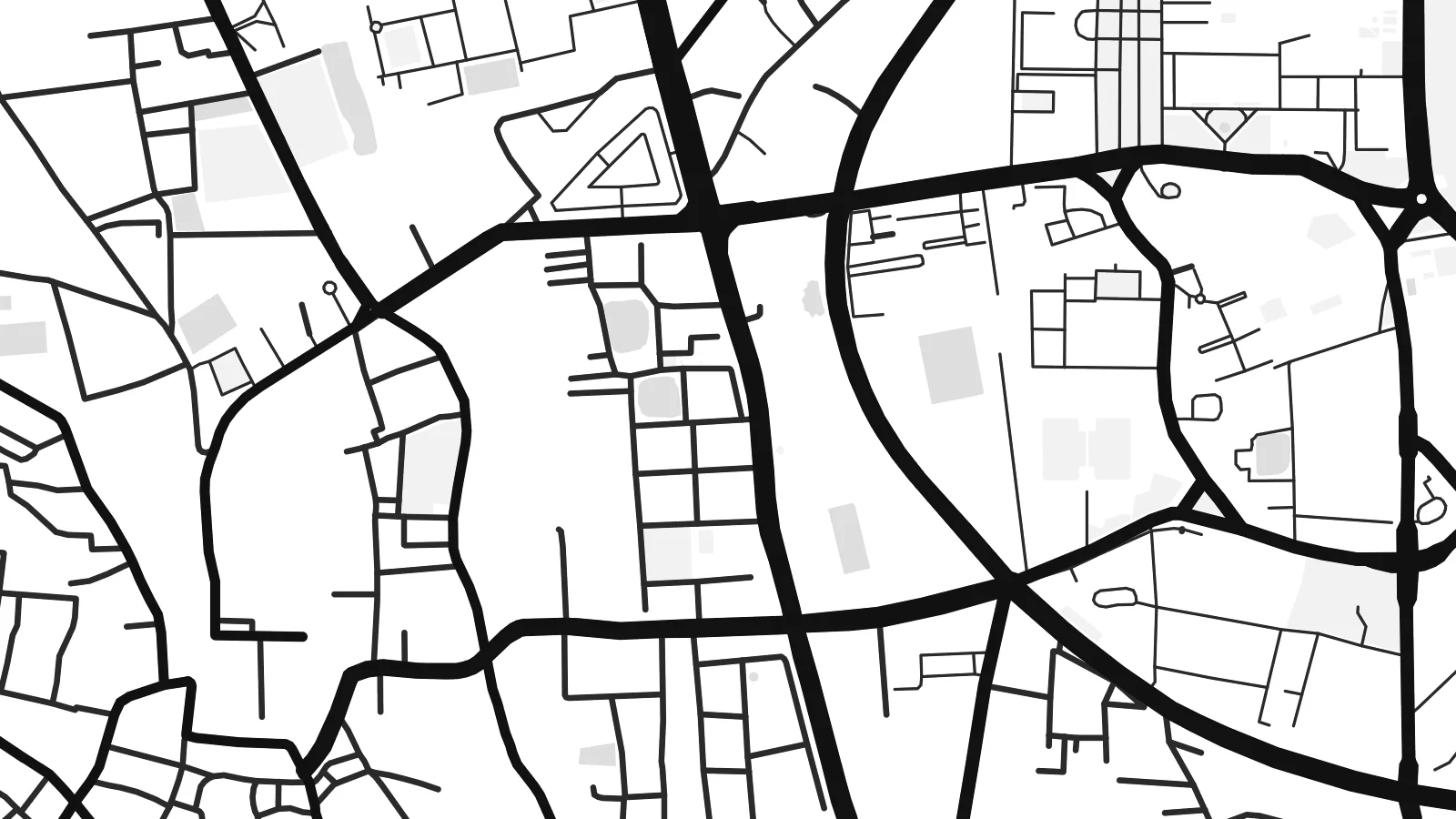
Azimpur is a neighbourhood in the older part of Dhaka, between the university area and the historic districts along the Buriganga River. Its map is one of contrasts. Planned government staff housing, with repeated rectangular blocks, sits beside a natural network of narrow lanes, markets and older buildings that reflect the city's long growth.
The area is widely known for Azimpur Graveyard, one of Dhaka's largest cemeteries, which appears as a clear open block among the dense surrounding streets. The University of Dhaka lies to the north, and Lalbagh Fort, the unfinished seventeenth-century Mughal fort, is close by to the west. Main roads frame the neighbourhood and carry heavy traffic between old and new Dhaka.
An Azimpur map poster captures a small, intensely built part of a very large city. At this scale individual lanes become visible, the housing colony shows its repeated geometry, and the graveyard and nearby campuses provide rare open space. For people who grew up in the colony or studied nearby, it is an exact picture of a familiar quarter.
Rows of government residential buildings stand in a regular layout with internal roads and courtyards. They form a planned pattern that stands out from the organic streets around them.
The large cemetery appears as an open block in the middle of dense urban fabric. It gives the composition a calm central space in one of Dhaka's busiest districts.
To the west and south, the lanes grow narrower and more irregular toward Lalbagh and the river. This shift in texture marks the transition into the historic city.
Taute ke ha hau
Lafi e aho, taha higoa po ke taha kupu haau, hiki e fakatino, lahi po ke tuaga.
Ko e kitiaaga nakai totogi kua tote e maaliali mo e fakamailoga vai. Ko e tau lolomi mo e tau faila HD kua taute ke he 300 DPI, hokotia ke he 7,200 × 10,800 px, nakai fai fakamailoga vai.
Ko e ha Azimpur
Generations of Dhaka families have lived in the Azimpur colony, and many students have passed through on their way to the university. A map of the neighbourhood records those streets precisely, making it a thoughtful gift for someone who has moved away or abroad.
Write your own title, subtitle and coordinates line, and choose from five styles. The $9 download gives you 300 DPI PNG and print-ready PDF files in six sizes, without a watermark. Printed matte posters ship from partners in more than 30 countries.
Talaage e poster Azimpur| Lahi he lolomi | Maama | Tau faila |
|---|---|---|
| 30 × 40 cm11.8 × 15.7″ | 3,543 × 4,724 px | PNG · PDF |
| 29.7 × 42 cm (A3)11.7 × 16.5″ | 3,508 × 4,961 px | PNG · PDF |
| 42 × 59.4 cm (A2)16.5 × 23.4″ | 4,961 × 7,016 px | PNG · PDF |
| 45.7 × 61 cm18 × 24″ | 5,400 × 7,200 px | PNG · PDF |
| 50 × 70 cm19.7 × 27.6″ | 5,906 × 8,268 px | PNG · PDF |
| 61 × 91.4 cm24 × 36″ | 7,200 × 10,800 px | PNG · PDF |
Ke fakatatai, ko e fakatino noa kua 900 px e laulahi, fai fakamailoga mo e mo e tau mata komipiuta ni. Ko e tau faila HD kua ato hoko ke he 8× e maama ke he tau faahi takitaha mo e lolomi mitaki he lahi katoa he fakatino.
Fifili e taha puhala i luga he kupega, ti fifili e Poster Lolomi — e lahi mo e, kaeke ke manako ai koe, taha poloka — po ke Tau Faila HD Fakaeletonika. Ko e fakaotiaga totogi ko e taha gahua ni, ti ko e kupega he hau a talaaga ka fakafou fakahaga i mua he fakaotiaga e totogi.
Kua lolomi ai ke he pepa mitaki 200 gsm matte he taha he tau lahi ono, mai he 30 × 40 cm ke hoko ke he 24 × 36″. Kamata e tau poster lolomi mai he $39, kua putoia ai e utaaga.
E. Fifili e poloka akau malolō ke he lanu uli, tea, akau oki mooli, po ke akau pouli. Kua fakalataha mo e sioga malolō nakai malepe ti kua mautali ke tautau. Kamata e tau poster poloka mai he $99, kua putoia ai e utaaga.
Nakai totogi e fakafano ke he motu 60+. Ko e fakatino taha kua lolomi he fenoga lolomi ha mautolu kua tata mo e tau motu 30+, kua hoko mai he tau aho gahua 3–7. Maeke ia koe ke kikite e tuaga mo e fakamuitua he lalo he Haku Tau Fakatonu. Ke he falu motu kua 2–5 e tau tapu, ti ka nakai fakafano a mautolu ki ai, to fakaha he api tupe ia ki mua he totogi.
Fakafano mai e taha ata ki a mautolu he loto he 14 e tau aho tali mai he hokoaga, ti to lolomi foki e mautolu nakai totogi po ke liu atu e totogi ki a koe.
E. He editor i luga he kupega nei, hikihiki e matakupu, e matakupu lalo mo e laini coordinates ke he taha mena kua manako a koe ki ai, ti fifili e puhala mo e lahi. Ko e tau talaaga lolomi, poloka mo e fakaeletonika oti kua fakaaoga tonu e hau a fakatino.
Ma e $9 ka moua e koe e tau faila PNG 300 DPI mo e PDF kua mautali ke lolomi he tau lahi ono oti, nakai fai fakamailoga vai, ke lolomi i fe mena. Nakai maopoopo agaia? Utu hifo fakamua e kitiaaga nakai totogi ne fai fakamailoga vai.
Tata mai
