Valley streets
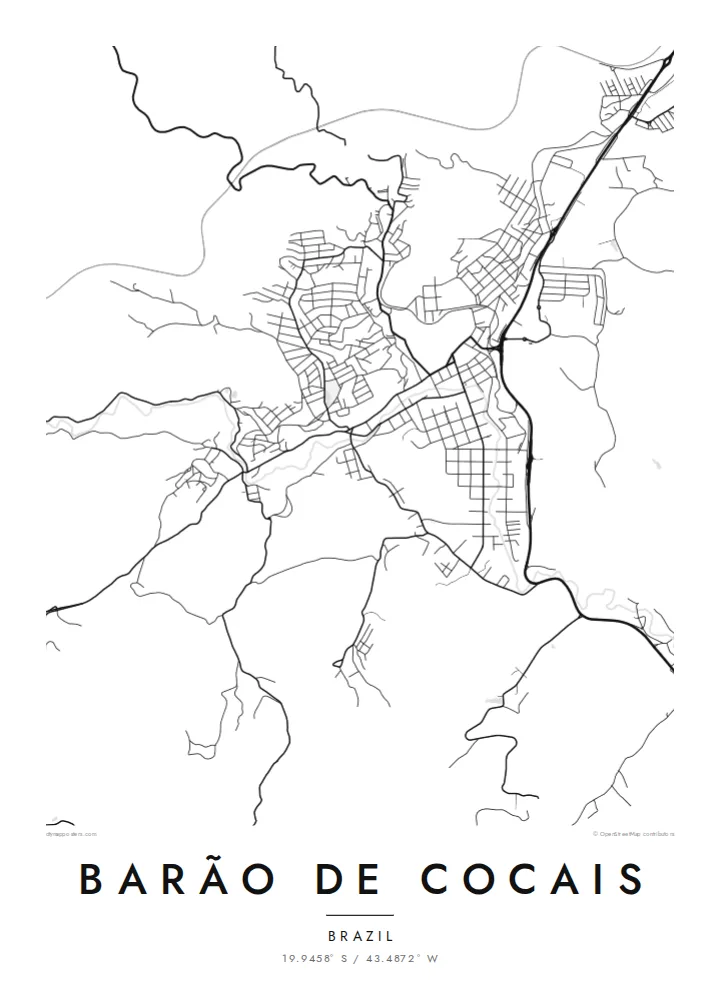
The town's roads follow the valley floor and bend around the hills, creating an organic street pattern with no dominant grid.
Fakatino mape mukamuka · Brazil
19.9458° S / 43.4872° W
A valley town in the iron country of Minas Gerais, its streets folding between steep ridges shaped by mining.
Taha e taone, lima e onoonoaga
Tapaki e taha puhala ke kitia ai ki luga he puipui. Kua tatai e totogi he tau puhala oti — pete he lolomi, poloka, po ke faila HD.
 Tau pikselo mooli · faila lolomi 24 × 36″
Maama mitaki ke lolomi
Ko e 100% e fahi mooli mai he faila lolomi. Ko e tau poster oti — pete kua lolomi, poloka, po ke utu hifo — kua taute ke he ha mautolu a tau tokoluga (server) ke he 300 DPI, hokotia ke he 7,200 × 10,800 piksela, ke maeke ai e tau ala ikiiki tote ke maaliali fakamitaki he lolomi 24 × 36″.
He Pā


Ko e mape
Barão de Cocais lies east of Belo Horizonte, within the Iron Quadrangle, one of Brazil's most important mining regions. The town fills a valley, and its streets follow the terrain instead of a grid, winding up hillsides and bending along the river. Around it, the map shows steep ridges, remnants of forest and large mining areas that give the landscape its rough, folded texture.
Settlement here dates from the colonial gold rush, and the historic centre still has its colonial-era church. In the twentieth century, iron ore and steel became the main industries, and mining still shapes the surrounding hills. The Serra do Caraça and its well-known sanctuary rise a short distance to the south, part of the same mountainous landscape.
A Barão de Cocais map poster captures a town where geography dictates everything. Roads curve with the slopes, neighbourhoods fill the flatter pockets of land, and hills rather than planners draw the edges of the town. It suits people from the town and anyone who knows the mining towns of Minas, where every map looks different because the land does.
The town's roads follow the valley floor and bend around the hills, creating an organic street pattern with no dominant grid.
The historic core around the old church keeps a tighter, older layout. It is a small knot of streets from the town's early colonial years.
Steep ridges and mining areas surround the town. At a wider zoom, the map shows how settlement squeezes in between high ground and industrial land.
Taute ke ha hau
Lafi e aho, taha higoa po ke taha kupu haau, hiki e fakatino, lahi po ke tuaga.
Ko e kitiaaga nakai totogi kua tote e maaliali mo e fakamailoga vai. Ko e tau lolomi mo e tau faila HD kua taute ke he 300 DPI, hokotia ke he 7,200 × 10,800 px, nakai fai fakamailoga vai.
Ko e ha Barão de Cocais
People from Minas Gerais living abroad, and those with family in the Iron Quadrangle, often want something that feels like home without being a landscape photo. A map of Barão de Cocais does that with restraint, and its irregular streets make an interesting graphic on any wall.
Add a title, a date or a family name in the subtitle, and adjust the coordinates line. Choose from five styles, from high-contrast Noir to warm Paper. Download the full set of print files for $9, or order a matte print from our print partners.
Talaage e poster Barão de Cocais| Lahi he lolomi | Maama | Tau faila |
|---|---|---|
| 30 × 40 cm11.8 × 15.7″ | 3,543 × 4,724 px | PNG · PDF |
| 29.7 × 42 cm (A3)11.7 × 16.5″ | 3,508 × 4,961 px | PNG · PDF |
| 42 × 59.4 cm (A2)16.5 × 23.4″ | 4,961 × 7,016 px | PNG · PDF |
| 45.7 × 61 cm18 × 24″ | 5,400 × 7,200 px | PNG · PDF |
| 50 × 70 cm19.7 × 27.6″ | 5,906 × 8,268 px | PNG · PDF |
| 61 × 91.4 cm24 × 36″ | 7,200 × 10,800 px | PNG · PDF |
Ke fakatatai, ko e fakatino noa kua 900 px e laulahi, fai fakamailoga mo e mo e tau mata komipiuta ni. Ko e tau faila HD kua ato hoko ke he 8× e maama ke he tau faahi takitaha mo e lolomi mitaki he lahi katoa he fakatino.
Fifili e taha puhala i luga he kupega, ti fifili e Poster Lolomi — e lahi mo e, kaeke ke manako ai koe, taha poloka — po ke Tau Faila HD Fakaeletonika. Ko e fakaotiaga totogi ko e taha gahua ni, ti ko e kupega he hau a talaaga ka fakafou fakahaga i mua he fakaotiaga e totogi.
Kua lolomi ai ke he pepa mitaki 200 gsm matte he taha he tau lahi ono, mai he 30 × 40 cm ke hoko ke he 24 × 36″. Kamata e tau poster lolomi mai he $39, kua putoia ai e utaaga.
E. Fifili e poloka akau malolō ke he lanu uli, tea, akau oki mooli, po ke akau pouli. Kua fakalataha mo e sioga malolō nakai malepe ti kua mautali ke tautau. Kamata e tau poster poloka mai he $99, kua putoia ai e utaaga.
Nakai totogi e fakafano ke he motu 60+. Ko e fakatino taha kua lolomi he fenoga lolomi ha mautolu kua tata mo e tau motu 30+, kua hoko mai he tau aho gahua 3–7. Maeke ia koe ke kikite e tuaga mo e fakamuitua he lalo he Haku Tau Fakatonu. Ke he falu motu kua 2–5 e tau tapu, ti ka nakai fakafano a mautolu ki ai, to fakaha he api tupe ia ki mua he totogi.
Fakafano mai e taha ata ki a mautolu he loto he 14 e tau aho tali mai he hokoaga, ti to lolomi foki e mautolu nakai totogi po ke liu atu e totogi ki a koe.
E. He editor i luga he kupega nei, hikihiki e matakupu, e matakupu lalo mo e laini coordinates ke he taha mena kua manako a koe ki ai, ti fifili e puhala mo e lahi. Ko e tau talaaga lolomi, poloka mo e fakaeletonika oti kua fakaaoga tonu e hau a fakatino.
Ma e $9 ka moua e koe e tau faila PNG 300 DPI mo e PDF kua mautali ke lolomi he tau lahi ono oti, nakai fai fakamailoga vai, ke lolomi i fe mena. Nakai maopoopo agaia? Utu hifo fakamua e kitiaaga nakai totogi ne fai fakamailoga vai.
Tata mai
