River confluence
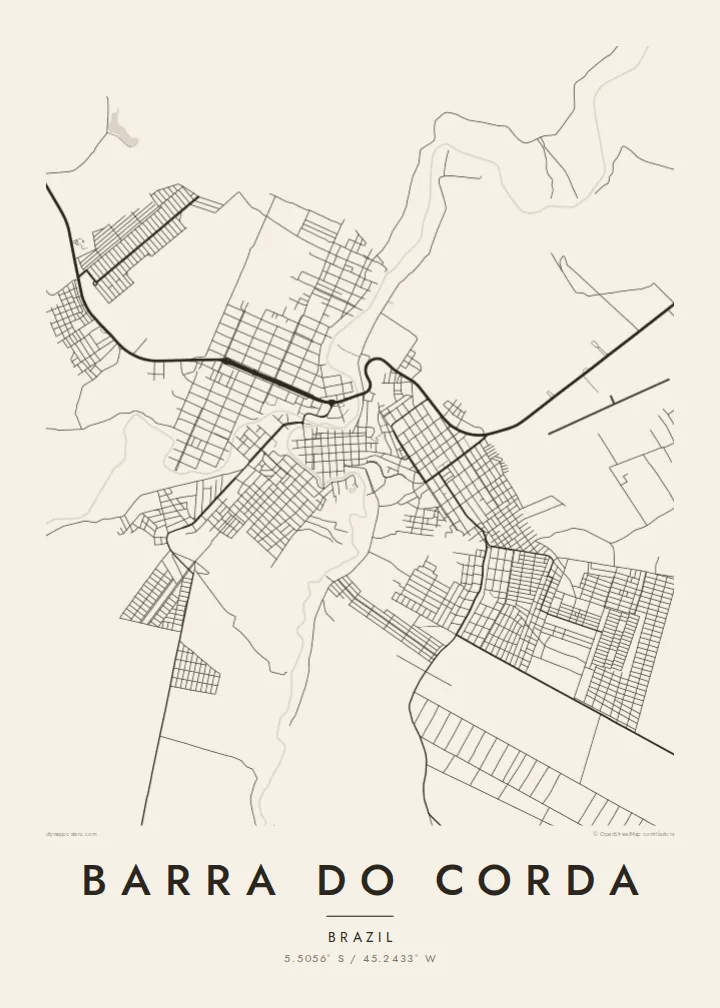
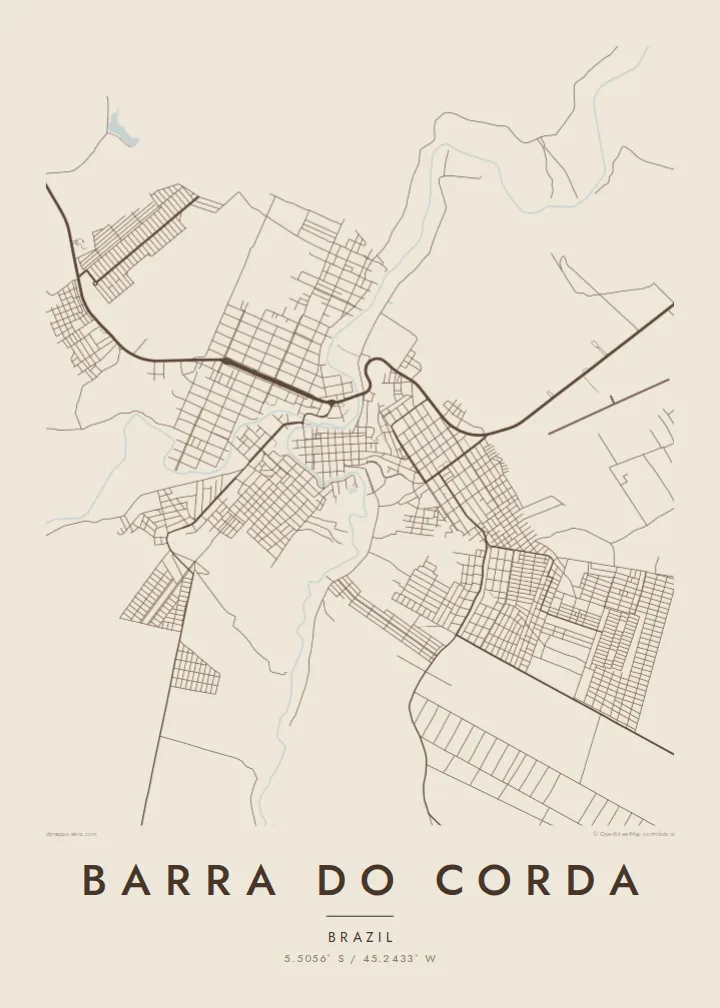
The Corda and the Mearim meet at the heart of the town. Their junction gives Barra do Corda its name and anchors the whole layout of streets around it.
Fakatino mape mukamuka · Brazil
5.5056° S / 45.2433° W
A river town in central Maranhão, laid out where the Corda meets the Mearim amid wooded, gently rolling country.



Taha e taone, lima e onoonoaga
Tapaki e taha puhala ke kitia ai ki luga he puipui. Kua tatai e totogi he tau puhala oti — pete he lolomi, poloka, po ke faila HD.
 Tau pikselo mooli · faila lolomi 24 × 36″
Maama mitaki ke lolomi
Ko e 100% e fahi mooli mai he faila lolomi. Ko e tau poster oti — pete kua lolomi, poloka, po ke utu hifo — kua taute ke he ha mautolu a tau tokoluga (server) ke he 300 DPI, hokotia ke he 7,200 × 10,800 piksela, ke maeke ai e tau ala ikiiki tote ke maaliali fakamitaki he lolomi 24 × 36″.
He Pā


Ko e mape
Barra do Corda takes its name from its site: barra means river mouth in Portuguese, and the town grew where the Corda River flows into the Mearim. On a map the two watercourses form the organising lines. The streets of the centre sit on the land between and beside them, and the outer neighbourhoods spread along the roads leading away.
The rivers wind in loose, looping curves, edged by strips of riparian woodland that stand out against the more open land beyond. Streets in the older centre follow a modest grid, bending where they meet the water. A Barra do Corda map poster keeps this relationship at the centre of the composition, with the town literally drawn around its confluence.
The municipality lies in the interior of Maranhão, in the transition between the Amazon forest to the west and the cerrado savanna. Several Indigenous territories of the Guajajara people lie in the surrounding region. The town serves as a regional centre for trade and services, reached by long highways that cross the state.
The Corda and the Mearim meet at the heart of the town. Their junction gives Barra do Corda its name and anchors the whole layout of streets around it.
Both rivers loop through the landscape in soft, irregular curves, lined with trees. On the map they are the most fluid lines against the straighter street pattern.
The older centre is laid out in a simple grid of blocks. It holds its order until it meets the water, where streets end or turn to follow the banks.
Taute ke ha hau
Lafi e aho, taha higoa po ke taha kupu haau, hiki e fakatino, lahi po ke tuaga.
Ko e kitiaaga nakai totogi kua tote e maaliali mo e fakamailoga vai. Ko e tau lolomi mo e tau faila HD kua taute ke he 300 DPI, hokotia ke he 7,200 × 10,800 px, nakai fai fakamailoga vai.
Ko e ha Barra do Corda
For people from Barra do Corda, the meeting of the two rivers is the town's signature, and a map shows it better than any photograph. It makes a meaningful piece for a family home or a gift for someone who moved away to São Luís or further.
Set the title, a subtitle and the coordinates line to your liking, perhaps adding a family name or a wedding date. Choose Classic black and white, Noir, Paper, Blueprint or Sand. Digital files cost $9, and printed posters ship from partners in over 30 countries.
Talaage e poster Barra do Corda| Lahi he lolomi | Maama | Tau faila |
|---|---|---|
| 30 × 40 cm11.8 × 15.7″ | 3,543 × 4,724 px | PNG · PDF |
| 29.7 × 42 cm (A3)11.7 × 16.5″ | 3,508 × 4,961 px | PNG · PDF |
| 42 × 59.4 cm (A2)16.5 × 23.4″ | 4,961 × 7,016 px | PNG · PDF |
| 45.7 × 61 cm18 × 24″ | 5,400 × 7,200 px | PNG · PDF |
| 50 × 70 cm19.7 × 27.6″ | 5,906 × 8,268 px | PNG · PDF |
| 61 × 91.4 cm24 × 36″ | 7,200 × 10,800 px | PNG · PDF |
Ke fakatatai, ko e fakatino noa kua 900 px e laulahi, fai fakamailoga mo e mo e tau mata komipiuta ni. Ko e tau faila HD kua ato hoko ke he 8× e maama ke he tau faahi takitaha mo e lolomi mitaki he lahi katoa he fakatino.
Fifili e taha puhala i luga he kupega, ti fifili e Poster Lolomi — e lahi mo e, kaeke ke manako ai koe, taha poloka — po ke Tau Faila HD Fakaeletonika. Ko e fakaotiaga totogi ko e taha gahua ni, ti ko e kupega he hau a talaaga ka fakafou fakahaga i mua he fakaotiaga e totogi.
Kua lolomi ai ke he pepa mitaki 200 gsm matte he taha he tau lahi ono, mai he 30 × 40 cm ke hoko ke he 24 × 36″. Kamata e tau poster lolomi mai he $39, kua putoia ai e utaaga.
E. Fifili e poloka akau malolō ke he lanu uli, tea, akau oki mooli, po ke akau pouli. Kua fakalataha mo e sioga malolō nakai malepe ti kua mautali ke tautau. Kamata e tau poster poloka mai he $99, kua putoia ai e utaaga.
Nakai totogi e fakafano ke he motu 60+. Ko e fakatino taha kua lolomi he fenoga lolomi ha mautolu kua tata mo e tau motu 30+, kua hoko mai he tau aho gahua 3–7. Maeke ia koe ke kikite e tuaga mo e fakamuitua he lalo he Haku Tau Fakatonu. Ke he falu motu kua 2–5 e tau tapu, ti ka nakai fakafano a mautolu ki ai, to fakaha he api tupe ia ki mua he totogi.
Fakafano mai e taha ata ki a mautolu he loto he 14 e tau aho tali mai he hokoaga, ti to lolomi foki e mautolu nakai totogi po ke liu atu e totogi ki a koe.
E. He editor i luga he kupega nei, hikihiki e matakupu, e matakupu lalo mo e laini coordinates ke he taha mena kua manako a koe ki ai, ti fifili e puhala mo e lahi. Ko e tau talaaga lolomi, poloka mo e fakaeletonika oti kua fakaaoga tonu e hau a fakatino.
Ma e $9 ka moua e koe e tau faila PNG 300 DPI mo e PDF kua mautali ke lolomi he tau lahi ono oti, nakai fai fakamailoga vai, ke lolomi i fe mena. Nakai maopoopo agaia? Utu hifo fakamua e kitiaaga nakai totogi ne fai fakamailoga vai.
Tata mai
