Aruwimi confluence
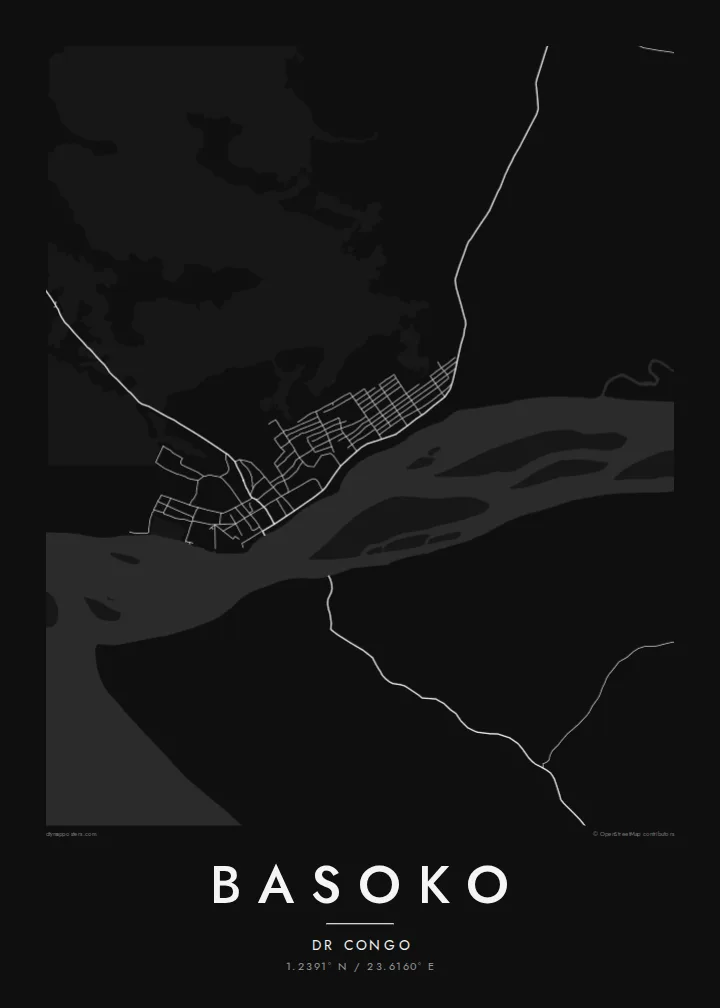
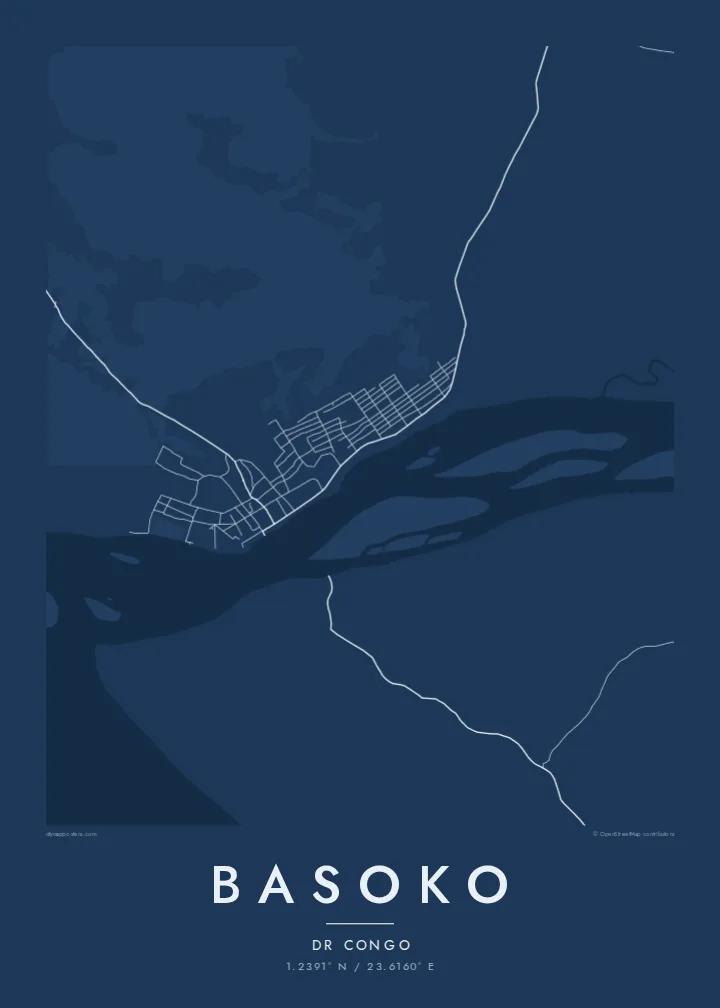
The Aruwimi enters the Congo beside the town, and the joining of two large rivers creates the strongest shape on the map, a fork of water around the settlement.
Fakatino mape mukamuka · Congo - Kinshasa
1.2391° N / 23.6160° E
A river town where the Aruwimi joins the Congo, surrounded by forest, islands and wide channels



Taha e taone, lima e onoonoaga
Tapaki e taha puhala ke kitia ai ki luga he puipui. Kua tatai e totogi he tau puhala oti — pete he lolomi, poloka, po ke faila HD.
 Tau pikselo mooli · faila lolomi 24 × 36″
Maama mitaki ke lolomi
Ko e 100% e fahi mooli mai he faila lolomi. Ko e tau poster oti — pete kua lolomi, poloka, po ke utu hifo — kua taute ke he ha mautolu a tau tokoluga (server) ke he 300 DPI, hokotia ke he 7,200 × 10,800 piksela, ke maeke ai e tau ala ikiiki tote ke maaliali fakamitaki he lolomi 24 × 36″.
He Pā


Ko e mape
Basoko stands on the bank of the Congo River in Tshopo province, at the point where the Aruwimi River flows in from the east. On a map the rivers dominate: broad channels, sandbanks and wooded islands around a compact settlement of streets set back from the water. Beyond, the land is equatorial forest crossed by very few roads.
The confluence made the town a natural stopping point for river traffic, and it served as a station during the colonial period, when steamers carried goods and people along the Congo between Kinshasa and Kisangani. River transport still matters more here than roads, which is visible in how the whole town faces the water.
A Basoko map poster is mostly about water and scale. The town itself is small, and the rivers around it are immense by comparison, so the print becomes a study of meeting currents, islands and shoreline, with the street pattern as a small precise detail on the bank of the great river.
The Aruwimi enters the Congo beside the town, and the joining of two large rivers creates the strongest shape on the map, a fork of water around the settlement.
The Congo here is broken into several channels by long forested islands and sandbanks, drawn as pale shapes separated by threads of water.
The streets form a small, compact pattern along the bank, oriented to the water that has long been the town's main connection to the rest of the country.
Taute ke ha hau
Lafi e aho, taha higoa po ke taha kupu haau, hiki e fakatino, lahi po ke tuaga.
Ko e kitiaaga nakai totogi kua tote e maaliali mo e fakamailoga vai. Ko e tau lolomi mo e tau faila HD kua taute ke he 300 DPI, hokotia ke he 7,200 × 10,800 px, nakai fai fakamailoga vai.
Ko e ha Basoko
This is a map for people with roots in Tshopo, travellers who have made the river journey, or anyone drawn to places defined by great rivers. The composition is bold and simple, closer to a landscape drawing than a street plan.
You can write your own title and subtitle and adjust the coordinates line, then choose from Classic black and white, Noir, Paper, Blueprint and Sand. Order the $9 HD files for home printing or a printed poster shipped from a partner near you.
Talaage e poster Basoko| Lahi he lolomi | Maama | Tau faila |
|---|---|---|
| 30 × 40 cm (11.8 × 15.7″) | 3,543 × 4,724 px | PNG · PDF |
| 29.7 × 42 cm (A3, 11.7 × 16.5″) | 3,508 × 4,961 px | PNG · PDF |
| 42 × 59.4 cm (A2, 16.5 × 23.4″) | 4,961 × 7,016 px | PNG · PDF |
| 45.7 × 61 cm (18 × 24″) | 5,400 × 7,200 px | PNG · PDF |
| 50 × 70 cm (19.7 × 27.6″) | 5,906 × 8,268 px | PNG · PDF |
| 61 × 91.4 cm (24 × 36″) | 7,200 × 10,800 px | PNG · PDF |
Ke fakatatai, ko e fakatino noa kua 900 px e laulahi, fai fakamailoga mo e mo e tau mata komipiuta ni. Ko e tau faila HD kua ato hoko ke he 8× e maama ke he tau faahi takitaha mo e lolomi mitaki he lahi katoa he fakatino.
Fifili e taha puhala i luga he kupega, ti fifili e Poster Lolomi — e lahi mo e, kaeke ke manako ai koe, taha poloka — po ke Tau Faila HD Fakaeletonika. Ko e fakaotiaga totogi ko e taha gahua ni, ti ko e kupega he hau a talaaga ka fakafou fakahaga i mua he fakaotiaga e totogi.
Kua lolomi ai ke he pepa mitaki 200 gsm matte he taha he tau lahi ono, mai he 30 × 40 cm ke hoko ke he 24 × 36″. Kamata e tau poster lolomi mai he $39, kua putoia ai e utaaga.
E. Fifili e poloka akau malolō ke he lanu uli, tea, akau oki mooli, po ke akau pouli. Kua fakalataha mo e sioga malolō nakai malepe ti kua mautali ke tautau. Kamata e tau poster poloka mai he $99, kua putoia ai e utaaga.
Ko e uta ke he lalolagi oti ha fai totogi. Ko e tā e poster taha he tupe ofi mahaki he falu kapitiga tā ha mautolu he motu 30+, ti kua hoko mai he tokai 3–7 e aho gahua. Maeke ia koe ke kikite e tutūaga mo e hukui he lalo ke he Tau Fakatonuaga haku. Falu motu kua fai 2–5 e faahi, ti ka nakai uta ni a mautolu ki ai, ka talahau atu he nofoaga i mua he totogi.
Fakafano mai e taha ata ki a mautolu he loto he 14 e tau aho tali mai he hokoaga, ti to lolomi foki e mautolu nakai totogi po ke liu atu e totogi ki a koe.
E. He editor i luga he kupega nei, hikihiki e matakupu, e matakupu lalo mo e laini coordinates ke he taha mena kua manako a koe ki ai, ti fifili e puhala mo e lahi. Ko e tau talaaga lolomi, poloka mo e fakaeletonika oti kua fakaaoga tonu e hau a fakatino.
Ma e $9 ka moua e koe e tau faila PNG 300 DPI mo e PDF kua mautali ke lolomi he tau lahi ono oti, nakai fai fakamailoga vai, ke lolomi i fe mena. Nakai maopoopo agaia? Utu hifo fakamua e kitiaaga nakai totogi ne fai fakamailoga vai.
Tata mai
