Lakes and tanks
Hundreds of man-made lakes once spread across the plateau, and many survive. On the poster they appear as scattered, irregular forms, giving the city a watery texture without any river.
Fakatino mape mukamuka · India
12.9719° N / 77.5937° E
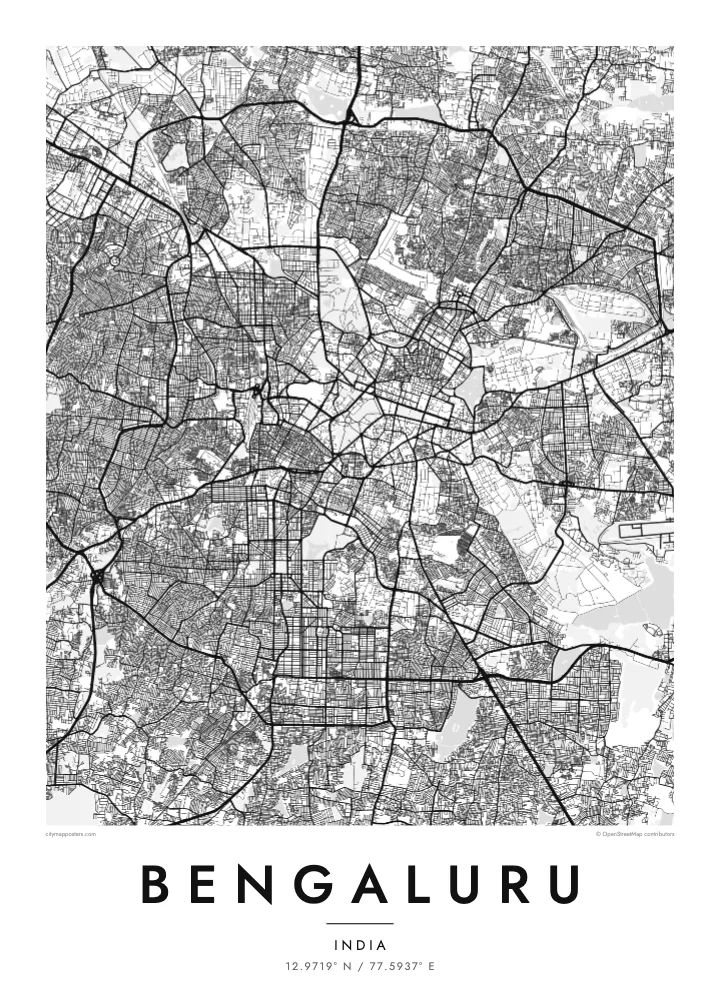
A plateau city of lakes and ring roads, with two large parks at its centre and tree-lined avenues spreading outward.


Taha e taone, lima e onoonoaga
Tapaki e taha puhala ke kitia ai ki luga he puipui. Kua tatai e totogi he tau puhala oti — pete he lolomi, poloka, po ke faila HD.
 Tau pikselo mooli · faila lolomi 24 × 36″
Maama mitaki ke lolomi
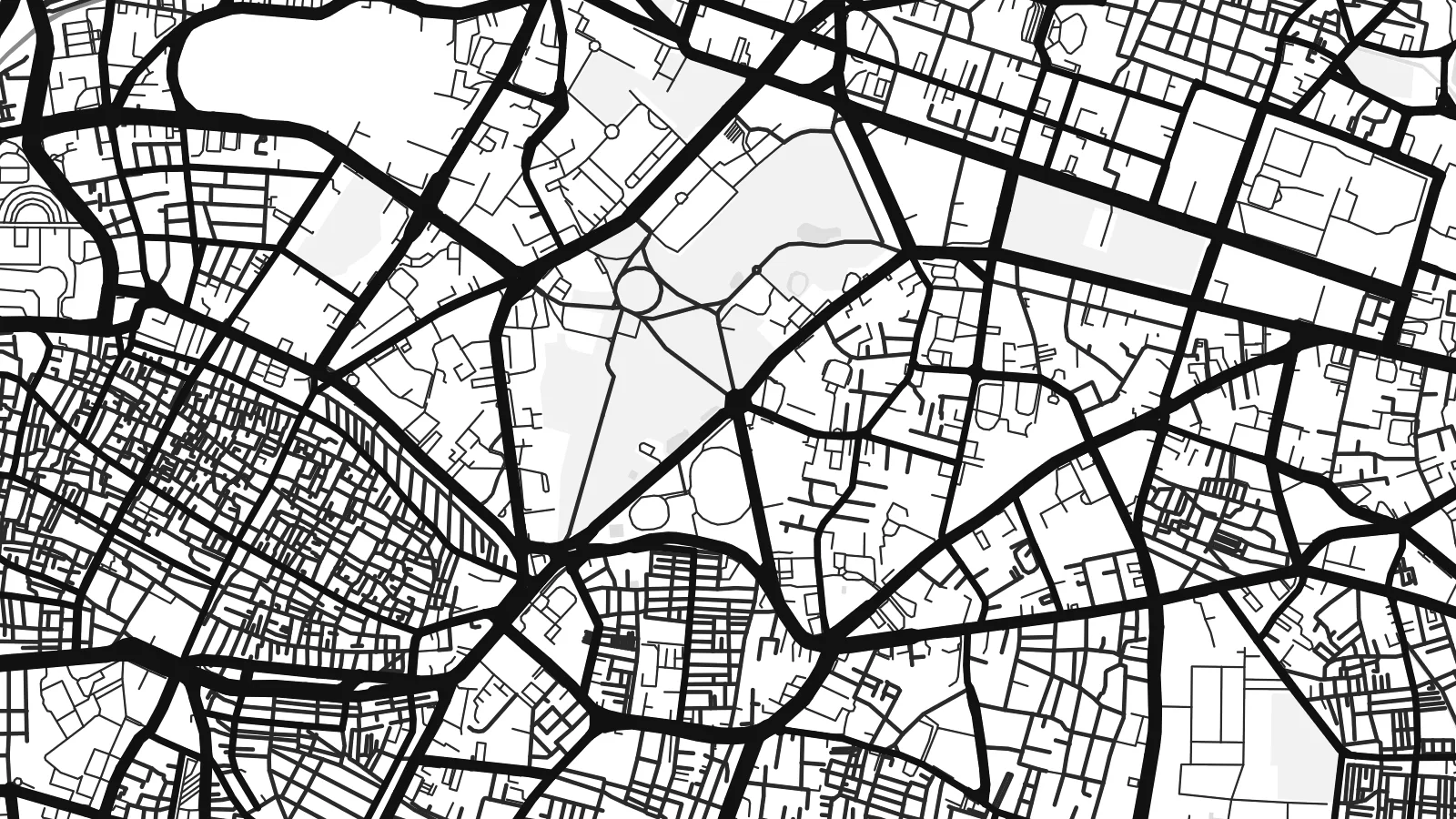
Ko e 100% e fahi mooli mai he faila lolomi. Ko e tau poster oti — pete kua lolomi, poloka, po ke utu hifo — kua taute ke he ha mautolu a tau tokoluga (server) ke he 300 DPI, hokotia ke he 7,200 × 10,800 piksela, ke maeke ai e tau ala ikiiki tote ke maaliali fakamitaki he lolomi 24 × 36″.
He Pā


Ko e mape
Bengaluru sits on the Deccan Plateau at roughly 900 metres, with no major river running through it. Instead, the map is dotted with lakes, most of them historic tanks built to store rainwater and once linked by channels that follow the gentle slope of the land. Ulsoor, Hebbal, Bellandur and many smaller lakes appear as irregular shapes between the streets.
The city traces its founding to 1537, when the chieftain Kempe Gowda built a mud fort here, and the old market area around the Pete still has narrow, crowded lanes. The centre is marked by two large green spaces: Cubbon Park, beside the Vidhana Soudha, and Lalbagh Botanical Garden to the south, both reasons the city was long called the Garden City of India.
Much of modern Bengaluru grew along its ring roads, especially the Outer Ring Road, where many of the technology parks behind its reputation as India's software capital are concentrated. A Bengaluru map poster places those newer districts in relation to the older centre, the lakes and the cantonment streets east of Cubbon Park, which were laid out under British rule.
Hundreds of man-made lakes once spread across the plateau, and many survive. On the poster they appear as scattered, irregular forms, giving the city a watery texture without any river.
A large park in the administrative centre, crossed by curving drives and paths and bordered by the Vidhana Soudha and the High Court. It is the clearest open space on the central map.
A long orbital road looping through the eastern and southern suburbs, lined with office campuses. Its broad arc roughly marks where the older, denser city gives way to newer growth.
Taute ke ha hau
Lafi e aho, taha higoa po ke taha kupu haau, hiki e fakatino, lahi po ke tuaga.
Ko e kitiaaga nakai totogi kua tote e maaliali mo e fakamailoga vai. Ko e tau lolomi mo e tau faila HD kua taute ke he 300 DPI, hokotia ke he 7,200 × 10,800 px, nakai fai fakamailoga vai.
Ko e ha Bengaluru
Bengaluru draws people from across India and abroad, and many spend important years there, in a first job, a first apartment, a favourite café in Indiranagar or Jayanagar. A map of the city keeps that chapter recognisable long after moving on.
Choose a title, add a subtitle with a date or neighbourhood, and decide whether to keep the coordinates line. Five styles are available, from Paper and Sand to Noir. Printed posters come on matte paper, with an optional wooden frame, from partners in 30+ countries.
Talaage e poster Bengaluru| Lahi he lolomi | Maama | Tau faila |
|---|---|---|
| 30 × 40 cm11.8 × 15.7″ | 3,543 × 4,724 px | PNG · PDF |
| 29.7 × 42 cm (A3)11.7 × 16.5″ | 3,508 × 4,961 px | PNG · PDF |
| 42 × 59.4 cm (A2)16.5 × 23.4″ | 4,961 × 7,016 px | PNG · PDF |
| 45.7 × 61 cm18 × 24″ | 5,400 × 7,200 px | PNG · PDF |
| 50 × 70 cm19.7 × 27.6″ | 5,906 × 8,268 px | PNG · PDF |
| 61 × 91.4 cm24 × 36″ | 7,200 × 10,800 px | PNG · PDF |
Ke fakatatai, ko e fakatino noa kua 900 px e laulahi, fai fakamailoga mo e mo e tau mata komipiuta ni. Ko e tau faila HD kua ato hoko ke he 8× e maama ke he tau faahi takitaha mo e lolomi mitaki he lahi katoa he fakatino.
Fifili e taha puhala i luga he kupega, ti fifili e Poster Lolomi — e lahi mo e, kaeke ke manako ai koe, taha poloka — po ke Tau Faila HD Fakaeletonika. Ko e fakaotiaga totogi ko e taha gahua ni, ti ko e kupega he hau a talaaga ka fakafou fakahaga i mua he fakaotiaga e totogi.
Kua lolomi ai ke he pepa mitaki 200 gsm matte he taha he tau lahi ono, mai he 30 × 40 cm ke hoko ke he 24 × 36″. Kamata e tau poster lolomi mai he $39, kua putoia ai e utaaga.
E. Fifili e poloka akau malolō ke he lanu uli, tea, akau oki mooli, po ke akau pouli. Kua fakalataha mo e sioga malolō nakai malepe ti kua mautali ke tautau. Kamata e tau poster poloka mai he $99, kua putoia ai e utaaga.
Nakai totogi e fakafano ke he motu 60+. Ko e fakatino taha kua lolomi he fenoga lolomi ha mautolu kua tata mo e tau motu 30+, kua hoko mai he tau aho gahua 3–7. Maeke ia koe ke kikite e tuaga mo e fakamuitua he lalo he Haku Tau Fakatonu. Ke he falu motu kua 2–5 e tau tapu, ti ka nakai fakafano a mautolu ki ai, to fakaha he api tupe ia ki mua he totogi.
Fakafano mai e taha ata ki a mautolu he loto he 14 e tau aho tali mai he hokoaga, ti to lolomi foki e mautolu nakai totogi po ke liu atu e totogi ki a koe.
E. He editor i luga he kupega nei, hikihiki e matakupu, e matakupu lalo mo e laini coordinates ke he taha mena kua manako a koe ki ai, ti fifili e puhala mo e lahi. Ko e tau talaaga lolomi, poloka mo e fakaeletonika oti kua fakaaoga tonu e hau a fakatino.
Ma e $9 ka moua e koe e tau faila PNG 300 DPI mo e PDF kua mautali ke lolomi he tau lahi ono oti, nakai fai fakamailoga vai, ke lolomi i fe mena. Nakai maopoopo agaia? Utu hifo fakamua e kitiaaga nakai totogi ne fai fakamailoga vai.
Tata mai
