Subdivision layouts
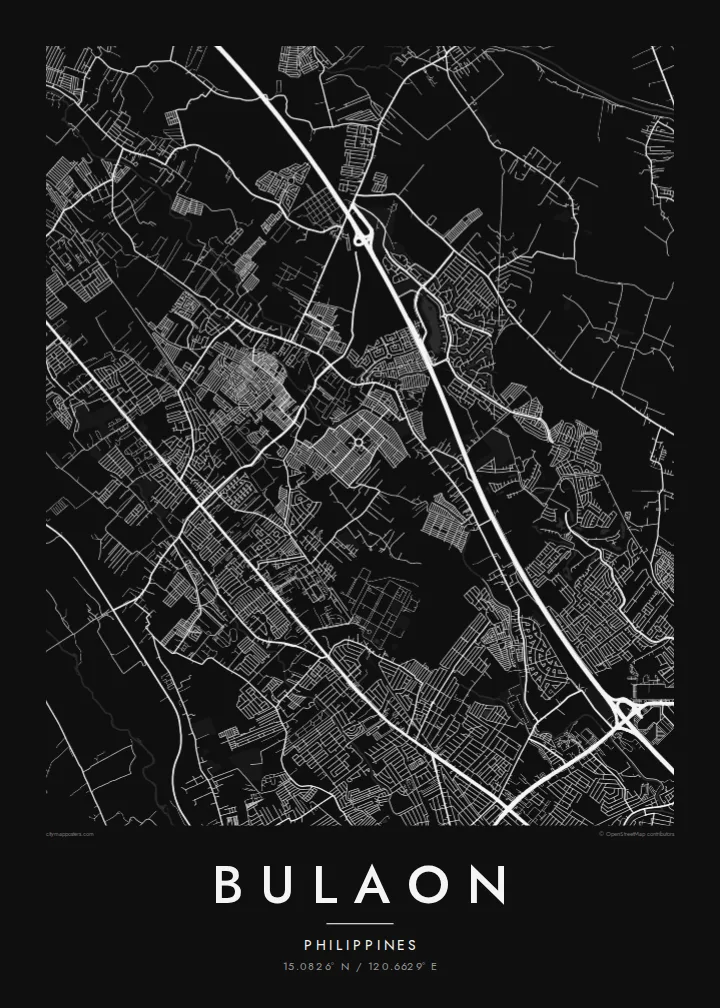
The curving streets and cul-de-sacs of residential subdivisions form compact, rounded clusters. They stand out clearly against the straighter main roads around them.
Fakatino mape mukamuka · Philippines
15.0826° N / 120.6629° E
Low, flat ground on the Pampanga plain, where roads, housing blocks and farmland meet near San Fernando.



Taha e taone, lima e onoonoaga
Tapaki e taha puhala ke kitia ai ki luga he puipui. Kua tatai e totogi he tau puhala oti — pete he lolomi, poloka, po ke faila HD.
 Tau pikselo mooli · faila lolomi 24 × 36″
Maama mitaki ke lolomi
Ko e 100% e fahi mooli mai he faila lolomi. Ko e tau poster oti — pete kua lolomi, poloka, po ke utu hifo — kua taute ke he ha mautolu a tau tokoluga (server) ke he 300 DPI, hokotia ke he 7,200 × 10,800 piksela, ke maeke ai e tau ala ikiiki tote ke maaliali fakamitaki he lolomi 24 × 36″.
He Pā


Ko e mape
Bulaon lies in the central lowlands of Luzon, close to the City of San Fernando, the capital of Pampanga province. The land here is almost perfectly flat, part of the broad plain between the Zambales mountains and the Sierra Madre. From above, that flatness turns the map into a study of roads and settlement patterns rather than terrain.
The area mixes planned subdivisions, older village lanes and open fields. Subdivision streets loop and branch in tidy clusters. The older roads follow property lines and waterways more loosely. Where the two meet, the map shows a patchwork that is typical of the fast-growing places along the corridor north of Manila.
Pampanga is known across the Philippines for its cooking, and San Fernando for its giant Christmas lanterns. The province also carries the memory of the 1991 eruption of Mount Pinatubo, whose lahar flows reshaped rivers and towns across the region. A Bulaon map poster keeps things simple: the street pattern of one corner of this province, framed as a personal record.
The curving streets and cul-de-sacs of residential subdivisions form compact, rounded clusters. They stand out clearly against the straighter main roads around them.
With almost no relief to show, the map is carried entirely by lines: highways, local roads and lanes spread evenly across the open plain.
Open fields between the built-up areas leave pale gaps on the poster. They give the composition room to breathe and mark where town gives way to countryside.
Taute ke ha hau
Lafi e aho, taha higoa po ke taha kupu haau, hiki e fakatino, lahi po ke tuaga.
Ko e kitiaaga nakai totogi kua tote e maaliali mo e fakamailoga vai. Ko e tau lolomi mo e tau faila HD kua taute ke he 300 DPI, hokotia ke he 7,200 × 10,800 px, nakai fai fakamailoga vai.
Ko e ha Bulaon
A map of Bulaon is a personal thing. It suits families who have settled here, people who grew up in Pampanga and moved abroad, and anyone who wants a quiet reminder of one neighbourhood rather than a famous skyline.
The title, subtitle and coordinates line can all be changed, so you can add a family name, a moving-in date or the name of your barangay. Choose Classic black & white, Noir, Paper, Blueprint or Sand to match the room where the poster will hang.
Talaage e poster Bulaon| Lahi he lolomi | Maama | Tau faila |
|---|---|---|
| 30 × 40 cm11.8 × 15.7″ | 3,543 × 4,724 px | PNG · PDF |
| 29.7 × 42 cm (A3)11.7 × 16.5″ | 3,508 × 4,961 px | PNG · PDF |
| 42 × 59.4 cm (A2)16.5 × 23.4″ | 4,961 × 7,016 px | PNG · PDF |
| 45.7 × 61 cm18 × 24″ | 5,400 × 7,200 px | PNG · PDF |
| 50 × 70 cm19.7 × 27.6″ | 5,906 × 8,268 px | PNG · PDF |
| 61 × 91.4 cm24 × 36″ | 7,200 × 10,800 px | PNG · PDF |
Ke fakatatai, ko e fakatino noa kua 900 px e laulahi, fai fakamailoga mo e mo e tau mata komipiuta ni. Ko e tau faila HD kua ato hoko ke he 8× e maama ke he tau faahi takitaha mo e lolomi mitaki he lahi katoa he fakatino.
Fifili e taha puhala i luga he kupega, ti fifili e Poster Lolomi — e lahi mo e, kaeke ke manako ai koe, taha poloka — po ke Tau Faila HD Fakaeletonika. Ko e fakaotiaga totogi ko e taha gahua ni, ti ko e kupega he hau a talaaga ka fakafou fakahaga i mua he fakaotiaga e totogi.
Kua lolomi ai ke he pepa mitaki 200 gsm matte he taha he tau lahi ono, mai he 30 × 40 cm ke hoko ke he 24 × 36″. Kamata e tau poster lolomi mai he $39, kua putoia ai e utaaga.
E. Fifili e poloka akau malolō ke he lanu uli, tea, akau oki mooli, po ke akau pouli. Kua fakalataha mo e sioga malolō nakai malepe ti kua mautali ke tautau. Kamata e tau poster poloka mai he $99, kua putoia ai e utaaga.
Nakai totogi e fakafano ke he motu 60+. Ko e fakatino taha kua lolomi he fenoga lolomi ha mautolu kua tata mo e tau motu 30+, kua hoko mai he tau aho gahua 3–7. Maeke ia koe ke kikite e tuaga mo e fakamuitua he lalo he Haku Tau Fakatonu. Ke he falu motu kua 2–5 e tau tapu, ti ka nakai fakafano a mautolu ki ai, to fakaha he api tupe ia ki mua he totogi.
Fakafano mai e taha ata ki a mautolu he loto he 14 e tau aho tali mai he hokoaga, ti to lolomi foki e mautolu nakai totogi po ke liu atu e totogi ki a koe.
E. He editor i luga he kupega nei, hikihiki e matakupu, e matakupu lalo mo e laini coordinates ke he taha mena kua manako a koe ki ai, ti fifili e puhala mo e lahi. Ko e tau talaaga lolomi, poloka mo e fakaeletonika oti kua fakaaoga tonu e hau a fakatino.
Ma e $9 ka moua e koe e tau faila PNG 300 DPI mo e PDF kua mautali ke lolomi he tau lahi ono oti, nakai fai fakamailoga vai, ke lolomi i fe mena. Nakai maopoopo agaia? Utu hifo fakamua e kitiaaga nakai totogi ne fai fakamailoga vai.
Tata mai
