Rio do Peixe
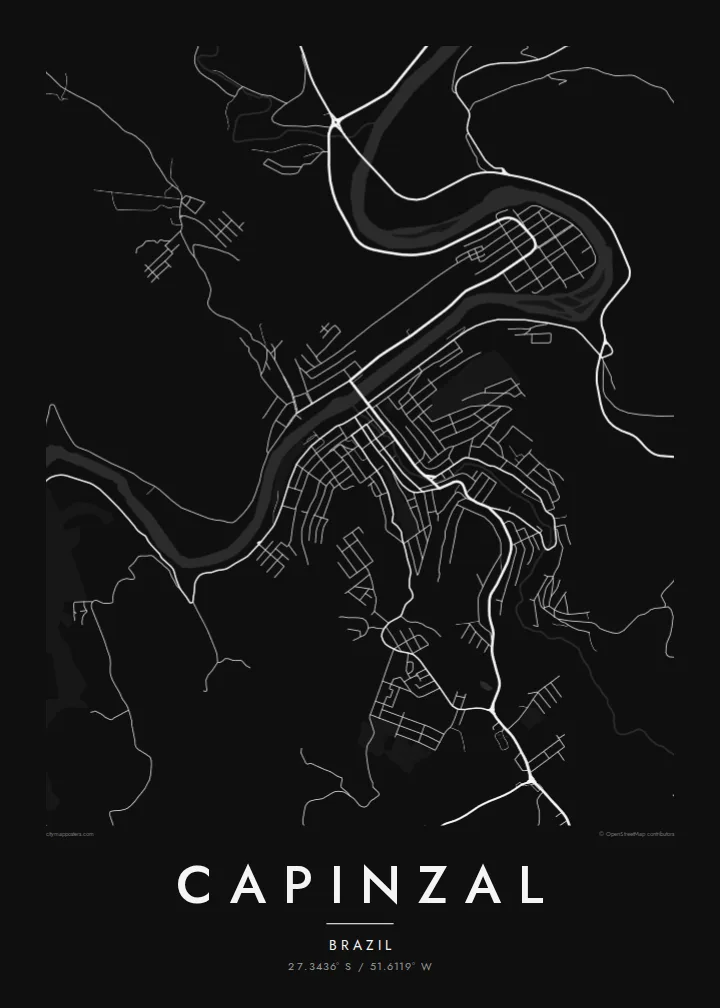
The river curves through the valley floor and splits the built-up area in two. It is the most prominent line on the poster and sets the direction of the whole town.
Fakatino mape mukamuka · Brazil
27.3436° S / 51.6119° W
A valley town on the Rio do Peixe, whose streets climb from the riverbanks into the green hills of western Santa Catarina.



Taha e taone, lima e onoonoaga
Tapaki e taha puhala ke kitia ai ki luga he puipui. Kua tatai e totogi he tau puhala oti — pete he lolomi, poloka, po ke faila HD.
 Tau pikselo mooli · faila lolomi 24 × 36″
Maama mitaki ke lolomi
Ko e 100% e fahi mooli mai he faila lolomi. Ko e tau poster oti — pete kua lolomi, poloka, po ke utu hifo — kua taute ke he ha mautolu a tau tokoluga (server) ke he 300 DPI, hokotia ke he 7,200 × 10,800 piksela, ke maeke ai e tau ala ikiiki tote ke maaliali fakamitaki he lolomi 24 × 36″.
He Pā


Ko e mape
Capinzal lies in the valley of the Rio do Peixe in western Santa Catarina, southern Brazil. The river is the centre of the map. It winds through a narrow valley, and the town has grown along its banks and up the slopes on either side. Streets follow the contours where they can, so the plan bends and terraces instead of forming a neat grid.
Directly across the river lies the neighbouring town of Ouro, and bridges tie the two together into what looks from above like one settlement divided by water. A Capinzal map poster shows that pairing clearly: two street networks facing each other, joined by the crossings over the Rio do Peixe.
The region was settled largely by descendants of European immigrants, and its economy rests on farming and food processing. Away from the river the hills carry farms and patches of forest, reached by roads that climb in long loops. In print, the valley's shape comes through strongly, with a dense riverside core, streets that loosen up the slopes, and open countryside above.
The river curves through the valley floor and splits the built-up area in two. It is the most prominent line on the poster and sets the direction of the whole town.
Crossings link Capinzal with Ouro on the opposite bank, so two municipalities read as one continuous town divided only by the river.
Away from the water, streets climb the valley sides in curves and switchbacks, and the relief shows through a road pattern that avoids straight lines.
Taute ke ha hau
Lafi e aho, taha higoa po ke taha kupu haau, hiki e fakatino, lahi po ke tuaga.
Ko e kitiaaga nakai totogi kua tote e maaliali mo e fakamailoga vai. Ko e tau lolomi mo e tau faila HD kua taute ke he 300 DPI, hokotia ke he 7,200 × 10,800 px, nakai fai fakamailoga vai.
Ko e ha Capinzal
Anyone who grew up in the Rio do Peixe valley will recognise the river's bend and the streets climbing from it. A map of Capinzal is a fitting gift for family who stayed or for those who moved to the bigger cities.
Personalise the title, subtitle and coordinates line, then choose Classic black & white, Noir, Paper, Blueprint or Sand. The digital files cost $9 and include six print sizes as 300 DPI PNG and PDF, and printed posters are available with an optional wooden frame.
Talaage e poster Capinzal| Lahi he lolomi | Maama | Tau faila |
|---|---|---|
| 30 × 40 cm11.8 × 15.7″ | 3,543 × 4,724 px | PNG · PDF |
| 29.7 × 42 cm (A3)11.7 × 16.5″ | 3,508 × 4,961 px | PNG · PDF |
| 42 × 59.4 cm (A2)16.5 × 23.4″ | 4,961 × 7,016 px | PNG · PDF |
| 45.7 × 61 cm18 × 24″ | 5,400 × 7,200 px | PNG · PDF |
| 50 × 70 cm19.7 × 27.6″ | 5,906 × 8,268 px | PNG · PDF |
| 61 × 91.4 cm24 × 36″ | 7,200 × 10,800 px | PNG · PDF |
Ke fakatatai, ko e fakatino noa kua 900 px e laulahi, fai fakamailoga mo e mo e tau mata komipiuta ni. Ko e tau faila HD kua ato hoko ke he 8× e maama ke he tau faahi takitaha mo e lolomi mitaki he lahi katoa he fakatino.
Fifili e taha puhala i luga he kupega, ti fifili e Poster Lolomi — e lahi mo e, kaeke ke manako ai koe, taha poloka — po ke Tau Faila HD Fakaeletonika. Ko e fakaotiaga totogi ko e taha gahua ni, ti ko e kupega he hau a talaaga ka fakafou fakahaga i mua he fakaotiaga e totogi.
Kua lolomi ai ke he pepa mitaki 200 gsm matte he taha he tau lahi ono, mai he 30 × 40 cm ke hoko ke he 24 × 36″. Kamata e tau poster lolomi mai he $39, kua putoia ai e utaaga.
E. Fifili e poloka akau malolō ke he lanu uli, tea, akau oki mooli, po ke akau pouli. Kua fakalataha mo e sioga malolō nakai malepe ti kua mautali ke tautau. Kamata e tau poster poloka mai he $99, kua putoia ai e utaaga.
Nakai totogi e fakafano ke he motu 60+. Ko e fakatino taha kua lolomi he fenoga lolomi ha mautolu kua tata mo e tau motu 30+, kua hoko mai he tau aho gahua 3–7. Maeke ia koe ke kikite e tuaga mo e fakamuitua he lalo he Haku Tau Fakatonu. Ke he falu motu kua 2–5 e tau tapu, ti ka nakai fakafano a mautolu ki ai, to fakaha he api tupe ia ki mua he totogi.
Fakafano mai e taha ata ki a mautolu he loto he 14 e tau aho tali mai he hokoaga, ti to lolomi foki e mautolu nakai totogi po ke liu atu e totogi ki a koe.
E. He editor i luga he kupega nei, hikihiki e matakupu, e matakupu lalo mo e laini coordinates ke he taha mena kua manako a koe ki ai, ti fifili e puhala mo e lahi. Ko e tau talaaga lolomi, poloka mo e fakaeletonika oti kua fakaaoga tonu e hau a fakatino.
Ma e $9 ka moua e koe e tau faila PNG 300 DPI mo e PDF kua mautali ke lolomi he tau lahi ono oti, nakai fai fakamailoga vai, ke lolomi i fe mena. Nakai maopoopo agaia? Utu hifo fakamua e kitiaaga nakai totogi ne fai fakamailoga vai.
