Concentric ring roads
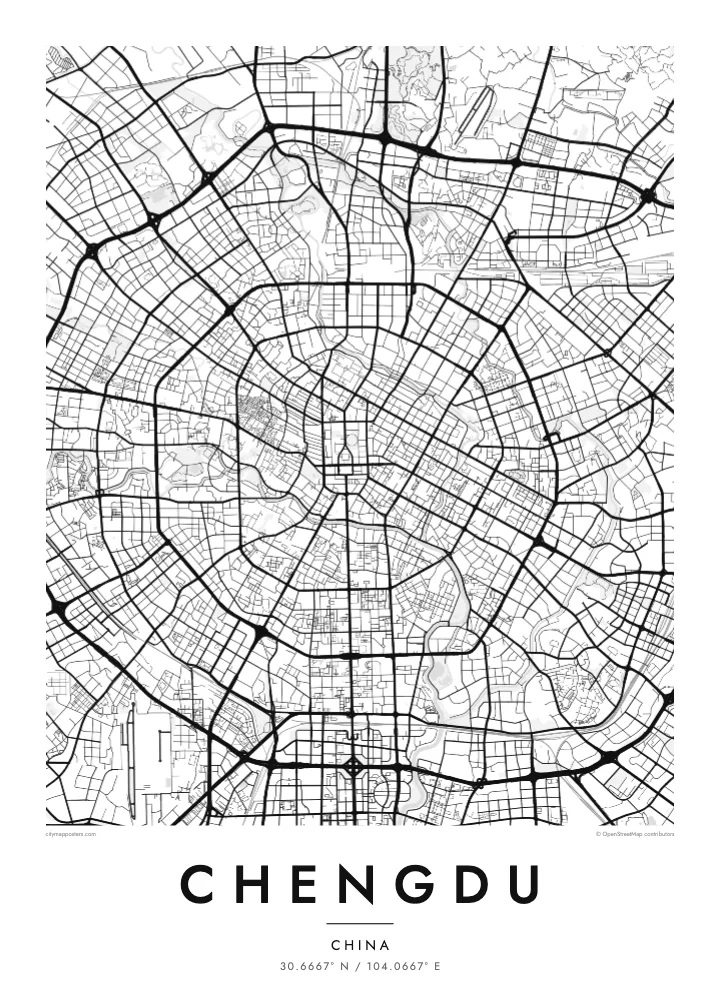
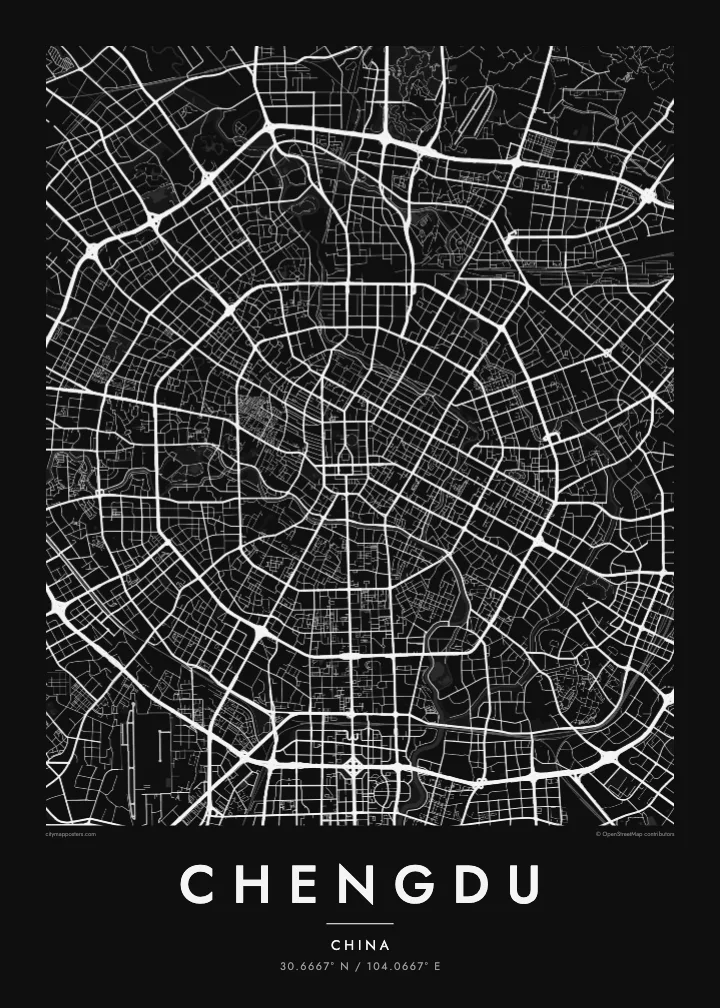
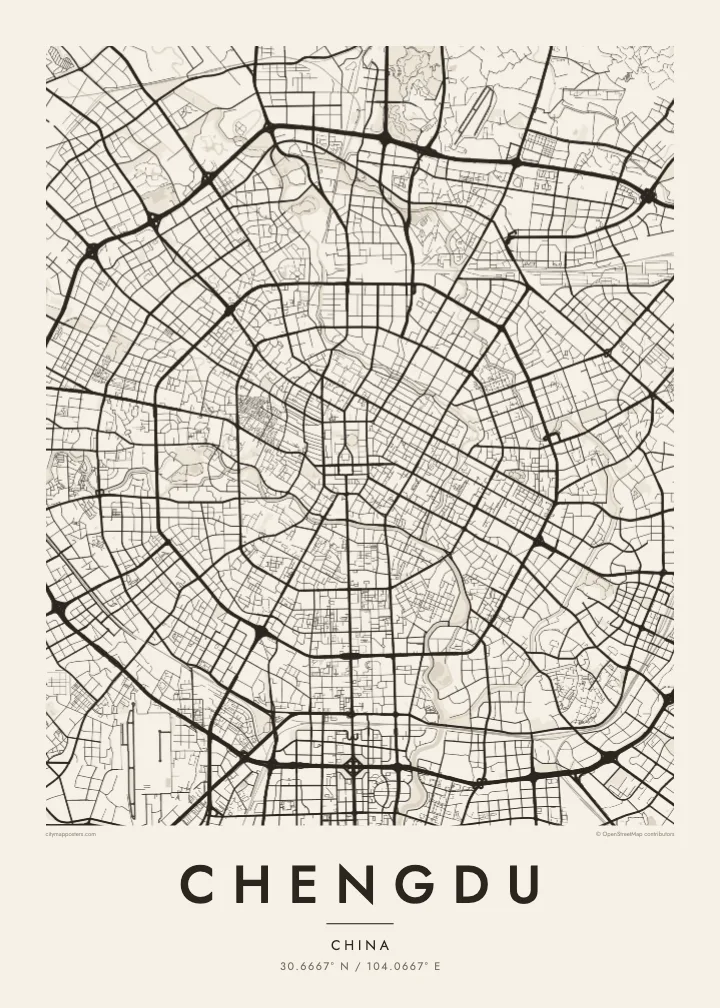
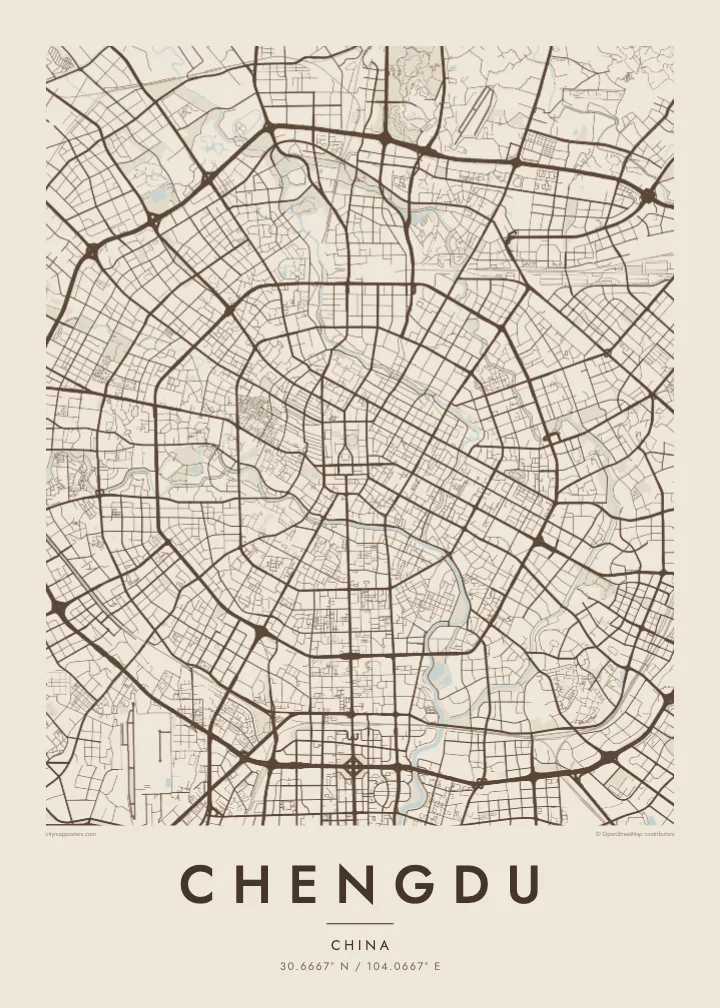
Several ring roads circle the centre at steady intervals, giving Chengdu one of the most legible layouts of any large city and a strong, almost geometric outline.
Fakatino mape mukamuka · China
30.6667° N / 104.0667° E
A flat plain city drawn in concentric rings, its old centre wrapped by two rivers and radiating roads

Taha e taone, lima e onoonoaga
Tapaki e taha puhala ke kitia ai ki luga he puipui. Kua tatai e totogi he tau puhala oti — pete he lolomi, poloka, po ke faila HD.
 Tau pikselo mooli · faila lolomi 24 × 36″
Maama mitaki ke lolomi
Ko e 100% e fahi mooli mai he faila lolomi. Ko e tau poster oti — pete kua lolomi, poloka, po ke utu hifo — kua taute ke he ha mautolu a tau tokoluga (server) ke he 300 DPI, hokotia ke he 7,200 × 10,800 piksela, ke maeke ai e tau ala ikiiki tote ke maaliali fakamitaki he lolomi 24 × 36″.
He Pā


Ko e mape
Chengdu sits on a wide, level plain in western Sichuan, and without hills to bend it the city has grown outward in rings. Seen from above, it looks almost like a target: a dense centre around Tianfu Square, then a series of ring roads, numbered from the First Ring outward, each circle wider than the last, with major avenues radiating from the middle like spokes.
Water frames the heart of the city. The Fu and Nan rivers, together often called the Jin River, curve around the old centre, enclosing the area where the historic walled city once stood. Within that loop the streets are finer and closer together, including the preserved lanes of Kuanzhai Xiangzi, while the newer districts beyond show larger blocks and broader roads.
A Chengdu map poster captures this unusually clear structure. The rings and rivers give it a calm, balanced composition, and the growth to the south toward Tianfu New Area stretches the pattern into a longer shape. To the north lies the well-known Giant Panda Breeding Research Base, one of the reasons many visitors first come to the city.
Several ring roads circle the centre at steady intervals, giving Chengdu one of the most legible layouts of any large city and a strong, almost geometric outline.
The Fu and Nan rivers wrap around the historic core, drawing a soft oval of water around the densest part of the map before joining to the southeast.
A long avenue runs south from Tianfu Square through the rings toward the newer districts, forming a clear central line that anchors the whole composition.
Taute ke ha hau
Lafi e aho, taha higoa po ke taha kupu haau, hiki e fakatino, lahi po ke tuaga.
Ko e kitiaaga nakai totogi kua tote e maaliali mo e fakamailoga vai. Ko e tau lolomi mo e tau faila HD kua taute ke he 300 DPI, hokotia ke he 7,200 × 10,800 px, nakai fai fakamailoga vai.
Ko e ha Chengdu
Chengdu is a city of teahouses, long meals and slow afternoons, and people often feel attached to it long after they leave. A map poster keeps that connection visible, whether it hangs in a home in the city, recalls a trip to see the pandas or is given to someone from Sichuan.
You can add a title and a meaningful date, and choose one of five styles: Classic black & white, Noir, Paper, Blueprint or Sand. The ring roads and river loop make a clean, balanced design in each of them.
Talaage e poster Chengdu| Lahi he lolomi | Maama | Tau faila |
|---|---|---|
| 30 × 40 cm11.8 × 15.7″ | 3,543 × 4,724 px | PNG · PDF |
| 29.7 × 42 cm (A3)11.7 × 16.5″ | 3,508 × 4,961 px | PNG · PDF |
| 42 × 59.4 cm (A2)16.5 × 23.4″ | 4,961 × 7,016 px | PNG · PDF |
| 45.7 × 61 cm18 × 24″ | 5,400 × 7,200 px | PNG · PDF |
| 50 × 70 cm19.7 × 27.6″ | 5,906 × 8,268 px | PNG · PDF |
| 61 × 91.4 cm24 × 36″ | 7,200 × 10,800 px | PNG · PDF |
Ke fakatatai, ko e fakatino noa kua 900 px e laulahi, fai fakamailoga mo e mo e tau mata komipiuta ni. Ko e tau faila HD kua ato hoko ke he 8× e maama ke he tau faahi takitaha mo e lolomi mitaki he lahi katoa he fakatino.
Fifili e taha puhala i luga he kupega, ti fifili e Poster Lolomi — e lahi mo e, kaeke ke manako ai koe, taha poloka — po ke Tau Faila HD Fakaeletonika. Ko e fakaotiaga totogi ko e taha gahua ni, ti ko e kupega he hau a talaaga ka fakafou fakahaga i mua he fakaotiaga e totogi.
Kua lolomi ai ke he pepa mitaki 200 gsm matte he taha he tau lahi ono, mai he 30 × 40 cm ke hoko ke he 24 × 36″. Kamata e tau poster lolomi mai he $39, kua putoia ai e utaaga.
E. Fifili e poloka akau malolō ke he lanu uli, tea, akau oki mooli, po ke akau pouli. Kua fakalataha mo e sioga malolō nakai malepe ti kua mautali ke tautau. Kamata e tau poster poloka mai he $99, kua putoia ai e utaaga.
Nakai totogi e fakafano ke he motu 60+. Ko e fakatino taha kua lolomi he fenoga lolomi ha mautolu kua tata mo e tau motu 30+, kua hoko mai he tau aho gahua 3–7. Maeke ia koe ke kikite e tuaga mo e fakamuitua he lalo he Haku Tau Fakatonu. Ke he falu motu kua 2–5 e tau tapu, ti ka nakai fakafano a mautolu ki ai, to fakaha he api tupe ia ki mua he totogi.
Fakafano mai e taha ata ki a mautolu he loto he 14 e tau aho tali mai he hokoaga, ti to lolomi foki e mautolu nakai totogi po ke liu atu e totogi ki a koe.
E. He editor i luga he kupega nei, hikihiki e matakupu, e matakupu lalo mo e laini coordinates ke he taha mena kua manako a koe ki ai, ti fifili e puhala mo e lahi. Ko e tau talaaga lolomi, poloka mo e fakaeletonika oti kua fakaaoga tonu e hau a fakatino.
Ma e $9 ka moua e koe e tau faila PNG 300 DPI mo e PDF kua mautali ke lolomi he tau lahi ono oti, nakai fai fakamailoga vai, ke lolomi i fe mena. Nakai maopoopo agaia? Utu hifo fakamua e kitiaaga nakai totogi ne fai fakamailoga vai.
Tata mai
