The Great Pyramid
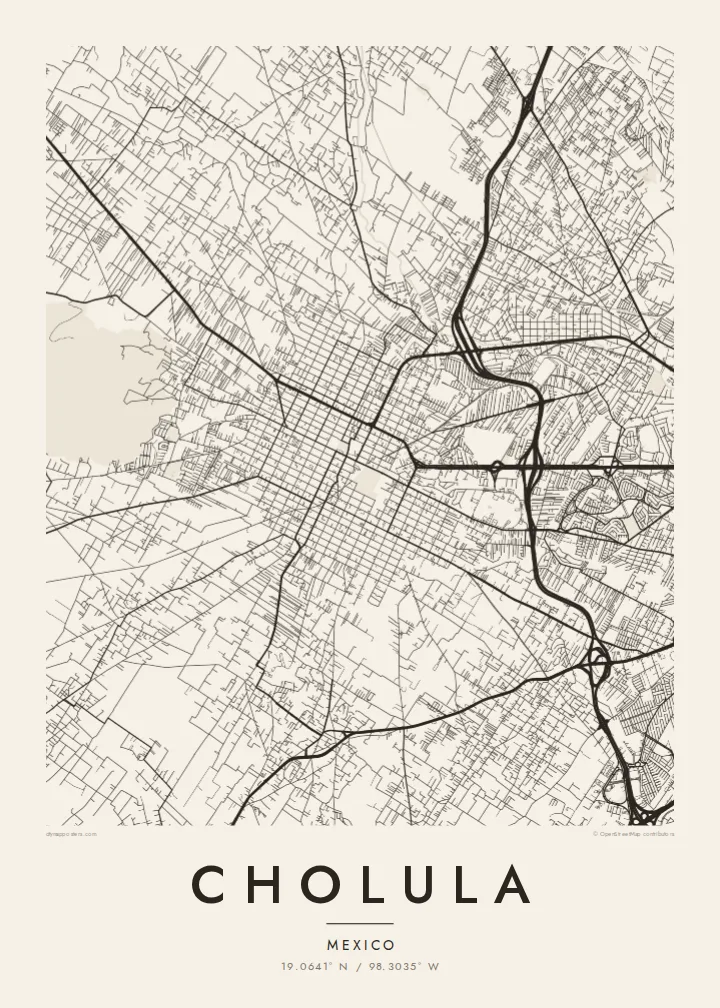
The vast mound fills a large block at the edge of the centre. Its rounded shape breaks the grid and forms the main landmark on the poster.
Fakatino mape mukamuka · Mexico
19.0641° N / 98.3035° W
A colonial grid at the foot of a vast ancient pyramid, with a hilltop church and volcanoes on the horizon.




Taha e taone, lima e onoonoaga
Tapaki e taha puhala ke kitia ai ki luga he puipui. Kua tatai e totogi he tau puhala oti — pete he lolomi, poloka, po ke faila HD.
 Tau pikselo mooli · faila lolomi 24 × 36″
Maama mitaki ke lolomi
Ko e 100% e fahi mooli mai he faila lolomi. Ko e tau poster oti — pete kua lolomi, poloka, po ke utu hifo — kua taute ke he ha mautolu a tau tokoluga (server) ke he 300 DPI, hokotia ke he 7,200 × 10,800 piksela, ke maeke ai e tau ala ikiiki tote ke maaliali fakamitaki he lolomi 24 × 36″.
He Pā


Ko e mape
Cholula lies just west of Puebla on the high plateau of central Mexico. It is one of the oldest continuously inhabited places in the Americas, and its map shows both of its layers. A regular Spanish colonial grid of blocks surrounds a central plaza, and the large, rounded mound of the Great Pyramid rises at its edge.
The Great Pyramid of Cholula, known as Tlachihualtepetl, is the largest pyramid in the world by volume, though from above it looks like a wooded hill. The church of Nuestra Señora de los Remedios stands on its summit, reached by a winding path. The area includes San Pedro Cholula and San Andrés Cholula, each with its own centre.
Cholula is known for its many churches, whose domes rise across the surrounding towns, and for its view of Popocatépetl on clear days. The Universidad de las Américas Puebla has its campus here. A Cholula map poster shows a place where pre-Hispanic and colonial plans overlap, and the pyramid mound still bends the streets around it.
The vast mound fills a large block at the edge of the centre. Its rounded shape breaks the grid and forms the main landmark on the poster.
The streets around the zócalo follow a regular pattern of square blocks, a clear example of Spanish town planning in central Mexico.
San Pedro and San Andrés Cholula meet near the pyramid, each with its own plaza and church. This gives the map two centres within one continuous fabric.
Taute ke ha hau
Lafi e aho, taha higoa po ke taha kupu haau, hiki e fakatino, lahi po ke tuaga.
Ko e kitiaaga nakai totogi kua tote e maaliali mo e fakamailoga vai. Ko e tau lolomi mo e tau faila HD kua taute ke he 300 DPI, hokotia ke he 7,200 × 10,800 px, nakai fai fakamailoga vai.
Ko e ha Cholula
Cholula draws students, travellers and families from Puebla, and the map makes a meaningful keepsake of time spent here: university years, a wedding in one of its churches, or evenings watching the volcano. The pyramid gives the poster a landmark few cities can match.
Change the title and subtitle to mark a name or date, adjust the coordinates line, and choose from five styles, from Classic black & white to Sand. Download the HD files for $9, or order a printed poster on matte paper, framed if you prefer.
Talaage e poster Cholula| Lahi he lolomi | Maama | Tau faila |
|---|---|---|
| 30 × 40 cm11.8 × 15.7″ | 3,543 × 4,724 px | PNG · PDF |
| 29.7 × 42 cm (A3)11.7 × 16.5″ | 3,508 × 4,961 px | PNG · PDF |
| 42 × 59.4 cm (A2)16.5 × 23.4″ | 4,961 × 7,016 px | PNG · PDF |
| 45.7 × 61 cm18 × 24″ | 5,400 × 7,200 px | PNG · PDF |
| 50 × 70 cm19.7 × 27.6″ | 5,906 × 8,268 px | PNG · PDF |
| 61 × 91.4 cm24 × 36″ | 7,200 × 10,800 px | PNG · PDF |
Ke fakatatai, ko e fakatino noa kua 900 px e laulahi, fai fakamailoga mo e mo e tau mata komipiuta ni. Ko e tau faila HD kua ato hoko ke he 8× e maama ke he tau faahi takitaha mo e lolomi mitaki he lahi katoa he fakatino.
Fifili e taha puhala i luga he kupega, ti fifili e Poster Lolomi — e lahi mo e, kaeke ke manako ai koe, taha poloka — po ke Tau Faila HD Fakaeletonika. Ko e fakaotiaga totogi ko e taha gahua ni, ti ko e kupega he hau a talaaga ka fakafou fakahaga i mua he fakaotiaga e totogi.
Kua lolomi ai ke he pepa mitaki 200 gsm matte he taha he tau lahi ono, mai he 30 × 40 cm ke hoko ke he 24 × 36″. Kamata e tau poster lolomi mai he $39, kua putoia ai e utaaga.
E. Fifili e poloka akau malolō ke he lanu uli, tea, akau oki mooli, po ke akau pouli. Kua fakalataha mo e sioga malolō nakai malepe ti kua mautali ke tautau. Kamata e tau poster poloka mai he $99, kua putoia ai e utaaga.
Nakai totogi e fakafano ke he motu 60+. Ko e fakatino taha kua lolomi he fenoga lolomi ha mautolu kua tata mo e tau motu 30+, kua hoko mai he tau aho gahua 3–7. Maeke ia koe ke kikite e tuaga mo e fakamuitua he lalo he Haku Tau Fakatonu. Ke he falu motu kua 2–5 e tau tapu, ti ka nakai fakafano a mautolu ki ai, to fakaha he api tupe ia ki mua he totogi.
Fakafano mai e taha ata ki a mautolu he loto he 14 e tau aho tali mai he hokoaga, ti to lolomi foki e mautolu nakai totogi po ke liu atu e totogi ki a koe.
E. He editor i luga he kupega nei, hikihiki e matakupu, e matakupu lalo mo e laini coordinates ke he taha mena kua manako a koe ki ai, ti fifili e puhala mo e lahi. Ko e tau talaaga lolomi, poloka mo e fakaeletonika oti kua fakaaoga tonu e hau a fakatino.
Ma e $9 ka moua e koe e tau faila PNG 300 DPI mo e PDF kua mautali ke lolomi he tau lahi ono oti, nakai fai fakamailoga vai, ke lolomi i fe mena. Nakai maopoopo agaia? Utu hifo fakamua e kitiaaga nakai totogi ne fai fakamailoga vai.
