Streets over hills
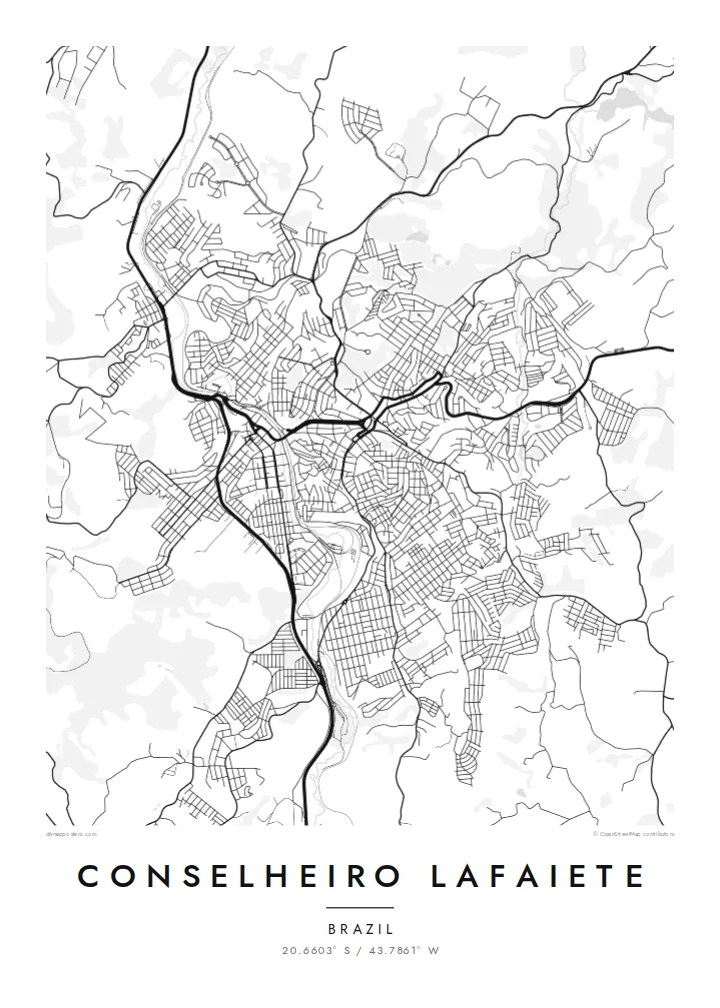
Roads bend with the contours instead of crossing them, producing a web of curves and short dead ends that reads almost like the veins of a leaf.
Fakatino mape mukamuka · Brazil
20.6603° S / 43.7861° W
A hilly Minas Gerais city whose streets curve and fold around valleys on the route between Belo Horizonte and Rio.
Taha e taone, lima e onoonoaga
Tapaki e taha puhala ke kitia ai ki luga he puipui. Kua tatai e totogi he tau puhala oti — pete he lolomi, poloka, po ke faila HD.
 Tau pikselo mooli · faila lolomi 24 × 36″
Maama mitaki ke lolomi
Ko e 100% e fahi mooli mai he faila lolomi. Ko e tau poster oti — pete kua lolomi, poloka, po ke utu hifo — kua taute ke he ha mautolu a tau tokoluga (server) ke he 300 DPI, hokotia ke he 7,200 × 10,800 piksela, ke maeke ai e tau ala ikiiki tote ke maaliali fakamitaki he lolomi 24 × 36″.
He Pā


Ko e mape
Conselheiro Lafaiete sits in the highlands of Minas Gerais, south of Belo Horizonte, along the corridor that leads toward Rio de Janeiro. The terrain is uneven, and the street plan shows it: roads curve along ridges and dip into valleys rather than holding to a straight grid. Seen from above, the city looks like a network of branches spreading over the hills.
The town was long known as Queluz and later took the name of Lafayette Rodrigues Pereira, a nineteenth-century jurist and statesman born there; Conselheiro refers to his title as a counsellor of the Empire. The surrounding region has a long mining history, and railway lines still trace the lower ground through town, adding long curves to the plan.
A Conselheiro Lafaiete map poster turns that uneven ground into a dense, organic drawing. There is no single axis to follow; instead the eye moves along winding streets that meet at irregular junctions, with neighbourhoods clustered wherever the land allowed them to settle. It is a good example of how topography writes itself into a city plan.
Roads bend with the contours instead of crossing them, producing a web of curves and short dead ends that reads almost like the veins of a leaf.
Rail lines keep to the lower, flatter ground, giving the map a few long and steady curves among the more restless street pattern.
The main road between Belo Horizonte and Rio passes the city, a straighter line at the edge of the composition that sets off the organic centre.
Taute ke ha hau
Lafi e aho, taha higoa po ke taha kupu haau, hiki e fakatino, lahi po ke tuaga.
Ko e kitiaaga nakai totogi kua tote e maaliali mo e fakamailoga vai. Ko e tau lolomi mo e tau faila HD kua taute ke he 300 DPI, hokotia ke he 7,200 × 10,800 px, nakai fai fakamailoga vai.
Ko e ha Conselheiro Lafaiete
Many who hang this map know Lafaiete through family, or passed through on the way between Minas and Rio and stayed. The drawing reflects what it feels like to walk there: always a slope, always a turn, and a view opening wherever a street reaches a ridge.
Add a title such as the old name Queluz, a date, or a family surname, and adjust the coordinates line underneath. Pick one of five styles: Classic black & white, Noir, Paper, Blueprint or Sand. The digital files cover six print sizes, each as a 300 DPI PNG and PDF.
Talaage e poster Conselheiro Lafaiete| Lahi he lolomi | Maama | Tau faila |
|---|---|---|
| 30 × 40 cm11.8 × 15.7″ | 3,543 × 4,724 px | PNG · PDF |
| 29.7 × 42 cm (A3)11.7 × 16.5″ | 3,508 × 4,961 px | PNG · PDF |
| 42 × 59.4 cm (A2)16.5 × 23.4″ | 4,961 × 7,016 px | PNG · PDF |
| 45.7 × 61 cm18 × 24″ | 5,400 × 7,200 px | PNG · PDF |
| 50 × 70 cm19.7 × 27.6″ | 5,906 × 8,268 px | PNG · PDF |
| 61 × 91.4 cm24 × 36″ | 7,200 × 10,800 px | PNG · PDF |
Ke fakatatai, ko e fakatino noa kua 900 px e laulahi, fai fakamailoga mo e mo e tau mata komipiuta ni. Ko e tau faila HD kua ato hoko ke he 8× e maama ke he tau faahi takitaha mo e lolomi mitaki he lahi katoa he fakatino.
Fifili e taha puhala i luga he kupega, ti fifili e Poster Lolomi — e lahi mo e, kaeke ke manako ai koe, taha poloka — po ke Tau Faila HD Fakaeletonika. Ko e fakaotiaga totogi ko e taha gahua ni, ti ko e kupega he hau a talaaga ka fakafou fakahaga i mua he fakaotiaga e totogi.
Kua lolomi ai ke he pepa mitaki 200 gsm matte he taha he tau lahi ono, mai he 30 × 40 cm ke hoko ke he 24 × 36″. Kamata e tau poster lolomi mai he $39, kua putoia ai e utaaga.
E. Fifili e poloka akau malolō ke he lanu uli, tea, akau oki mooli, po ke akau pouli. Kua fakalataha mo e sioga malolō nakai malepe ti kua mautali ke tautau. Kamata e tau poster poloka mai he $99, kua putoia ai e utaaga.
Nakai totogi e fakafano ke he motu 60+. Ko e fakatino taha kua lolomi he fenoga lolomi ha mautolu kua tata mo e tau motu 30+, kua hoko mai he tau aho gahua 3–7. Maeke ia koe ke kikite e tuaga mo e fakamuitua he lalo he Haku Tau Fakatonu. Ke he falu motu kua 2–5 e tau tapu, ti ka nakai fakafano a mautolu ki ai, to fakaha he api tupe ia ki mua he totogi.
Fakafano mai e taha ata ki a mautolu he loto he 14 e tau aho tali mai he hokoaga, ti to lolomi foki e mautolu nakai totogi po ke liu atu e totogi ki a koe.
E. He editor i luga he kupega nei, hikihiki e matakupu, e matakupu lalo mo e laini coordinates ke he taha mena kua manako a koe ki ai, ti fifili e puhala mo e lahi. Ko e tau talaaga lolomi, poloka mo e fakaeletonika oti kua fakaaoga tonu e hau a fakatino.
Ma e $9 ka moua e koe e tau faila PNG 300 DPI mo e PDF kua mautali ke lolomi he tau lahi ono oti, nakai fai fakamailoga vai, ke lolomi i fe mena. Nakai maopoopo agaia? Utu hifo fakamua e kitiaaga nakai totogi ne fai fakamailoga vai.
Tata mai
