River confluence
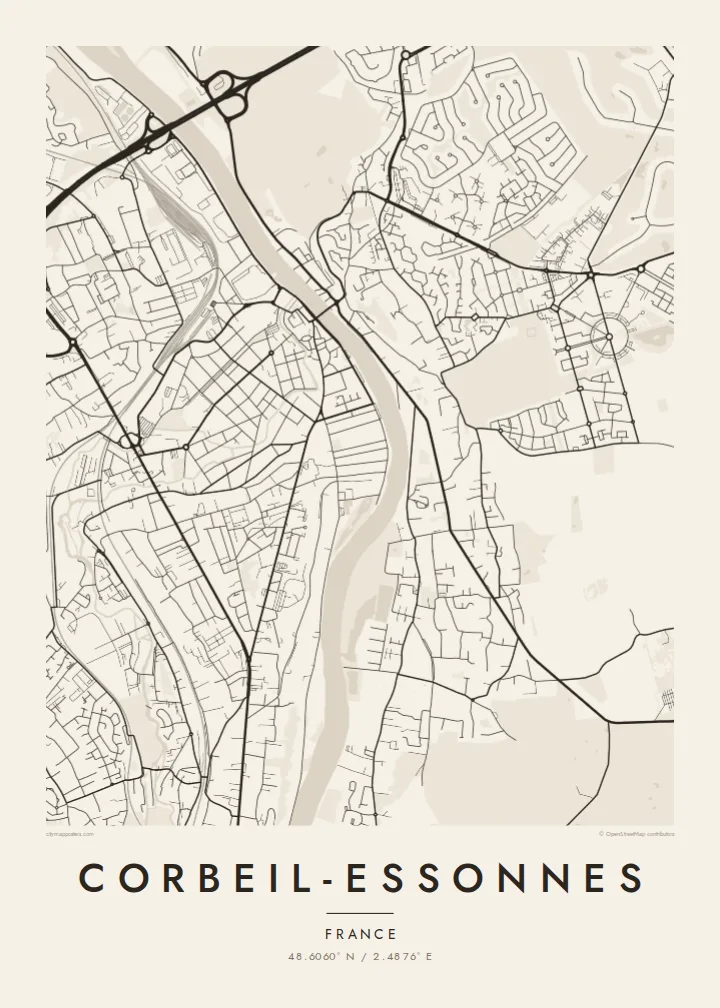
The Essonne joins the Seine near the town centre, where the two rivers form a clear meeting point. This is the natural heart of the composition and the reason the town exists.
Fakatino mape mukamuka · France
48.6060° N / 2.4876° E
A town at the confluence of the Essonne and the Seine, where old mills, bridges and a medieval church mark the riverbanks.



Taha e taone, lima e onoonoaga
Tapaki e taha puhala ke kitia ai ki luga he puipui. Kua tatai e totogi he tau puhala oti — pete he lolomi, poloka, po ke faila HD.
 Tau pikselo mooli · faila lolomi 24 × 36″
Maama mitaki ke lolomi
Ko e 100% e fahi mooli mai he faila lolomi. Ko e tau poster oti — pete kua lolomi, poloka, po ke utu hifo — kua taute ke he ha mautolu a tau tokoluga (server) ke he 300 DPI, hokotia ke he 7,200 × 10,800 piksela, ke maeke ai e tau ala ikiiki tote ke maaliali fakamitaki he lolomi 24 × 36″.
He Pā


Ko e mape
Corbeil-Essonnes lies south of Paris in the Essonne department, where the Essonne river flows into the Seine. The town was formed in 1951 by merging two communes, Corbeil and Essonnes, and on the map that double origin is still visible. The two rivers meet near the centre, and the streets of the old quarters gather on both sides of the confluence.
Water has shaped the town for centuries. The Seine and the Essonne powered mills here, and the Grands Moulins de Corbeil, a major flour-milling complex on the Seine, remain a landmark. The church of Saint-Spire, with its medieval tower, stands in the historic centre. Bridges link the two banks of the Seine, and the railway follows the river valley toward Paris.
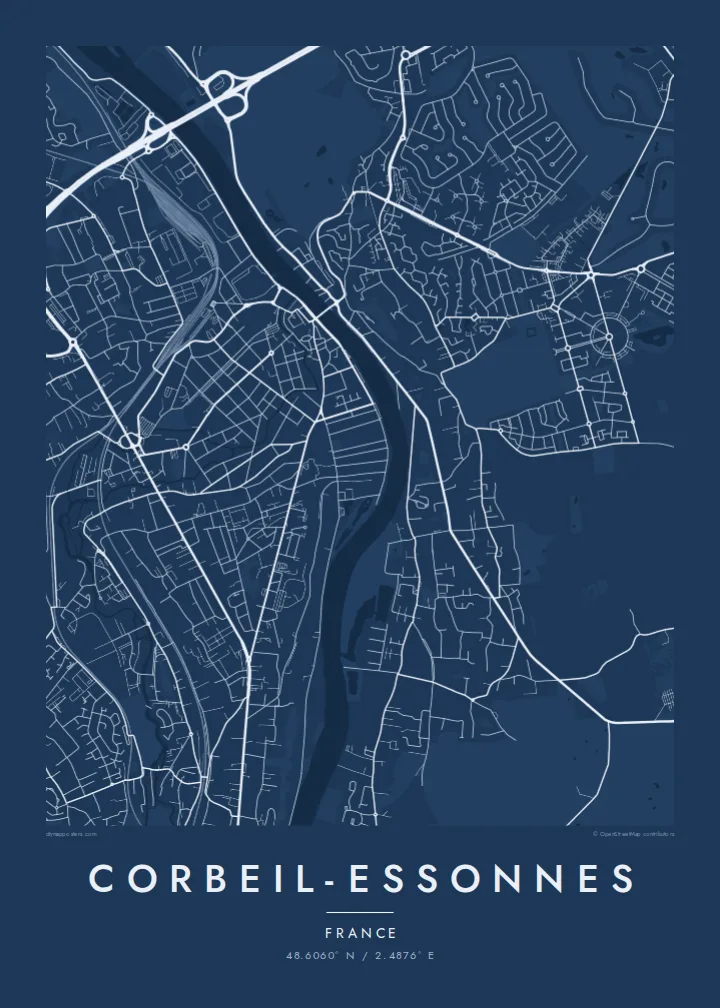
A Corbeil-Essonnes map poster centres on that meeting of rivers. The broad curve of the Seine and the narrower, winding Essonne divide the town into distinct parts, while bridges, rail lines and roads stitch them back together. In black and white the rivers become strong, flowing shapes, giving the poster a clear structure and a sense of place rooted in water.
The Essonne joins the Seine near the town centre, where the two rivers form a clear meeting point. This is the natural heart of the composition and the reason the town exists.
The Seine sweeps through the town, lined with the industrial buildings of the Grands Moulins. Bridges cross it at intervals, adding sharp lines to its broad curve.
The historic quarters of the two former communes sit on either side of the rivers, their narrow, irregular streets forming the densest part of the map.
Taute ke ha hau
Lafi e aho, taha higoa po ke taha kupu haau, hiki e fakatino, lahi po ke tuaga.
Ko e kitiaaga nakai totogi kua tote e maaliali mo e fakamailoga vai. Ko e tau lolomi mo e tau faila HD kua taute ke he 300 DPI, hokotia ke he 7,200 × 10,800 px, nakai fai fakamailoga vai.
Ko e ha Corbeil-Essonnes
Corbeil-Essonnes suits people who grew up along its riverbanks, commute from its station or have family roots in the Essonne. The confluence gives the map an unusually strong shape, an image that feels both personal and well composed on the wall.
Personalise the title, subtitle and coordinates, perhaps with a quarter or a date, and choose from Classic black & white, Noir, Paper, Blueprint or Sand. HD files are $9 in six sizes, including 30×40 and 50×70 cm. Printed matte posters are shipped by partners in more than 30 countries.
Talaage e poster Corbeil-Essonnes| Lahi he lolomi | Maama | Tau faila |
|---|---|---|
| 30 × 40 cm11.8 × 15.7″ | 3,543 × 4,724 px | PNG · PDF |
| 29.7 × 42 cm (A3)11.7 × 16.5″ | 3,508 × 4,961 px | PNG · PDF |
| 42 × 59.4 cm (A2)16.5 × 23.4″ | 4,961 × 7,016 px | PNG · PDF |
| 45.7 × 61 cm18 × 24″ | 5,400 × 7,200 px | PNG · PDF |
| 50 × 70 cm19.7 × 27.6″ | 5,906 × 8,268 px | PNG · PDF |
| 61 × 91.4 cm24 × 36″ | 7,200 × 10,800 px | PNG · PDF |
Ke fakatatai, ko e fakatino noa kua 900 px e laulahi, fai fakamailoga mo e mo e tau mata komipiuta ni. Ko e tau faila HD kua ato hoko ke he 8× e maama ke he tau faahi takitaha mo e lolomi mitaki he lahi katoa he fakatino.
Fifili e taha puhala i luga he kupega, ti fifili e Poster Lolomi — e lahi mo e, kaeke ke manako ai koe, taha poloka — po ke Tau Faila HD Fakaeletonika. Ko e fakaotiaga totogi ko e taha gahua ni, ti ko e kupega he hau a talaaga ka fakafou fakahaga i mua he fakaotiaga e totogi.
Kua lolomi ai ke he pepa mitaki 200 gsm matte he taha he tau lahi ono, mai he 30 × 40 cm ke hoko ke he 24 × 36″. Kamata e tau poster lolomi mai he $39, kua putoia ai e utaaga.
E. Fifili e poloka akau malolō ke he lanu uli, tea, akau oki mooli, po ke akau pouli. Kua fakalataha mo e sioga malolō nakai malepe ti kua mautali ke tautau. Kamata e tau poster poloka mai he $99, kua putoia ai e utaaga.
Nakai totogi e fakafano ke he motu 60+. Ko e fakatino taha kua lolomi he fenoga lolomi ha mautolu kua tata mo e tau motu 30+, kua hoko mai he tau aho gahua 3–7. Maeke ia koe ke kikite e tuaga mo e fakamuitua he lalo he Haku Tau Fakatonu. Ke he falu motu kua 2–5 e tau tapu, ti ka nakai fakafano a mautolu ki ai, to fakaha he api tupe ia ki mua he totogi.
Fakafano mai e taha ata ki a mautolu he loto he 14 e tau aho tali mai he hokoaga, ti to lolomi foki e mautolu nakai totogi po ke liu atu e totogi ki a koe.
E. He editor i luga he kupega nei, hikihiki e matakupu, e matakupu lalo mo e laini coordinates ke he taha mena kua manako a koe ki ai, ti fifili e puhala mo e lahi. Ko e tau talaaga lolomi, poloka mo e fakaeletonika oti kua fakaaoga tonu e hau a fakatino.
Ma e $9 ka moua e koe e tau faila PNG 300 DPI mo e PDF kua mautali ke lolomi he tau lahi ono oti, nakai fai fakamailoga vai, ke lolomi i fe mena. Nakai maopoopo agaia? Utu hifo fakamua e kitiaaga nakai totogi ne fai fakamailoga vai.
Tata mai
