Mennonite campos
Numbered farm villages laid out along straight roads, each a line of farmsteads with long fields behind. They repeat across the plain in a strikingly regular pattern.
Fakatino mape mukamuka · Mexico
28.4063° N / 106.8667° W
A high-plains city in Chihuahua, ringed by apple orchards and the long ruled fields of the Mennonite farm colonies.


Taha e taone, lima e onoonoaga
Tapaki e taha puhala ke kitia ai ki luga he puipui. Kua tatai e totogi he tau puhala oti — pete he lolomi, poloka, po ke faila HD.
 Tau pikselo mooli · faila lolomi 24 × 36″
Maama mitaki ke lolomi
Ko e 100% e fahi mooli mai he faila lolomi. Ko e tau poster oti — pete kua lolomi, poloka, po ke utu hifo — kua taute ke he ha mautolu a tau tokoluga (server) ke he 300 DPI, hokotia ke he 7,200 × 10,800 piksela, ke maeke ai e tau ala ikiiki tote ke maaliali fakamitaki he lolomi 24 × 36″.
He Pā


Ko e mape
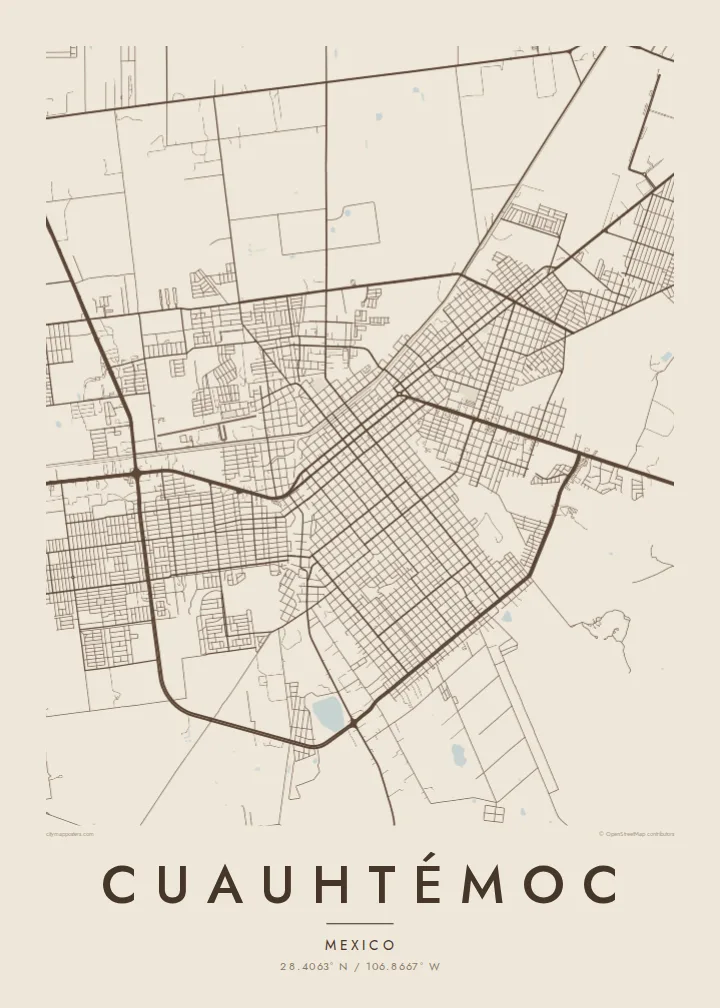
Cuauhtémoc stands in a broad valley in the high country of western Chihuahua, at the edge of the Sierra Madre Occidental. The city itself is a mostly rectilinear grid spreading from a central core, with a railway line and highways running through it. Beyond its edges the landscape turns into one of the most distinctive farm patterns in Mexico.
In the early 1920s Mennonite families arrived from Canada and settled the lands around the town. They organised them into numbered farming villages called campos. Seen from above, these are long straight roads lined with farmsteads, set in orderly strips of fields. The highway leading out of the city toward the campos, known as the Mennonite commercial corridor, is lined with their shops and workshops.
The valley is one of Mexico's most important apple-growing areas, and orchards appear as finely dotted blocks across the valley floor. A Cuauhtémoc map poster brings these layers together. It shows the city grid, the rail line, and the surrounding pattern of villages and orchards that makes this corner of Chihuahua recognisable on any map.
Numbered farm villages laid out along straight roads, each a line of farmsteads with long fields behind. They repeat across the plain in a strikingly regular pattern.
A long stretch of highway outside the city lined with Mennonite-run businesses and workshops. It forms a single strong line connecting the town to the campos around it.
The Chihuahua al Pacífico railway crosses the city on its way toward the Copper Canyon region, a clean line cutting across the street grid.
Taute ke ha hau
Lafi e aho, taha higoa po ke taha kupu haau, hiki e fakatino, lahi po ke tuaga.
Ko e kitiaaga nakai totogi kua tote e maaliali mo e fakamailoga vai. Ko e tau lolomi mo e tau faila HD kua taute ke he 300 DPI, hokotia ke he 7,200 × 10,800 px, nakai fai fakamailoga vai.
Ko e ha Cuauhtémoc
This map has an unusual story in its lines, with a Mexican city and a century-old farming colony side by side. It makes a thoughtful gift for families from the region, with a surname, a campo number or an anniversary written into the title.
Pick Sand for the dry high-plains palette, Blueprint to emphasise the grid, or Classic, Noir or Paper. The digital download costs $9 and includes six print sizes without a watermark. You can also order a matte poster with an optional wooden frame.
Talaage e poster Cuauhtémoc| Lahi he lolomi | Maama | Tau faila |
|---|---|---|
| 30 × 40 cm11.8 × 15.7″ | 3,543 × 4,724 px | PNG · PDF |
| 29.7 × 42 cm (A3)11.7 × 16.5″ | 3,508 × 4,961 px | PNG · PDF |
| 42 × 59.4 cm (A2)16.5 × 23.4″ | 4,961 × 7,016 px | PNG · PDF |
| 45.7 × 61 cm18 × 24″ | 5,400 × 7,200 px | PNG · PDF |
| 50 × 70 cm19.7 × 27.6″ | 5,906 × 8,268 px | PNG · PDF |
| 61 × 91.4 cm24 × 36″ | 7,200 × 10,800 px | PNG · PDF |
Ke fakatatai, ko e fakatino noa kua 900 px e laulahi, fai fakamailoga mo e mo e tau mata komipiuta ni. Ko e tau faila HD kua ato hoko ke he 8× e maama ke he tau faahi takitaha mo e lolomi mitaki he lahi katoa he fakatino.
Fifili e taha puhala i luga he kupega, ti fifili e Poster Lolomi — e lahi mo e, kaeke ke manako ai koe, taha poloka — po ke Tau Faila HD Fakaeletonika. Ko e fakaotiaga totogi ko e taha gahua ni, ti ko e kupega he hau a talaaga ka fakafou fakahaga i mua he fakaotiaga e totogi.
Kua lolomi ai ke he pepa mitaki 200 gsm matte he taha he tau lahi ono, mai he 30 × 40 cm ke hoko ke he 24 × 36″. Kamata e tau poster lolomi mai he $39, kua putoia ai e utaaga.
E. Fifili e poloka akau malolō ke he lanu uli, tea, akau oki mooli, po ke akau pouli. Kua fakalataha mo e sioga malolō nakai malepe ti kua mautali ke tautau. Kamata e tau poster poloka mai he $99, kua putoia ai e utaaga.
Nakai totogi e fakafano ke he motu 60+. Ko e fakatino taha kua lolomi he fenoga lolomi ha mautolu kua tata mo e tau motu 30+, kua hoko mai he tau aho gahua 3–7. Maeke ia koe ke kikite e tuaga mo e fakamuitua he lalo he Haku Tau Fakatonu. Ke he falu motu kua 2–5 e tau tapu, ti ka nakai fakafano a mautolu ki ai, to fakaha he api tupe ia ki mua he totogi.
Fakafano mai e taha ata ki a mautolu he loto he 14 e tau aho tali mai he hokoaga, ti to lolomi foki e mautolu nakai totogi po ke liu atu e totogi ki a koe.
E. He editor i luga he kupega nei, hikihiki e matakupu, e matakupu lalo mo e laini coordinates ke he taha mena kua manako a koe ki ai, ti fifili e puhala mo e lahi. Ko e tau talaaga lolomi, poloka mo e fakaeletonika oti kua fakaaoga tonu e hau a fakatino.
Ma e $9 ka moua e koe e tau faila PNG 300 DPI mo e PDF kua mautali ke lolomi he tau lahi ono oti, nakai fai fakamailoga vai, ke lolomi i fe mena. Nakai maopoopo agaia? Utu hifo fakamua e kitiaaga nakai totogi ne fai fakamailoga vai.
Tata mai
