São Francisco riverbank
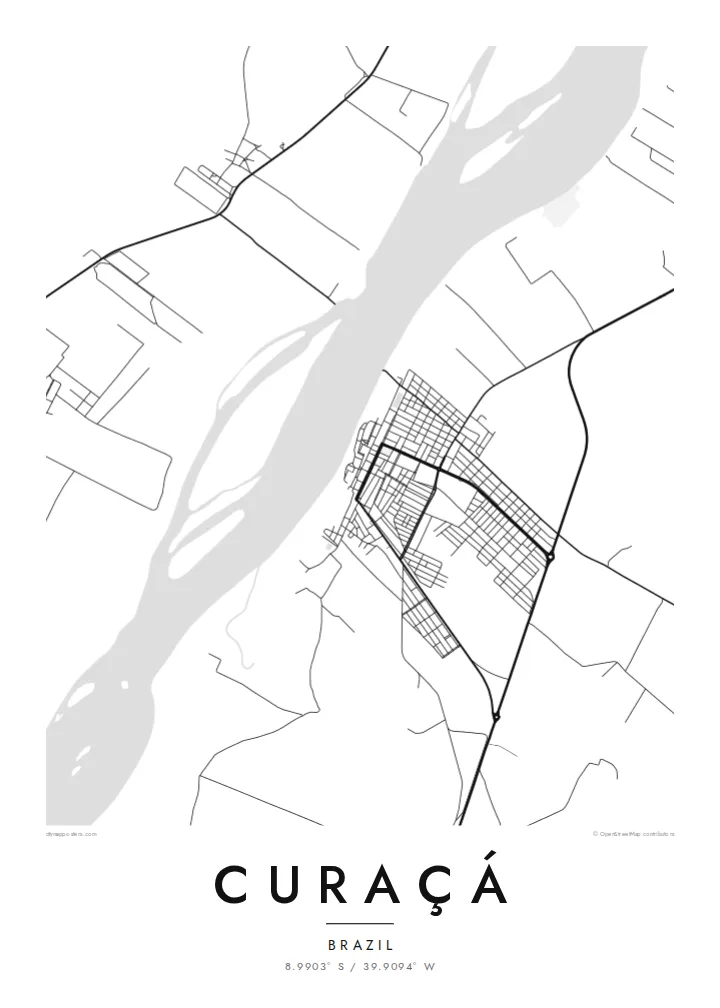
The town lines up along the São Francisco, one of Brazil's longest rivers. On the poster the water forms a broad band that frames the streets and gives the composition its main direction.
Fakatino mape mukamuka · Brazil
8.9903° S / 39.9094° W
A compact river town on the São Francisco, its short grid laid against a wide bend of water and open dry country


Taha e taone, lima e onoonoaga
Tapaki e taha puhala ke kitia ai ki luga he puipui. Kua tatai e totogi he tau puhala oti — pete he lolomi, poloka, po ke faila HD.
 Tau pikselo mooli · faila lolomi 24 × 36″
Maama mitaki ke lolomi
Ko e 100% e fahi mooli mai he faila lolomi. Ko e tau poster oti — pete kua lolomi, poloka, po ke utu hifo — kua taute ke he ha mautolu a tau tokoluga (server) ke he 300 DPI, hokotia ke he 7,200 × 10,800 piksela, ke maeke ai e tau ala ikiiki tote ke maaliali fakamitaki he lolomi 24 × 36″.
He Pā


Ko e mape
Curaçá sits on the bank of the São Francisco River in northern Bahia, deep in the semi-arid sertão. From above, the town is small and clearly bounded: a modest grid of streets pressed against the riverbank, with the broad, pale band of water on one side and thinly settled land stretching away on the other. The contrast between dense blocks and empty country gives the map an unusually clean edge.
The municipality is best known beyond Brazil for the Spix's macaw, a small blue parrot whose last wild population lived in the caatinga woodland around Curaçá. After years of being considered extinct in the wild, birds bred in captivity were released back into this landscape, and the name of the town is now closely tied to that conservation effort.
A Curaçá map poster reduces all of this to line and space. The river becomes a heavy, flowing shape, the town a tight cluster of rectangles, and the surrounding caatinga a quiet field of scattered tracks and field boundaries. It is a map about the relationship between a settlement and the single great river that makes life in dry country possible.
The town lines up along the São Francisco, one of Brazil's longest rivers. On the poster the water forms a broad band that frames the streets and gives the composition its main direction.
Curaçá's centre is a small, regular grid of blocks. Its compact size means the whole urban area fits comfortably on a single print with room left for the river and surrounding land.
Beyond the last streets, the map thins into sparse roads and tracks crossing dry scrubland. This emptiness is part of the picture and makes the dense town centre stand out clearly.
Taute ke ha hau
Lafi e aho, taha higoa po ke taha kupu haau, hiki e fakatino, lahi po ke tuaga.
Ko e kitiaaga nakai totogi kua tote e maaliali mo e fakamailoga vai. Ko e tau lolomi mo e tau faila HD kua taute ke he 300 DPI, hokotia ke he 7,200 × 10,800 px, nakai fai fakamailoga vai.
Ko e ha Curaçá
People hang a map of Curaçá because it holds a very particular landscape: a river town in the sertão, linked to one of Brazil's most closely watched conservation stories. For anyone from the town or with family along the São Francisco, it is a recognisable outline of home rather than a generic view.
The title, subtitle and coordinates line can be changed, so the print might carry a family name or a year of arrival. Choose from Classic black & white, Noir, Paper, Blueprint or Sand, and order either the $9 HD files for home printing or a printed matte poster with an optional wooden frame.
Talaage e poster Curaçá| Lahi he lolomi | Maama | Tau faila |
|---|---|---|
| 30 × 40 cm11.8 × 15.7″ | 3,543 × 4,724 px | PNG · PDF |
| 29.7 × 42 cm (A3)11.7 × 16.5″ | 3,508 × 4,961 px | PNG · PDF |
| 42 × 59.4 cm (A2)16.5 × 23.4″ | 4,961 × 7,016 px | PNG · PDF |
| 45.7 × 61 cm18 × 24″ | 5,400 × 7,200 px | PNG · PDF |
| 50 × 70 cm19.7 × 27.6″ | 5,906 × 8,268 px | PNG · PDF |
| 61 × 91.4 cm24 × 36″ | 7,200 × 10,800 px | PNG · PDF |
Ke fakatatai, ko e fakatino noa kua 900 px e laulahi, fai fakamailoga mo e mo e tau mata komipiuta ni. Ko e tau faila HD kua ato hoko ke he 8× e maama ke he tau faahi takitaha mo e lolomi mitaki he lahi katoa he fakatino.
Fifili e taha puhala i luga he kupega, ti fifili e Poster Lolomi — e lahi mo e, kaeke ke manako ai koe, taha poloka — po ke Tau Faila HD Fakaeletonika. Ko e fakaotiaga totogi ko e taha gahua ni, ti ko e kupega he hau a talaaga ka fakafou fakahaga i mua he fakaotiaga e totogi.
Kua lolomi ai ke he pepa mitaki 200 gsm matte he taha he tau lahi ono, mai he 30 × 40 cm ke hoko ke he 24 × 36″. Kamata e tau poster lolomi mai he $39, kua putoia ai e utaaga.
E. Fifili e poloka akau malolō ke he lanu uli, tea, akau oki mooli, po ke akau pouli. Kua fakalataha mo e sioga malolō nakai malepe ti kua mautali ke tautau. Kamata e tau poster poloka mai he $99, kua putoia ai e utaaga.
Nakai totogi e fakafano ke he motu 60+. Ko e fakatino taha kua lolomi he fenoga lolomi ha mautolu kua tata mo e tau motu 30+, kua hoko mai he tau aho gahua 3–7. Maeke ia koe ke kikite e tuaga mo e fakamuitua he lalo he Haku Tau Fakatonu. Ke he falu motu kua 2–5 e tau tapu, ti ka nakai fakafano a mautolu ki ai, to fakaha he api tupe ia ki mua he totogi.
Fakafano mai e taha ata ki a mautolu he loto he 14 e tau aho tali mai he hokoaga, ti to lolomi foki e mautolu nakai totogi po ke liu atu e totogi ki a koe.
E. He editor i luga he kupega nei, hikihiki e matakupu, e matakupu lalo mo e laini coordinates ke he taha mena kua manako a koe ki ai, ti fifili e puhala mo e lahi. Ko e tau talaaga lolomi, poloka mo e fakaeletonika oti kua fakaaoga tonu e hau a fakatino.
Ma e $9 ka moua e koe e tau faila PNG 300 DPI mo e PDF kua mautali ke lolomi he tau lahi ono oti, nakai fai fakamailoga vai, ke lolomi i fe mena. Nakai maopoopo agaia? Utu hifo fakamua e kitiaaga nakai totogi ne fai fakamailoga vai.
