Basalt city walls
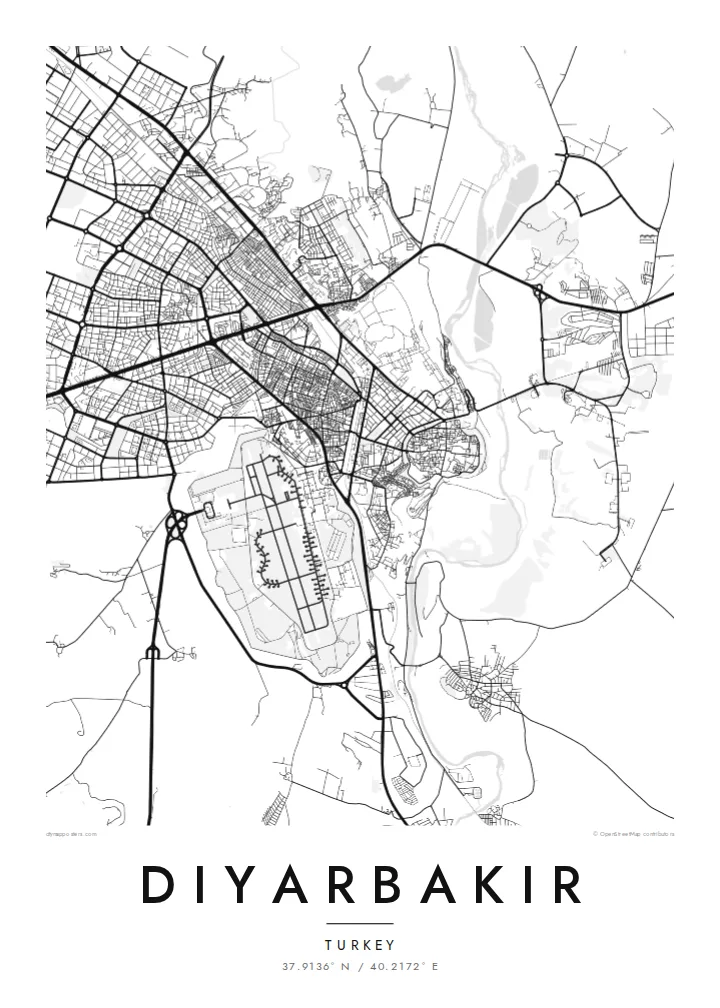
The ring of walls around Sur creates a strong, closed outline on the poster, separating the dense old town from the wide districts built beyond it.
Fakatino mape mukamuka · Türkiye
37.9136° N / 40.2172° E
An old walled city of dark basalt on a bluff above the Tigris, with gardens spread along the river below.


Taha e taone, lima e onoonoaga
Tapaki e taha puhala ke kitia ai ki luga he puipui. Kua tatai e totogi he tau puhala oti — pete he lolomi, poloka, po ke faila HD.
 Tau pikselo mooli · faila lolomi 24 × 36″
Maama mitaki ke lolomi
Ko e 100% e fahi mooli mai he faila lolomi. Ko e tau poster oti — pete kua lolomi, poloka, po ke utu hifo — kua taute ke he ha mautolu a tau tokoluga (server) ke he 300 DPI, hokotia ke he 7,200 × 10,800 piksela, ke maeke ai e tau ala ikiiki tote ke maaliali fakamitaki he lolomi 24 × 36″.
He Pā


Ko e mape
Diyarbakır sits on a basalt plateau above the Tigris in southeastern Turkey, and its historic core, Sur, is still enclosed by an almost complete ring of city walls. Built mostly of dark volcanic stone, the walls run for several kilometres and are among the longest and best preserved of their kind, giving the old town a firm, rounded outline on the map.
Inside the walls the streets form a close, irregular maze of lanes and courtyards, divided by a few main roads that meet near the centre. Outside, the city has grown in all directions in wide modern blocks. To the southeast the plateau drops to the Tigris valley, where the Hevsel Gardens spread across the floodplain in a patchwork of fields.
The fortress and the Hevsel Gardens were added to the UNESCO World Heritage List in 2015. South of the city, the Ten-Eyed Bridge, built in the eleventh century, crosses the Tigris on ten arches. A Diyarbakır map poster shows the walled city, the river and the green valley together, one of the most complete urban compositions in the region.
The ring of walls around Sur creates a strong, closed outline on the poster, separating the dense old town from the wide districts built beyond it.
Between the walls and the Tigris, a broad strip of cultivated land forms a soft, open area on the map, historically the city's source of fruit and vegetables.
Downstream of the gardens, this eleventh-century stone bridge crosses the Tigris on ten arches and marks a clear crossing point on the river's curve.
Taute ke ha hau
Lafi e aho, taha higoa po ke taha kupu haau, hiki e fakatino, lahi po ke tuaga.
Ko e kitiaaga nakai totogi kua tote e maaliali mo e fakamailoga vai. Ko e tau lolomi mo e tau faila HD kua taute ke he 300 DPI, hokotia ke he 7,200 × 10,800 px, nakai fai fakamailoga vai.
Ko e ha Diyarbakır
Diyarbakır is a city people remain deeply attached to, whether they grew up inside the walls or in the newer districts. A map of the ring, the river and the gardens holds much of that identity in a single image.
Personalise the title, subtitle and coordinates, perhaps with a family name, a street or a year, and select Classic black & white, Noir, Paper, Blueprint or Sand. It is available as HD files or as a printed poster, with or without a wooden frame.
Talaage e poster Diyarbakır| Lahi he lolomi | Maama | Tau faila |
|---|---|---|
| 30 × 40 cm11.8 × 15.7″ | 3,543 × 4,724 px | PNG · PDF |
| 29.7 × 42 cm (A3)11.7 × 16.5″ | 3,508 × 4,961 px | PNG · PDF |
| 42 × 59.4 cm (A2)16.5 × 23.4″ | 4,961 × 7,016 px | PNG · PDF |
| 45.7 × 61 cm18 × 24″ | 5,400 × 7,200 px | PNG · PDF |
| 50 × 70 cm19.7 × 27.6″ | 5,906 × 8,268 px | PNG · PDF |
| 61 × 91.4 cm24 × 36″ | 7,200 × 10,800 px | PNG · PDF |
Ke fakatatai, ko e fakatino noa kua 900 px e laulahi, fai fakamailoga mo e mo e tau mata komipiuta ni. Ko e tau faila HD kua ato hoko ke he 8× e maama ke he tau faahi takitaha mo e lolomi mitaki he lahi katoa he fakatino.
Fifili e taha puhala i luga he kupega, ti fifili e Poster Lolomi — e lahi mo e, kaeke ke manako ai koe, taha poloka — po ke Tau Faila HD Fakaeletonika. Ko e fakaotiaga totogi ko e taha gahua ni, ti ko e kupega he hau a talaaga ka fakafou fakahaga i mua he fakaotiaga e totogi.
Kua lolomi ai ke he pepa mitaki 200 gsm matte he taha he tau lahi ono, mai he 30 × 40 cm ke hoko ke he 24 × 36″. Kamata e tau poster lolomi mai he $39, kua putoia ai e utaaga.
E. Fifili e poloka akau malolō ke he lanu uli, tea, akau oki mooli, po ke akau pouli. Kua fakalataha mo e sioga malolō nakai malepe ti kua mautali ke tautau. Kamata e tau poster poloka mai he $99, kua putoia ai e utaaga.
Nakai totogi e fakafano ke he motu 60+. Ko e fakatino taha kua lolomi he fenoga lolomi ha mautolu kua tata mo e tau motu 30+, kua hoko mai he tau aho gahua 3–7. Maeke ia koe ke kikite e tuaga mo e fakamuitua he lalo he Haku Tau Fakatonu. Ke he falu motu kua 2–5 e tau tapu, ti ka nakai fakafano a mautolu ki ai, to fakaha he api tupe ia ki mua he totogi.
Fakafano mai e taha ata ki a mautolu he loto he 14 e tau aho tali mai he hokoaga, ti to lolomi foki e mautolu nakai totogi po ke liu atu e totogi ki a koe.
E. He editor i luga he kupega nei, hikihiki e matakupu, e matakupu lalo mo e laini coordinates ke he taha mena kua manako a koe ki ai, ti fifili e puhala mo e lahi. Ko e tau talaaga lolomi, poloka mo e fakaeletonika oti kua fakaaoga tonu e hau a fakatino.
Ma e $9 ka moua e koe e tau faila PNG 300 DPI mo e PDF kua mautali ke lolomi he tau lahi ono oti, nakai fai fakamailoga vai, ke lolomi i fe mena. Nakai maopoopo agaia? Utu hifo fakamua e kitiaaga nakai totogi ne fai fakamailoga vai.
Tata mai
