Great Mosque
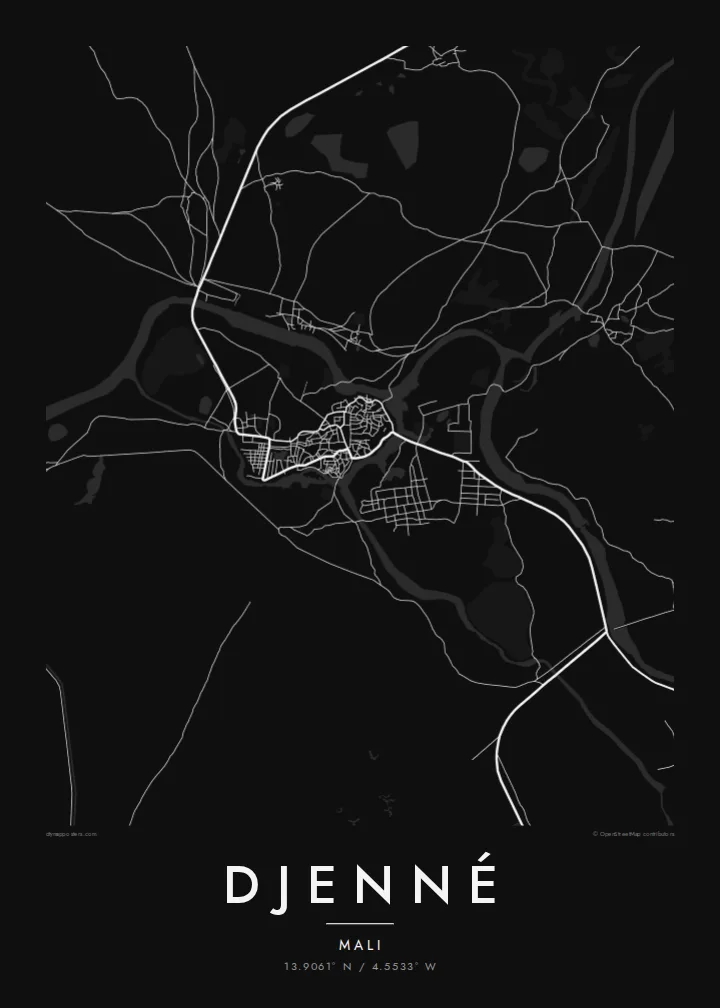
The mosque's broad rectangle and adjoining market square form the clearest landmark on the map, a calm geometric shape set within the dense fabric of the town.
Fakatino mape mukamuka · Mali
13.9061° N / 4.5533° W
An ancient mud-brick town on a seasonal island in the Bani floodplain, its dense lanes gathered around the Great Mosque.



Taha e taone, lima e onoonoaga
Tapaki e taha puhala ke kitia ai ki luga he puipui. Kua tatai e totogi he tau puhala oti — pete he lolomi, poloka, po ke faila HD.
 Tau pikselo mooli · faila lolomi 24 × 36″
Maama mitaki ke lolomi
Ko e 100% e fahi mooli mai he faila lolomi. Ko e tau poster oti — pete kua lolomi, poloka, po ke utu hifo — kua taute ke he ha mautolu a tau tokoluga (server) ke he 300 DPI, hokotia ke he 7,200 × 10,800 piksela, ke maeke ai e tau ala ikiiki tote ke maaliali fakamitaki he lolomi 24 × 36″.
He Pā


Ko e mape
Djenné stands in the inland delta of the Niger in central Mali, on land that becomes an island when the Bani river and its channels flood each year. The old town is a compact, rounded mass of houses and courtyards, built almost entirely of sun-dried mud brick. From above, it appears as a tightly packed maze of narrow lanes, with no clear grid and very little open space.
At its heart lies the Great Mosque, the largest mud-brick building in the world, rebuilt in its present form in 1907, and the square in front of it, where a weekly Monday market gathers traders from across the region. A Djenné map poster shows the mosque's large rectangular footprint as the one clear, regular form within the intricate web of lanes.
The old towns of Djenné, together with nearby archaeological sites such as Djenné-Djeno, are listed as a UNESCO World Heritage Site, and Djenné-Djeno is regarded as one of the oldest known urban sites in sub-Saharan Africa. Around the town, the floodplain spreads out in channels, marshes and fields that change with the seasons, giving the map an open, watery frame.
The mosque's broad rectangle and adjoining market square form the clearest landmark on the map, a calm geometric shape set within the dense fabric of the town.
Narrow lanes twist between courtyard houses, producing an intricate, irregular street pattern that fills the old town and reads as fine texture in black and white.
Channels of the Bani floodplain surround the town, isolating it during high water and giving the map its distinctive enclosed, island-like outline.
Taute ke ha hau
Lafi e aho, taha higoa po ke taha kupu haau, hiki e fakatino, lahi po ke tuaga.
Ko e kitiaaga nakai totogi kua tote e maaliali mo e fakamailoga vai. Ko e tau lolomi mo e tau faila HD kua taute ke he 300 DPI, hokotia ke he 7,200 × 10,800 px, nakai fai fakamailoga vai.
Ko e ha Djenné
Djenné is one of the most recognisable towns in West Africa, and its plan carries many centuries of continuous settlement. For those who have visited, studied its architecture, or have roots in the Mopti region, a map of its lanes and waters is a meaningful piece.
The title, subtitle and coordinates can be personalised, so the poster can mark a journey, a research trip or a family connection. Choose Classic black & white, Noir, Paper, Blueprint or Sand, and download it for $9 or order a matte print.
Talaage e poster Djenné| Lahi he lolomi | Maama | Tau faila |
|---|---|---|
| 30 × 40 cm11.8 × 15.7″ | 3,543 × 4,724 px | PNG · PDF |
| 29.7 × 42 cm (A3)11.7 × 16.5″ | 3,508 × 4,961 px | PNG · PDF |
| 42 × 59.4 cm (A2)16.5 × 23.4″ | 4,961 × 7,016 px | PNG · PDF |
| 45.7 × 61 cm18 × 24″ | 5,400 × 7,200 px | PNG · PDF |
| 50 × 70 cm19.7 × 27.6″ | 5,906 × 8,268 px | PNG · PDF |
| 61 × 91.4 cm24 × 36″ | 7,200 × 10,800 px | PNG · PDF |
Ke fakatatai, ko e fakatino noa kua 900 px e laulahi, fai fakamailoga mo e mo e tau mata komipiuta ni. Ko e tau faila HD kua ato hoko ke he 8× e maama ke he tau faahi takitaha mo e lolomi mitaki he lahi katoa he fakatino.
Fifili e taha puhala i luga he kupega, ti fifili e Poster Lolomi — e lahi mo e, kaeke ke manako ai koe, taha poloka — po ke Tau Faila HD Fakaeletonika. Ko e fakaotiaga totogi ko e taha gahua ni, ti ko e kupega he hau a talaaga ka fakafou fakahaga i mua he fakaotiaga e totogi.
Kua lolomi ai ke he pepa mitaki 200 gsm matte he taha he tau lahi ono, mai he 30 × 40 cm ke hoko ke he 24 × 36″. Kamata e tau poster lolomi mai he $39, kua putoia ai e utaaga.
E. Fifili e poloka akau malolō ke he lanu uli, tea, akau oki mooli, po ke akau pouli. Kua fakalataha mo e sioga malolō nakai malepe ti kua mautali ke tautau. Kamata e tau poster poloka mai he $99, kua putoia ai e utaaga.
Nakai totogi e fakafano ke he motu 60+. Ko e fakatino taha kua lolomi he fenoga lolomi ha mautolu kua tata mo e tau motu 30+, kua hoko mai he tau aho gahua 3–7. Maeke ia koe ke kikite e tuaga mo e fakamuitua he lalo he Haku Tau Fakatonu. Ke he falu motu kua 2–5 e tau tapu, ti ka nakai fakafano a mautolu ki ai, to fakaha he api tupe ia ki mua he totogi.
Fakafano mai e taha ata ki a mautolu he loto he 14 e tau aho tali mai he hokoaga, ti to lolomi foki e mautolu nakai totogi po ke liu atu e totogi ki a koe.
E. He editor i luga he kupega nei, hikihiki e matakupu, e matakupu lalo mo e laini coordinates ke he taha mena kua manako a koe ki ai, ti fifili e puhala mo e lahi. Ko e tau talaaga lolomi, poloka mo e fakaeletonika oti kua fakaaoga tonu e hau a fakatino.
Ma e $9 ka moua e koe e tau faila PNG 300 DPI mo e PDF kua mautali ke lolomi he tau lahi ono oti, nakai fai fakamailoga vai, ke lolomi i fe mena. Nakai maopoopo agaia? Utu hifo fakamua e kitiaaga nakai totogi ne fai fakamailoga vai.
Tata mai
