The citadel
The oval mound rises above the centre of the city. Its dense historic fabric and ring of buildings form the clear focal point from which every ring road is measured.
Fakatino mape mukamuka · Iraq
36.1912° N / 44.0094° E
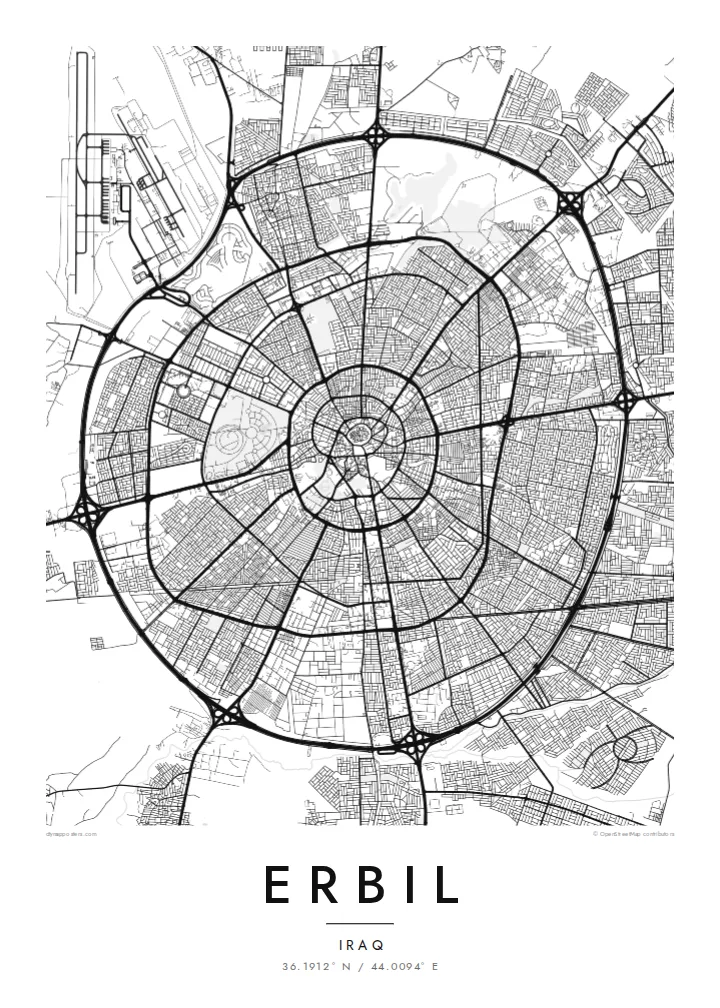
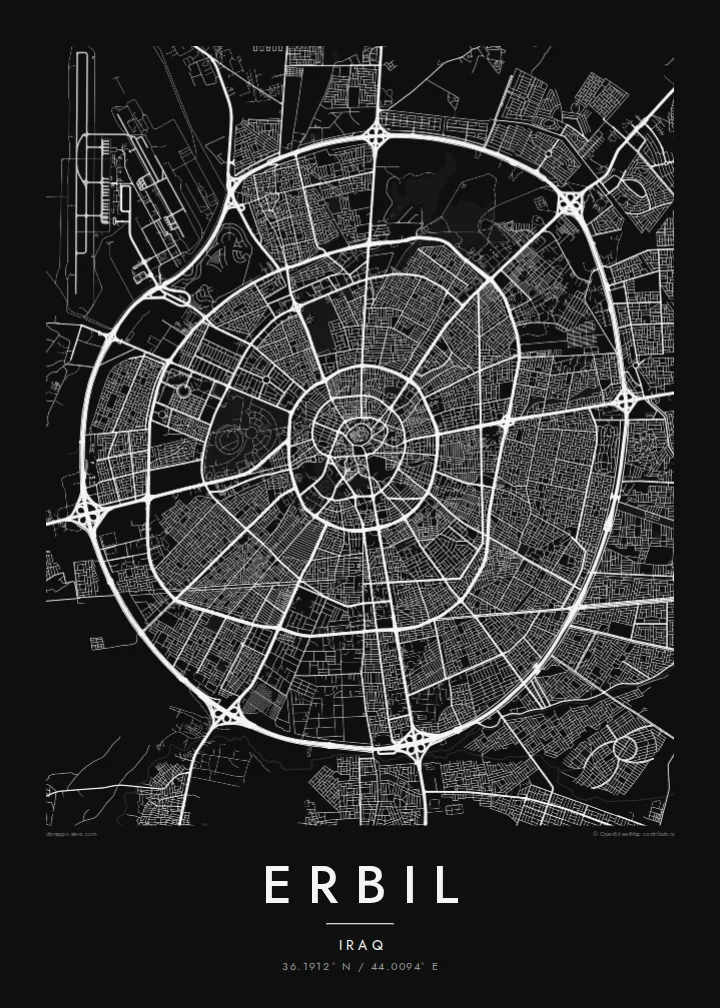
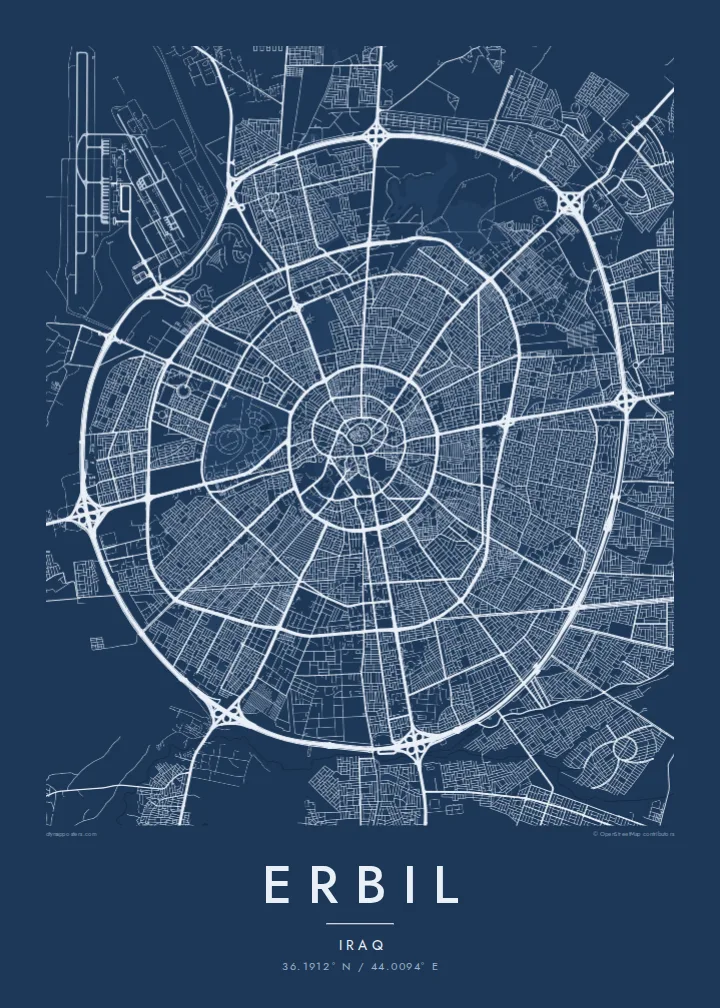
A citadel on its mound at the centre of concentric ring roads, with the city spreading outward in even circles.


Taha e taone, lima e onoonoaga
Tapaki e taha puhala ke kitia ai ki luga he puipui. Kua tatai e totogi he tau puhala oti — pete he lolomi, poloka, po ke faila HD.
 Tau pikselo mooli · faila lolomi 24 × 36″
Maama mitaki ke lolomi
Ko e 100% e fahi mooli mai he faila lolomi. Ko e tau poster oti — pete kua lolomi, poloka, po ke utu hifo — kua taute ke he ha mautolu a tau tokoluga (server) ke he 300 DPI, hokotia ke he 7,200 × 10,800 piksela, ke maeke ai e tau ala ikiiki tote ke maaliali fakamitaki he lolomi 24 × 36″.
He Pā


Ko e mape
Few cities show their history as clearly on a map as Erbil. At its centre stands the citadel, a large oval mound built up over thousands of years of settlement, with a ring of houses along its edge. Around it the modern city has grown in a series of concentric ring roads. From above, Erbil looks like a set of circles drawn from the same point.
Radial roads cross the rings toward Mosul, Kirkuk, Duhok and the mountains to the north-east, dividing the city into wedge-shaped districts. The bazaar and old neighbourhoods cluster at the foot of the citadel. Newer quarters, parks and housing extend across the plain toward the outer rings, which are still being built as the city grows.
Erbil is the capital of the Kurdistan Region of Iraq. Its citadel, among the oldest continuously inhabited sites in the world, was listed by UNESCO in 2014. An Erbil map poster shows a layout that would be hard to invent, with an ancient settlement at the core and modern ring roads around it. It reads clearly at every print size.
The oval mound rises above the centre of the city. Its dense historic fabric and ring of buildings form the clear focal point from which every ring road is measured.
Several concentric roads circle the centre at increasing distances. They give Erbil one of the most recognisable street patterns of any city in the region.
At the southern foot of the citadel, the covered market spreads through narrow lanes. It is a small, dense area between the mound and the main square.
Taute ke ha hau
Lafi e aho, taha higoa po ke taha kupu haau, hiki e fakatino, lahi po ke tuaga.
Ko e kitiaaga nakai totogi kua tote e maaliali mo e fakamailoga vai. Ko e tau lolomi mo e tau faila HD kua taute ke he 300 DPI, hokotia ke he 7,200 × 10,800 px, nakai fai fakamailoga vai.
Ko e ha Erbil
For Kurdish families abroad and for people who have worked in Erbil, the circular city is instantly recognisable. Write the city or a district in the title, add a date or dedication in the subtitle, and keep the coordinates of home.
Sand matches the colour of the citadel walls, and Classic black and white makes the rings stand out sharply. Digital HD files cost $9 for six sizes with no watermark. Printed posters come on matte paper with an optional wooden frame.
Talaage e poster Erbil| Lahi he lolomi | Maama | Tau faila |
|---|---|---|
| 30 × 40 cm11.8 × 15.7″ | 3,543 × 4,724 px | PNG · PDF |
| 29.7 × 42 cm (A3)11.7 × 16.5″ | 3,508 × 4,961 px | PNG · PDF |
| 42 × 59.4 cm (A2)16.5 × 23.4″ | 4,961 × 7,016 px | PNG · PDF |
| 45.7 × 61 cm18 × 24″ | 5,400 × 7,200 px | PNG · PDF |
| 50 × 70 cm19.7 × 27.6″ | 5,906 × 8,268 px | PNG · PDF |
| 61 × 91.4 cm24 × 36″ | 7,200 × 10,800 px | PNG · PDF |
Ke fakatatai, ko e fakatino noa kua 900 px e laulahi, fai fakamailoga mo e mo e tau mata komipiuta ni. Ko e tau faila HD kua ato hoko ke he 8× e maama ke he tau faahi takitaha mo e lolomi mitaki he lahi katoa he fakatino.
Fifili e taha puhala i luga he kupega, ti fifili e Poster Lolomi — e lahi mo e, kaeke ke manako ai koe, taha poloka — po ke Tau Faila HD Fakaeletonika. Ko e fakaotiaga totogi ko e taha gahua ni, ti ko e kupega he hau a talaaga ka fakafou fakahaga i mua he fakaotiaga e totogi.
Kua lolomi ai ke he pepa mitaki 200 gsm matte he taha he tau lahi ono, mai he 30 × 40 cm ke hoko ke he 24 × 36″. Kamata e tau poster lolomi mai he $39, kua putoia ai e utaaga.
E. Fifili e poloka akau malolō ke he lanu uli, tea, akau oki mooli, po ke akau pouli. Kua fakalataha mo e sioga malolō nakai malepe ti kua mautali ke tautau. Kamata e tau poster poloka mai he $99, kua putoia ai e utaaga.
Nakai totogi e fakafano ke he motu 60+. Ko e fakatino taha kua lolomi he fenoga lolomi ha mautolu kua tata mo e tau motu 30+, kua hoko mai he tau aho gahua 3–7. Maeke ia koe ke kikite e tuaga mo e fakamuitua he lalo he Haku Tau Fakatonu. Ke he falu motu kua 2–5 e tau tapu, ti ka nakai fakafano a mautolu ki ai, to fakaha he api tupe ia ki mua he totogi.
Fakafano mai e taha ata ki a mautolu he loto he 14 e tau aho tali mai he hokoaga, ti to lolomi foki e mautolu nakai totogi po ke liu atu e totogi ki a koe.
E. He editor i luga he kupega nei, hikihiki e matakupu, e matakupu lalo mo e laini coordinates ke he taha mena kua manako a koe ki ai, ti fifili e puhala mo e lahi. Ko e tau talaaga lolomi, poloka mo e fakaeletonika oti kua fakaaoga tonu e hau a fakatino.
Ma e $9 ka moua e koe e tau faila PNG 300 DPI mo e PDF kua mautali ke lolomi he tau lahi ono oti, nakai fai fakamailoga vai, ke lolomi i fe mena. Nakai maopoopo agaia? Utu hifo fakamua e kitiaaga nakai totogi ne fai fakamailoga vai.
Tata mai
