River Inde
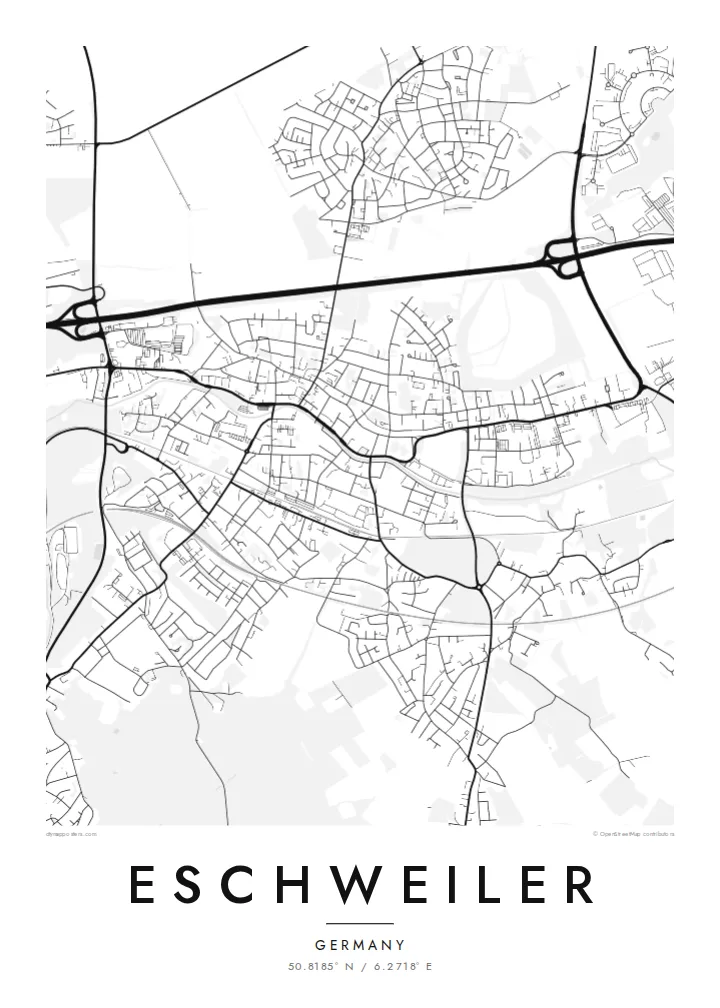
The Inde flows through the town centre, a narrow winding line around which the oldest streets gathered long before the mines and motorways arrived.
Fakatino mape mukamuka · Germany
50.8185° N / 6.2718° E
A town on the Inde river east of Aachen, surrounded by old mining land, reclaimed lakes and open-cast pits.


Taha e taone, lima e onoonoaga
Tapaki e taha puhala ke kitia ai ki luga he puipui. Kua tatai e totogi he tau puhala oti — pete he lolomi, poloka, po ke faila HD.
 Tau pikselo mooli · faila lolomi 24 × 36″
Maama mitaki ke lolomi
Ko e 100% e fahi mooli mai he faila lolomi. Ko e tau poster oti — pete kua lolomi, poloka, po ke utu hifo — kua taute ke he ha mautolu a tau tokoluga (server) ke he 300 DPI, hokotia ke he 7,200 × 10,800 piksela, ke maeke ai e tau ala ikiiki tote ke maaliali fakamitaki he lolomi 24 × 36″.
He Pā


Ko e mape
Eschweiler lies in the Aachen region of North Rhine-Westphalia, a few kilometres east of Aachen itself. The small river Inde runs through the centre, and the older streets follow its course before spreading out into residential districts and villages. On the map, the plan feels layered: a historic core, a railway line, motorways and large blocks of industrial land around the edges.
The area has a long mining history, first hard coal and later lignite. East of town, open-cast mining and the Weisweiler power station have reshaped the landscape on a huge scale, while the Blausteinsee, a lake created from a former lignite pit, now serves as a recreation area. An Eschweiler map poster records this worked landscape alongside the ordinary streets.
Few German towns of this size show their economic history so plainly from above. The straight edges of former pits, reclaimed lakes, forested spoil heaps and the winding line of the Inde all sit on one sheet. In black and white these shapes become abstract, almost architectural, and the town at the centre reads as the fixed point among them.
The Inde flows through the town centre, a narrow winding line around which the oldest streets gathered long before the mines and motorways arrived.
This lake, formed in a former lignite pit, has a clean, engineered outline that stands out on the map and today is used for swimming, sailing and walking.
To the east, open-cast mining areas and the Weisweiler power station create large geometric forms, a striking contrast with the finer residential grid of the town.
Taute ke ha hau
Lafi e aho, taha higoa po ke taha kupu haau, hiki e fakatino, lahi po ke tuaga.
Ko e kitiaaga nakai totogi kua tote e maaliali mo e fakamailoga vai. Ko e tau lolomi mo e tau faila HD kua taute ke he 300 DPI, hokotia ke he 7,200 × 10,800 px, nakai fai fakamailoga vai.
Ko e ha Eschweiler
People from Eschweiler often feel strongly about the region's mining past, and this map shows it in a way a postcard cannot. It also suits anyone living between Aachen and Düren who wants their own town rather than the city next door.
Set the title, subtitle and coordinates line to your liking, for example a street name or a year, and choose from Classic black & white, Noir, Paper, Blueprint and Sand. Printed posters come on matte paper, with or without a wooden frame.
Talaage e poster Eschweiler| Lahi he lolomi | Maama | Tau faila |
|---|---|---|
| 30 × 40 cm11.8 × 15.7″ | 3,543 × 4,724 px | PNG · PDF |
| 29.7 × 42 cm (A3)11.7 × 16.5″ | 3,508 × 4,961 px | PNG · PDF |
| 42 × 59.4 cm (A2)16.5 × 23.4″ | 4,961 × 7,016 px | PNG · PDF |
| 45.7 × 61 cm18 × 24″ | 5,400 × 7,200 px | PNG · PDF |
| 50 × 70 cm19.7 × 27.6″ | 5,906 × 8,268 px | PNG · PDF |
| 61 × 91.4 cm24 × 36″ | 7,200 × 10,800 px | PNG · PDF |
Ke fakatatai, ko e fakatino noa kua 900 px e laulahi, fai fakamailoga mo e mo e tau mata komipiuta ni. Ko e tau faila HD kua ato hoko ke he 8× e maama ke he tau faahi takitaha mo e lolomi mitaki he lahi katoa he fakatino.
Fifili e taha puhala i luga he kupega, ti fifili e Poster Lolomi — e lahi mo e, kaeke ke manako ai koe, taha poloka — po ke Tau Faila HD Fakaeletonika. Ko e fakaotiaga totogi ko e taha gahua ni, ti ko e kupega he hau a talaaga ka fakafou fakahaga i mua he fakaotiaga e totogi.
Kua lolomi ai ke he pepa mitaki 200 gsm matte he taha he tau lahi ono, mai he 30 × 40 cm ke hoko ke he 24 × 36″. Kamata e tau poster lolomi mai he $39, kua putoia ai e utaaga.
E. Fifili e poloka akau malolō ke he lanu uli, tea, akau oki mooli, po ke akau pouli. Kua fakalataha mo e sioga malolō nakai malepe ti kua mautali ke tautau. Kamata e tau poster poloka mai he $99, kua putoia ai e utaaga.
Nakai totogi e fakafano ke he motu 60+. Ko e fakatino taha kua lolomi he fenoga lolomi ha mautolu kua tata mo e tau motu 30+, kua hoko mai he tau aho gahua 3–7. Maeke ia koe ke kikite e tuaga mo e fakamuitua he lalo he Haku Tau Fakatonu. Ke he falu motu kua 2–5 e tau tapu, ti ka nakai fakafano a mautolu ki ai, to fakaha he api tupe ia ki mua he totogi.
Fakafano mai e taha ata ki a mautolu he loto he 14 e tau aho tali mai he hokoaga, ti to lolomi foki e mautolu nakai totogi po ke liu atu e totogi ki a koe.
E. He editor i luga he kupega nei, hikihiki e matakupu, e matakupu lalo mo e laini coordinates ke he taha mena kua manako a koe ki ai, ti fifili e puhala mo e lahi. Ko e tau talaaga lolomi, poloka mo e fakaeletonika oti kua fakaaoga tonu e hau a fakatino.
Ma e $9 ka moua e koe e tau faila PNG 300 DPI mo e PDF kua mautali ke lolomi he tau lahi ono oti, nakai fai fakamailoga vai, ke lolomi i fe mena. Nakai maopoopo agaia? Utu hifo fakamua e kitiaaga nakai totogi ne fai fakamailoga vai.
Tata mai
