Mount Kinka
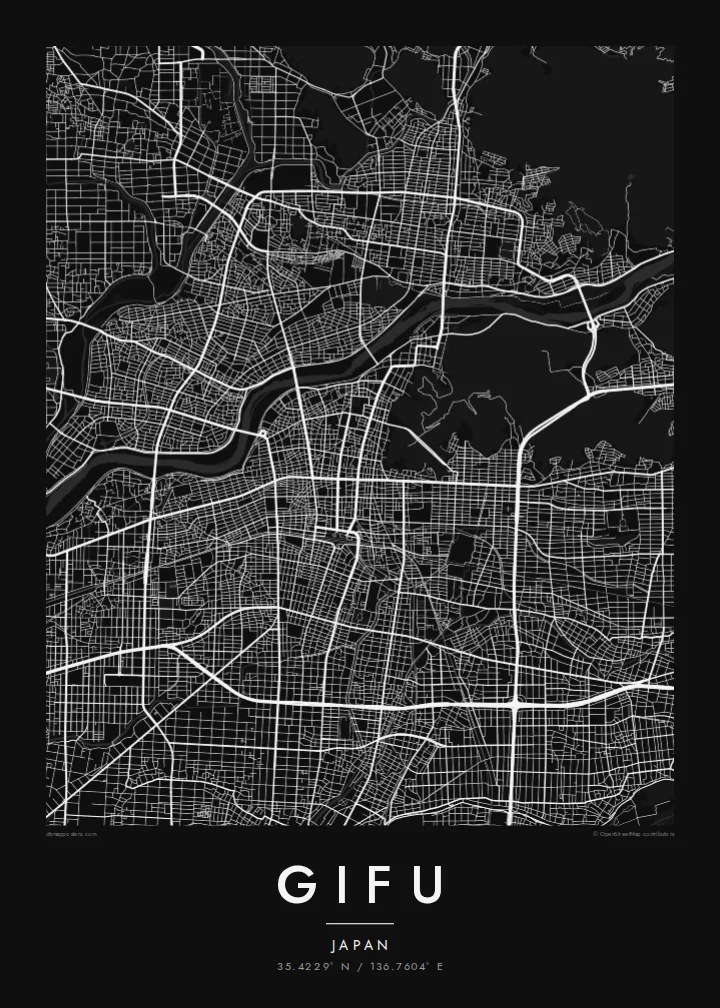
A forested peak rising straight out of the city's northeastern edge, left almost untouched by roads. On the map it forms a large open shape, with the castle at its summit.
Fakatino mape mukamuka · Japan
35.4229° N / 136.7604° E
A flat city on the Nobi Plain, pinned between the curving Nagara River and the steep wooded mass of Mount Kinka.



Taha e taone, lima e onoonoaga
Tapaki e taha puhala ke kitia ai ki luga he puipui. Kua tatai e totogi he tau puhala oti — pete he lolomi, poloka, po ke faila HD.
 Tau pikselo mooli · faila lolomi 24 × 36″
Maama mitaki ke lolomi
Ko e 100% e fahi mooli mai he faila lolomi. Ko e tau poster oti — pete kua lolomi, poloka, po ke utu hifo — kua taute ke he ha mautolu a tau tokoluga (server) ke he 300 DPI, hokotia ke he 7,200 × 10,800 piksela, ke maeke ai e tau ala ikiiki tote ke maaliali fakamitaki he lolomi 24 × 36″.
He Pā


Ko e mape
Gifu sits where the mountains of central Japan give way to the Nobi Plain, and the map shows that edge clearly. To the north, the Nagara River sweeps past in a clean, wide arc, and Mount Kinka rises abruptly beside it as a dark, almost roadless island of forest. South of the river, the city spreads in a regular grid of streets toward the main railway station.
Gifu Castle stands on the summit of Mount Kinka, reached by ropeway, and the name of the city itself is traditionally credited to Oda Nobunaga, who took the castle in the sixteenth century. On summer nights the Nagara hosts ukai, cormorant fishing by torchlight from wooden boats, a practice the city has kept alive for well over a thousand years.
A Gifu map poster captures the contrast between two textures: the precise, even grid of the lowland city and the blank, organic outline of the mountain and river on its northern edge. Smaller streams and channels thread through the southern districts, and the whole composition reads as a meeting of plain, water and hill in a single frame.
A forested peak rising straight out of the city's northeastern edge, left almost untouched by roads. On the map it forms a large open shape, with the castle at its summit.
The river runs clear and wide along the north of the centre and is known for its summer cormorant fishing. Its long curve gives the poster a natural upper boundary.
Around JR Gifu Station the streets settle into an orderly grid, the densest part of the map and the commercial core of the city.
Taute ke ha hau
Lafi e aho, taha higoa po ke taha kupu haau, hiki e fakatino, lahi po ke tuaga.
Ko e kitiaaga nakai totogi kua tote e maaliali mo e fakamailoga vai. Ko e tau lolomi mo e tau faila HD kua taute ke he 300 DPI, hokotia ke he 7,200 × 10,800 px, nakai fai fakamailoga vai.
Ko e ha Gifu
For many, Gifu means summers by the river and the ropeway ride up to the castle. A map of the city holds that geography in one view and suits anyone with family ties to the prefecture or good memories of a trip through central Japan.
You can personalise the title, subtitle and coordinates line, for example with a home address or the date of a visit. The poster comes in five styles, from Classic black & white and Noir to Paper, Blueprint and Sand, as a digital file or printed on matte paper.
Talaage e poster Gifu| Lahi he lolomi | Maama | Tau faila |
|---|---|---|
| 30 × 40 cm11.8 × 15.7″ | 3,543 × 4,724 px | PNG · PDF |
| 29.7 × 42 cm (A3)11.7 × 16.5″ | 3,508 × 4,961 px | PNG · PDF |
| 42 × 59.4 cm (A2)16.5 × 23.4″ | 4,961 × 7,016 px | PNG · PDF |
| 45.7 × 61 cm18 × 24″ | 5,400 × 7,200 px | PNG · PDF |
| 50 × 70 cm19.7 × 27.6″ | 5,906 × 8,268 px | PNG · PDF |
| 61 × 91.4 cm24 × 36″ | 7,200 × 10,800 px | PNG · PDF |
Ke fakatatai, ko e fakatino noa kua 900 px e laulahi, fai fakamailoga mo e mo e tau mata komipiuta ni. Ko e tau faila HD kua ato hoko ke he 8× e maama ke he tau faahi takitaha mo e lolomi mitaki he lahi katoa he fakatino.
Fifili e taha puhala i luga he kupega, ti fifili e Poster Lolomi — e lahi mo e, kaeke ke manako ai koe, taha poloka — po ke Tau Faila HD Fakaeletonika. Ko e fakaotiaga totogi ko e taha gahua ni, ti ko e kupega he hau a talaaga ka fakafou fakahaga i mua he fakaotiaga e totogi.
Kua lolomi ai ke he pepa mitaki 200 gsm matte he taha he tau lahi ono, mai he 30 × 40 cm ke hoko ke he 24 × 36″. Kamata e tau poster lolomi mai he $39, kua putoia ai e utaaga.
E. Fifili e poloka akau malolō ke he lanu uli, tea, akau oki mooli, po ke akau pouli. Kua fakalataha mo e sioga malolō nakai malepe ti kua mautali ke tautau. Kamata e tau poster poloka mai he $99, kua putoia ai e utaaga.
Nakai totogi e fakafano ke he motu 60+. Ko e fakatino taha kua lolomi he fenoga lolomi ha mautolu kua tata mo e tau motu 30+, kua hoko mai he tau aho gahua 3–7. Maeke ia koe ke kikite e tuaga mo e fakamuitua he lalo he Haku Tau Fakatonu. Ke he falu motu kua 2–5 e tau tapu, ti ka nakai fakafano a mautolu ki ai, to fakaha he api tupe ia ki mua he totogi.
Fakafano mai e taha ata ki a mautolu he loto he 14 e tau aho tali mai he hokoaga, ti to lolomi foki e mautolu nakai totogi po ke liu atu e totogi ki a koe.
E. He editor i luga he kupega nei, hikihiki e matakupu, e matakupu lalo mo e laini coordinates ke he taha mena kua manako a koe ki ai, ti fifili e puhala mo e lahi. Ko e tau talaaga lolomi, poloka mo e fakaeletonika oti kua fakaaoga tonu e hau a fakatino.
Ma e $9 ka moua e koe e tau faila PNG 300 DPI mo e PDF kua mautali ke lolomi he tau lahi ono oti, nakai fai fakamailoga vai, ke lolomi i fe mena. Nakai maopoopo agaia? Utu hifo fakamua e kitiaaga nakai totogi ne fai fakamailoga vai.
Tata mai
