Regular street grid
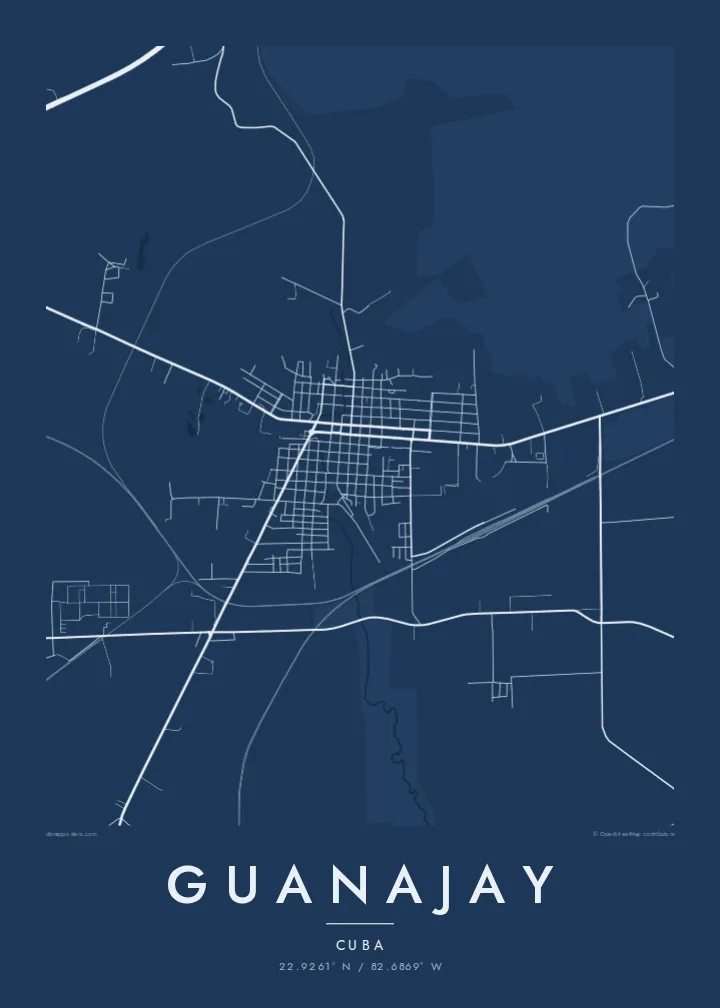
The core of town is made of evenly spaced streets crossing at close to right angles, producing a steady rhythm of small rectangular blocks that reads clearly even at the smallest print size.
Fakatino mape mukamuka · Cuba
22.9261° N / 82.6869° W
A compact inland grid in western Cuba, its regular blocks fading into the farmland of Artemisa province.



Taha e taone, lima e onoonoaga
Tapaki e taha puhala ke kitia ai ki luga he puipui. Kua tatai e totogi he tau puhala oti — pete he lolomi, poloka, po ke faila HD.
 Tau pikselo mooli · faila lolomi 24 × 36″
Maama mitaki ke lolomi
Ko e 100% e fahi mooli mai he faila lolomi. Ko e tau poster oti — pete kua lolomi, poloka, po ke utu hifo — kua taute ke he ha mautolu a tau tokoluga (server) ke he 300 DPI, hokotia ke he 7,200 × 10,800 piksela, ke maeke ai e tau ala ikiiki tote ke maaliali fakamitaki he lolomi 24 × 36″.
He Pā


Ko e mape
Guanajay lies inland in Artemisa, the province west of Havana, on gently rolling agricultural land between the capital and the hills further west. Seen from above it is a modest, orderly town: streets laid out in a largely regular pattern, blocks of similar size, and a clear edge where the built area gives way to fields and to the roads leading out toward neighbouring towns.
Like many Cuban towns of Spanish colonial origin, its layout follows the familiar logic of the grid, with the main streets carrying traffic from the centre out into the countryside. The land around it has long been farmed, and the province itself is young: Artemisa was created in 2011, when the former Havana province was divided in two.
A Guanajay map poster is a study in restraint. There are no dramatic coastlines or rivers to carry the composition, so the pattern of blocks does the work, and the way the grid loosens at the outskirts gives the image a soft, natural border. It suits anyone who prefers a quiet, balanced print to a busy one.
The core of town is made of evenly spaced streets crossing at close to right angles, producing a steady rhythm of small rectangular blocks that reads clearly even at the smallest print size.
Several roads leave the centre and head out across the flat surroundings, drawing thin lines toward the neighbouring towns of Artemisa and giving the composition a sense of direction.
Instead of a hard boundary, the built area thins gradually into farmland, so the map ends in a scatter of lanes and tracks rather than a sharp outline.
Taute ke ha hau
Lafi e aho, taha higoa po ke taha kupu haau, hiki e fakatino, lahi po ke tuaga.
Ko e kitiaaga nakai totogi kua tote e maaliali mo e fakamailoga vai. Ko e tau lolomi mo e tau faila HD kua taute ke he 300 DPI, hokotia ke he 7,200 × 10,800 px, nakai fai fakamailoga vai.
Ko e ha Guanajay
For families with roots in Guanajay, or anyone who has spent time in this part of western Cuba, the map is a way to keep the shape of home on the wall. The town is modest in scale, which makes it an intimate subject for a print.
Add a personal title, a subtitle such as a surname or a year, and the coordinates line, then pick one of five styles; Sand and Paper feel especially warm here. The HD files cost $9 and come as a 300 DPI PNG and a print-ready PDF in six sizes.
Talaage e poster Guanajay| Lahi he lolomi | Maama | Tau faila |
|---|---|---|
| 30 × 40 cm11.8 × 15.7″ | 3,543 × 4,724 px | PNG · PDF |
| 29.7 × 42 cm (A3)11.7 × 16.5″ | 3,508 × 4,961 px | PNG · PDF |
| 42 × 59.4 cm (A2)16.5 × 23.4″ | 4,961 × 7,016 px | PNG · PDF |
| 45.7 × 61 cm18 × 24″ | 5,400 × 7,200 px | PNG · PDF |
| 50 × 70 cm19.7 × 27.6″ | 5,906 × 8,268 px | PNG · PDF |
| 61 × 91.4 cm24 × 36″ | 7,200 × 10,800 px | PNG · PDF |
Ke fakatatai, ko e fakatino noa kua 900 px e laulahi, fai fakamailoga mo e mo e tau mata komipiuta ni. Ko e tau faila HD kua ato hoko ke he 8× e maama ke he tau faahi takitaha mo e lolomi mitaki he lahi katoa he fakatino.
Fifili e taha puhala i luga he kupega, ti fifili e Poster Lolomi — e lahi mo e, kaeke ke manako ai koe, taha poloka — po ke Tau Faila HD Fakaeletonika. Ko e fakaotiaga totogi ko e taha gahua ni, ti ko e kupega he hau a talaaga ka fakafou fakahaga i mua he fakaotiaga e totogi.
Kua lolomi ai ke he pepa mitaki 200 gsm matte he taha he tau lahi ono, mai he 30 × 40 cm ke hoko ke he 24 × 36″. Kamata e tau poster lolomi mai he $39, kua putoia ai e utaaga.
E. Fifili e poloka akau malolō ke he lanu uli, tea, akau oki mooli, po ke akau pouli. Kua fakalataha mo e sioga malolō nakai malepe ti kua mautali ke tautau. Kamata e tau poster poloka mai he $99, kua putoia ai e utaaga.
Nakai totogi e fakafano ke he motu 60+. Ko e fakatino taha kua lolomi he fenoga lolomi ha mautolu kua tata mo e tau motu 30+, kua hoko mai he tau aho gahua 3–7. Maeke ia koe ke kikite e tuaga mo e fakamuitua he lalo he Haku Tau Fakatonu. Ke he falu motu kua 2–5 e tau tapu, ti ka nakai fakafano a mautolu ki ai, to fakaha he api tupe ia ki mua he totogi.
Fakafano mai e taha ata ki a mautolu he loto he 14 e tau aho tali mai he hokoaga, ti to lolomi foki e mautolu nakai totogi po ke liu atu e totogi ki a koe.
E. He editor i luga he kupega nei, hikihiki e matakupu, e matakupu lalo mo e laini coordinates ke he taha mena kua manako a koe ki ai, ti fifili e puhala mo e lahi. Ko e tau talaaga lolomi, poloka mo e fakaeletonika oti kua fakaaoga tonu e hau a fakatino.
Ma e $9 ka moua e koe e tau faila PNG 300 DPI mo e PDF kua mautali ke lolomi he tau lahi ono oti, nakai fai fakamailoga vai, ke lolomi i fe mena. Nakai maopoopo agaia? Utu hifo fakamua e kitiaaga nakai totogi ne fai fakamailoga vai.
Tata mai
