Irrigation canals
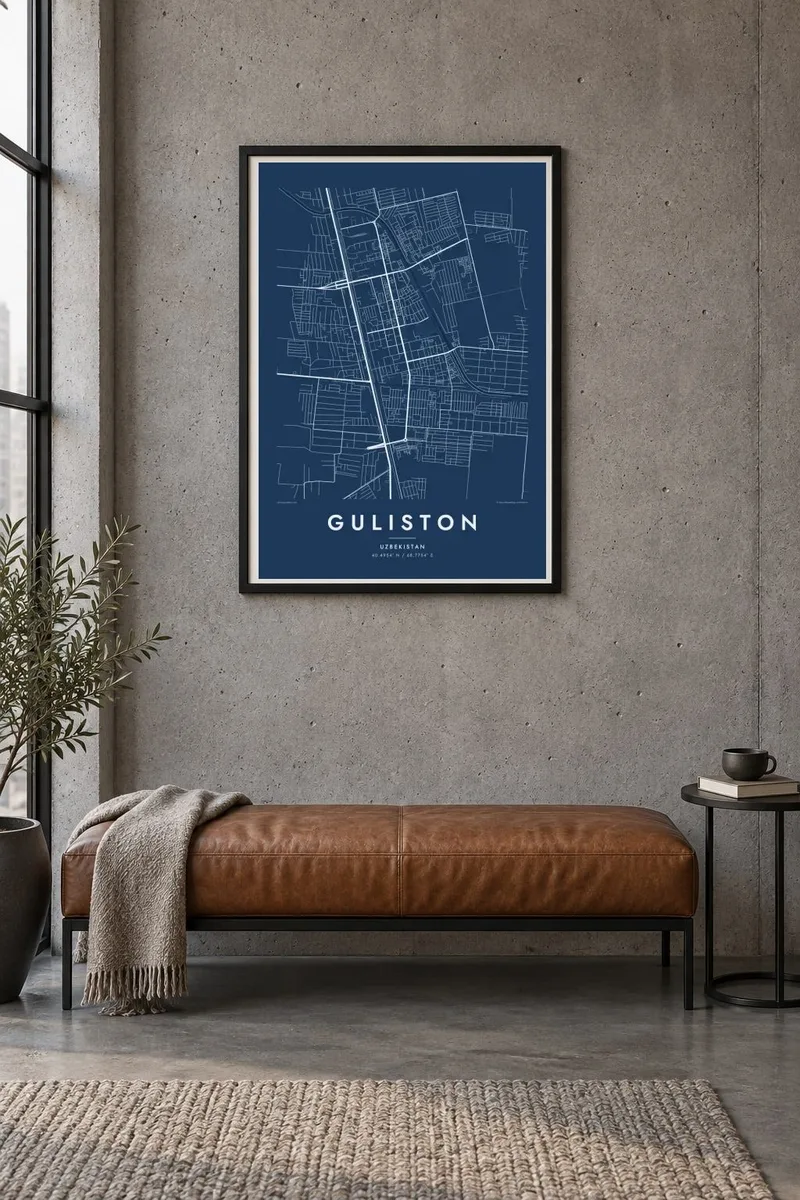
Straight canals cross the town and fields around it. They are the reason the steppe could be farmed, and on the poster they draw long, firm lines.
Fakatino mape mukamuka · Uzbekistan
40.4954° N / 68.7754° E
A planned Soviet-era grid on the flat Hungry Steppe, crossed by straight irrigation canals in every direction.

Taha e taone, lima e onoonoaga
Tapaki e taha puhala ke kitia ai ki luga he puipui. Kua tatai e totogi he tau puhala oti — pete he lolomi, poloka, po ke faila HD.
 Tau pikselo mooli · faila lolomi 24 × 36″
Maama mitaki ke lolomi
Ko e 100% e fahi mooli mai he faila lolomi. Ko e tau poster oti — pete kua lolomi, poloka, po ke utu hifo — kua taute ke he ha mautolu a tau tokoluga (server) ke he 300 DPI, hokotia ke he 7,200 × 10,800 piksela, ke maeke ai e tau ala ikiiki tote ke maaliali fakamitaki he lolomi 24 × 36″.
He Pā


Ko e mape
Guliston is the capital of Uzbekistan's Sirdaryo Region, built on the Mirzachul, or Hungry Steppe, south of the Syr Darya. The land was once dry steppe and was turned into farmland with large irrigation schemes in the twentieth century. From above, the result is unmistakable: straight canals, rectangular fields and a town laid out with the same regularity.
The town was renamed Guliston, meaning land of flowers, in 1961. Its plan reflects Soviet urban design: broad avenues, large residential blocks and generous open spaces between them. Canals and drainage channels run along and across the streets. The pattern extends into the surrounding cotton fields, so the town and the landscape look like parts of one design.
A Guliston map poster captures that geometric logic. There are no old winding lanes here, only lines, right angles and the long straight edges of canals. In black and white the image looks almost like a technical drawing, which suits the Blueprint style especially well. It is a clear picture of how the Hungry Steppe was reshaped.
Straight canals cross the town and fields around it. They are the reason the steppe could be farmed, and on the poster they draw long, firm lines.
Wide, straight avenues divide the town into large, regular blocks. The layout reflects Soviet planning and looks crisp and orderly on paper.
Beyond the town, rectangular fields follow the canal network. They continue the grid to the edges of the frame, so town and farmland read as one pattern.
Taute ke ha hau
Lafi e aho, taha higoa po ke taha kupu haau, hiki e fakatino, lahi po ke tuaga.
Ko e kitiaaga nakai totogi kua tote e maaliali mo e fakamailoga vai. Ko e tau lolomi mo e tau faila HD kua taute ke he 300 DPI, hokotia ke he 7,200 × 10,800 px, nakai fai fakamailoga vai.
Ko e ha Guliston
A Guliston map suits people with roots in the Sirdaryo region and anyone drawn to planned landscapes. Its clear geometry works well in modern rooms. Add a personal title, a date, or the coordinates of a family home to the subtitle.
Five styles are available: Classic black & white, Noir, Paper, Blueprint and Sand. For $9 you get six HD print sizes, each as a 300 DPI PNG and print-ready PDF. Printed matte posters, framed or not, ship from partners in 30+ countries.
Talaage e poster Guliston| Lahi he lolomi | Maama | Tau faila |
|---|---|---|
| 30 × 40 cm11.8 × 15.7″ | 3,543 × 4,724 px | PNG · PDF |
| 29.7 × 42 cm (A3)11.7 × 16.5″ | 3,508 × 4,961 px | PNG · PDF |
| 42 × 59.4 cm (A2)16.5 × 23.4″ | 4,961 × 7,016 px | PNG · PDF |
| 45.7 × 61 cm18 × 24″ | 5,400 × 7,200 px | PNG · PDF |
| 50 × 70 cm19.7 × 27.6″ | 5,906 × 8,268 px | PNG · PDF |
| 61 × 91.4 cm24 × 36″ | 7,200 × 10,800 px | PNG · PDF |
Ke fakatatai, ko e fakatino noa kua 900 px e laulahi, fai fakamailoga mo e mo e tau mata komipiuta ni. Ko e tau faila HD kua ato hoko ke he 8× e maama ke he tau faahi takitaha mo e lolomi mitaki he lahi katoa he fakatino.
Fifili e taha puhala i luga he kupega, ti fifili e Poster Lolomi — e lahi mo e, kaeke ke manako ai koe, taha poloka — po ke Tau Faila HD Fakaeletonika. Ko e fakaotiaga totogi ko e taha gahua ni, ti ko e kupega he hau a talaaga ka fakafou fakahaga i mua he fakaotiaga e totogi.
Kua lolomi ai ke he pepa mitaki 200 gsm matte he taha he tau lahi ono, mai he 30 × 40 cm ke hoko ke he 24 × 36″. Kamata e tau poster lolomi mai he $39, kua putoia ai e utaaga.
E. Fifili e poloka akau malolō ke he lanu uli, tea, akau oki mooli, po ke akau pouli. Kua fakalataha mo e sioga malolō nakai malepe ti kua mautali ke tautau. Kamata e tau poster poloka mai he $99, kua putoia ai e utaaga.
Nakai totogi e fakafano ke he motu 60+. Ko e fakatino taha kua lolomi he fenoga lolomi ha mautolu kua tata mo e tau motu 30+, kua hoko mai he tau aho gahua 3–7. Maeke ia koe ke kikite e tuaga mo e fakamuitua he lalo he Haku Tau Fakatonu. Ke he falu motu kua 2–5 e tau tapu, ti ka nakai fakafano a mautolu ki ai, to fakaha he api tupe ia ki mua he totogi.
Fakafano mai e taha ata ki a mautolu he loto he 14 e tau aho tali mai he hokoaga, ti to lolomi foki e mautolu nakai totogi po ke liu atu e totogi ki a koe.
E. He editor i luga he kupega nei, hikihiki e matakupu, e matakupu lalo mo e laini coordinates ke he taha mena kua manako a koe ki ai, ti fifili e puhala mo e lahi. Ko e tau talaaga lolomi, poloka mo e fakaeletonika oti kua fakaaoga tonu e hau a fakatino.
Ma e $9 ka moua e koe e tau faila PNG 300 DPI mo e PDF kua mautali ke lolomi he tau lahi ono oti, nakai fai fakamailoga vai, ke lolomi i fe mena. Nakai maopoopo agaia? Utu hifo fakamua e kitiaaga nakai totogi ne fai fakamailoga vai.
Tata mai
