Congtai Park
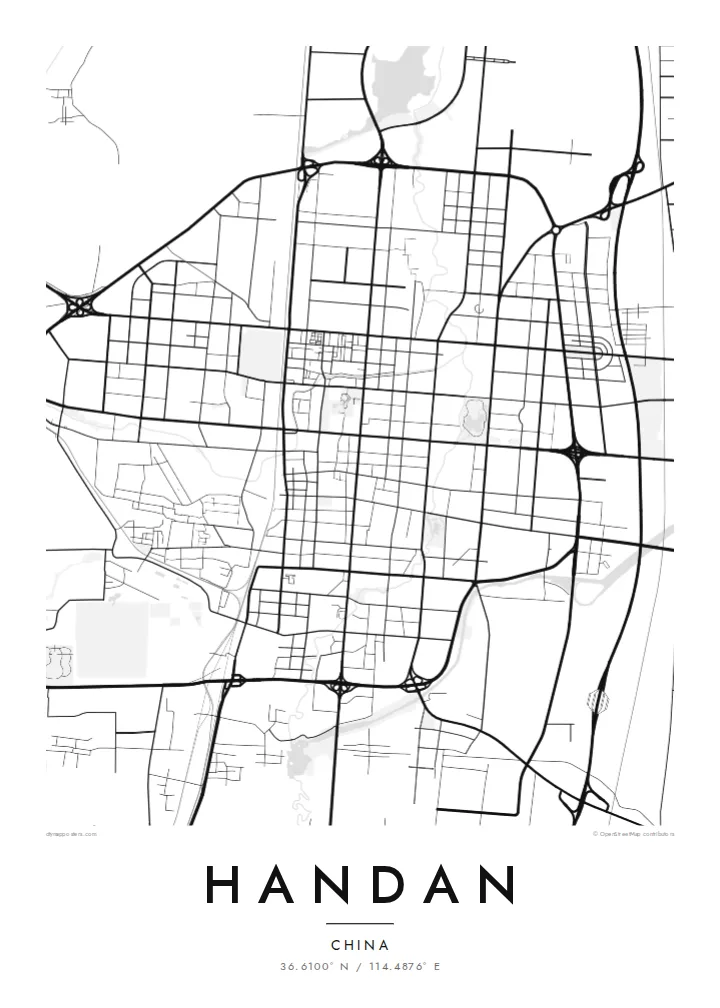
A large park with a lake near the city centre, built around an old terrace linked to the Zhao kings. On the map it forms an open, rounded shape among the rectangular blocks.
Fakatino mape mukamuka · China
36.6100° N / 114.4876° E
A broad, regular grid on the North China Plain, crossed by the Fuyang River below the Taihang foothills


Taha e taone, lima e onoonoaga
Tapaki e taha puhala ke kitia ai ki luga he puipui. Kua tatai e totogi he tau puhala oti — pete he lolomi, poloka, po ke faila HD.
 Tau pikselo mooli · faila lolomi 24 × 36″
Maama mitaki ke lolomi
Ko e 100% e fahi mooli mai he faila lolomi. Ko e tau poster oti — pete kua lolomi, poloka, po ke utu hifo — kua taute ke he ha mautolu a tau tokoluga (server) ke he 300 DPI, hokotia ke he 7,200 × 10,800 piksela, ke maeke ai e tau ala ikiiki tote ke maaliali fakamitaki he lolomi 24 × 36″.
He Pā


Ko e mape
Handan is one of China's oldest cities. It served as the capital of the State of Zhao during the Warring States period and has kept the same name for close to three thousand years. It is often called the home of Chinese idioms, since a large number of classical four-character sayings, among them the story of learning to walk in Handan, trace their origins to events set here.
The modern city is laid out on the flat North China Plain, with the foothills of the Taihang Mountains rising to the west. On the map it reads as a broad, regular grid of wide avenues and large blocks, crossed by the winding Fuyang River and by the main north–south railway, with industrial districts spread across its outer areas.
Near the centre, Congtai Park surrounds a lake and the raised terrace traditionally associated with King Wuling of Zhao. A Handan map poster sets this green space and the curve of the river against the rigour of the street grid, producing a composition that is ordered yet not mechanical, and that reflects both the ancient capital and the working industrial city.
A large park with a lake near the city centre, built around an old terrace linked to the Zhao kings. On the map it forms an open, rounded shape among the rectangular blocks.
The river winds through Handan in gentle curves, the main natural line crossing an otherwise strictly rectilinear city.
Wide avenues running north–south and east–west divide Handan into large, even blocks, a pattern that gives the poster its calm and measured rhythm.
Taute ke ha hau
Lafi e aho, taha higoa po ke taha kupu haau, hiki e fakatino, lahi po ke tuaga.
Ko e kitiaaga nakai totogi kua tote e maaliali mo e fakamailoga vai. Ko e tau lolomi mo e tau faila HD kua taute ke he 300 DPI, hokotia ke he 7,200 × 10,800 px, nakai fai fakamailoga vai.
Ko e ha Handan
Handan appeals to people with family roots in southern Hebei, and to anyone drawn to cities where ancient history lies under a modern plan. Its orderly grid and single winding river make a clean, graphic image that works in both traditional and contemporary interiors.
Add your own title, perhaps a favourite idiom or a family name, and a date or place in the subtitle, with an editable coordinates line. Five styles are available: Classic black & white, Noir, Paper, Blueprint and Sand.
Talaage e poster Handan| Lahi he lolomi | Maama | Tau faila |
|---|---|---|
| 30 × 40 cm11.8 × 15.7″ | 3,543 × 4,724 px | PNG · PDF |
| 29.7 × 42 cm (A3)11.7 × 16.5″ | 3,508 × 4,961 px | PNG · PDF |
| 42 × 59.4 cm (A2)16.5 × 23.4″ | 4,961 × 7,016 px | PNG · PDF |
| 45.7 × 61 cm18 × 24″ | 5,400 × 7,200 px | PNG · PDF |
| 50 × 70 cm19.7 × 27.6″ | 5,906 × 8,268 px | PNG · PDF |
| 61 × 91.4 cm24 × 36″ | 7,200 × 10,800 px | PNG · PDF |
Ke fakatatai, ko e fakatino noa kua 900 px e laulahi, fai fakamailoga mo e mo e tau mata komipiuta ni. Ko e tau faila HD kua ato hoko ke he 8× e maama ke he tau faahi takitaha mo e lolomi mitaki he lahi katoa he fakatino.
Fifili e taha puhala i luga he kupega, ti fifili e Poster Lolomi — e lahi mo e, kaeke ke manako ai koe, taha poloka — po ke Tau Faila HD Fakaeletonika. Ko e fakaotiaga totogi ko e taha gahua ni, ti ko e kupega he hau a talaaga ka fakafou fakahaga i mua he fakaotiaga e totogi.
Kua lolomi ai ke he pepa mitaki 200 gsm matte he taha he tau lahi ono, mai he 30 × 40 cm ke hoko ke he 24 × 36″. Kamata e tau poster lolomi mai he $39, kua putoia ai e utaaga.
E. Fifili e poloka akau malolō ke he lanu uli, tea, akau oki mooli, po ke akau pouli. Kua fakalataha mo e sioga malolō nakai malepe ti kua mautali ke tautau. Kamata e tau poster poloka mai he $99, kua putoia ai e utaaga.
Nakai totogi e fakafano ke he motu 60+. Ko e fakatino taha kua lolomi he fenoga lolomi ha mautolu kua tata mo e tau motu 30+, kua hoko mai he tau aho gahua 3–7. Maeke ia koe ke kikite e tuaga mo e fakamuitua he lalo he Haku Tau Fakatonu. Ke he falu motu kua 2–5 e tau tapu, ti ka nakai fakafano a mautolu ki ai, to fakaha he api tupe ia ki mua he totogi.
Fakafano mai e taha ata ki a mautolu he loto he 14 e tau aho tali mai he hokoaga, ti to lolomi foki e mautolu nakai totogi po ke liu atu e totogi ki a koe.
E. He editor i luga he kupega nei, hikihiki e matakupu, e matakupu lalo mo e laini coordinates ke he taha mena kua manako a koe ki ai, ti fifili e puhala mo e lahi. Ko e tau talaaga lolomi, poloka mo e fakaeletonika oti kua fakaaoga tonu e hau a fakatino.
Ma e $9 ka moua e koe e tau faila PNG 300 DPI mo e PDF kua mautali ke lolomi he tau lahi ono oti, nakai fai fakamailoga vai, ke lolomi i fe mena. Nakai maopoopo agaia? Utu hifo fakamua e kitiaaga nakai totogi ne fai fakamailoga vai.
Tata mai
