Qing town wall
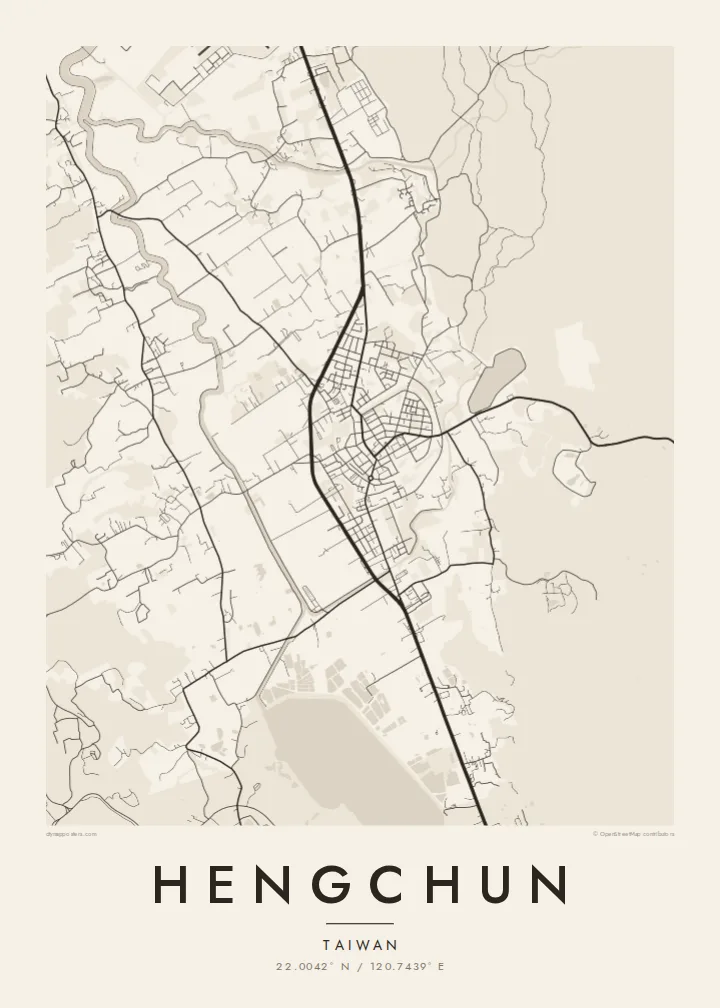
The outline of the nineteenth-century wall frames the old centre, with streets passing through its gates, a rare sight of a walled town on a modern Taiwanese map.
Fakatino mape mukamuka · Taiwan
22.0042° N / 120.7439° E
A walled old town near Taiwan's southern tip, with sea on two sides and the Kenting coast just to the south.




Taha e taone, lima e onoonoaga
Tapaki e taha puhala ke kitia ai ki luga he puipui. Kua tatai e totogi he tau puhala oti — pete he lolomi, poloka, po ke faila HD.
 Tau pikselo mooli · faila lolomi 24 × 36″
Maama mitaki ke lolomi
Ko e 100% e fahi mooli mai he faila lolomi. Ko e tau poster oti — pete kua lolomi, poloka, po ke utu hifo — kua taute ke he ha mautolu a tau tokoluga (server) ke he 300 DPI, hokotia ke he 7,200 × 10,800 piksela, ke maeke ai e tau ala ikiiki tote ke maaliali fakamitaki he lolomi 24 × 36″.
He Pā


Ko e mape
Hengchun covers the southern end of Taiwan's main island, on the peninsula that carries its name in Pingtung County. The land narrows here between the Taiwan Strait and the Pacific, ending in capes above the Bashi Channel. The town centre lies in a low basin a little inland from the western shore, with green hills to the east and the resort strip of Kenting further south.
The old town is its signature. Hengchun's Qing-dynasty wall, built in the 1870s, is among the best preserved in Taiwan, and its four gates still stand on the north, south, east and west sides. From above, the line of the wall can be traced as an outline around the historic streets, with modern roads passing through the gates and spreading outward in a looser pattern.
Many visitors know the area from the film Cape No. 7, shot in and around the town, or from summers on the beaches of Kenting National Park. A Hengchun map poster brings those memories together with the quieter reality of the place: a small historic town, farmland on the plain and a coastline shaped by coral reef and steady wind.
The outline of the nineteenth-century wall frames the old centre, with streets passing through its gates, a rare sight of a walled town on a modern Taiwanese map.
The peninsula is narrow enough that a wider frame can show both coasts, the Taiwan Strait on one side and the Pacific on the other, meeting beyond the southern capes.
The main coastal highway runs south out of town toward Kenting and the southern tip, a single strong line tracing the shore between beaches and headlands.
Taute ke ha hau
Lafi e aho, taha higoa po ke taha kupu haau, hiki e fakatino, lahi po ke tuaga.
Ko e kitiaaga nakai totogi kua tote e maaliali mo e fakamailoga vai. Ko e tau lolomi mo e tau faila HD kua taute ke he 300 DPI, hokotia ke he 7,200 × 10,800 px, nakai fai fakamailoga vai.
Ko e ha Hengchun
For many in Taiwan, Hengchun means the long drive south, the first sight of the sea and the gates of the old town at dusk. It makes a thoughtful map for travellers, film lovers and families with roots on the peninsula.
Set the title in any wording, add a subtitle such as a trip date and edit the coordinates line. Among the five styles, Noir suits the coast at night and Sand its beaches, and every $9 order includes six sizes as PNG and PDF.
Talaage e poster Hengchun| Lahi he lolomi | Maama | Tau faila |
|---|---|---|
| 30 × 40 cm11.8 × 15.7″ | 3,543 × 4,724 px | PNG · PDF |
| 29.7 × 42 cm (A3)11.7 × 16.5″ | 3,508 × 4,961 px | PNG · PDF |
| 42 × 59.4 cm (A2)16.5 × 23.4″ | 4,961 × 7,016 px | PNG · PDF |
| 45.7 × 61 cm18 × 24″ | 5,400 × 7,200 px | PNG · PDF |
| 50 × 70 cm19.7 × 27.6″ | 5,906 × 8,268 px | PNG · PDF |
| 61 × 91.4 cm24 × 36″ | 7,200 × 10,800 px | PNG · PDF |
Ke fakatatai, ko e fakatino noa kua 900 px e laulahi, fai fakamailoga mo e mo e tau mata komipiuta ni. Ko e tau faila HD kua ato hoko ke he 8× e maama ke he tau faahi takitaha mo e lolomi mitaki he lahi katoa he fakatino.
Fifili e taha puhala i luga he kupega, ti fifili e Poster Lolomi — e lahi mo e, kaeke ke manako ai koe, taha poloka — po ke Tau Faila HD Fakaeletonika. Ko e fakaotiaga totogi ko e taha gahua ni, ti ko e kupega he hau a talaaga ka fakafou fakahaga i mua he fakaotiaga e totogi.
Kua lolomi ai ke he pepa mitaki 200 gsm matte he taha he tau lahi ono, mai he 30 × 40 cm ke hoko ke he 24 × 36″. Kamata e tau poster lolomi mai he $39, kua putoia ai e utaaga.
E. Fifili e poloka akau malolō ke he lanu uli, tea, akau oki mooli, po ke akau pouli. Kua fakalataha mo e sioga malolō nakai malepe ti kua mautali ke tautau. Kamata e tau poster poloka mai he $99, kua putoia ai e utaaga.
Nakai totogi e fakafano ke he motu 60+. Ko e fakatino taha kua lolomi he fenoga lolomi ha mautolu kua tata mo e tau motu 30+, kua hoko mai he tau aho gahua 3–7. Maeke ia koe ke kikite e tuaga mo e fakamuitua he lalo he Haku Tau Fakatonu. Ke he falu motu kua 2–5 e tau tapu, ti ka nakai fakafano a mautolu ki ai, to fakaha he api tupe ia ki mua he totogi.
Fakafano mai e taha ata ki a mautolu he loto he 14 e tau aho tali mai he hokoaga, ti to lolomi foki e mautolu nakai totogi po ke liu atu e totogi ki a koe.
E. He editor i luga he kupega nei, hikihiki e matakupu, e matakupu lalo mo e laini coordinates ke he taha mena kua manako a koe ki ai, ti fifili e puhala mo e lahi. Ko e tau talaaga lolomi, poloka mo e fakaeletonika oti kua fakaaoga tonu e hau a fakatino.
Ma e $9 ka moua e koe e tau faila PNG 300 DPI mo e PDF kua mautali ke lolomi he tau lahi ono oti, nakai fai fakamailoga vai, ke lolomi i fe mena. Nakai maopoopo agaia? Utu hifo fakamua e kitiaaga nakai totogi ne fai fakamailoga vai.
Tata mai
