Town grid
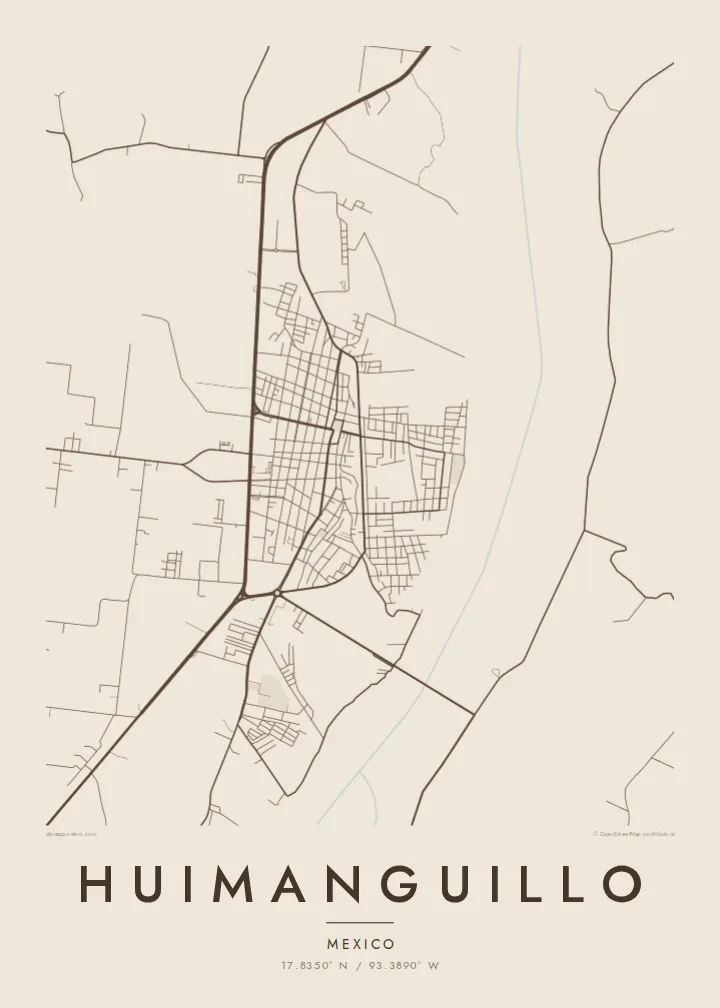
Straight streets and rectangular blocks give the centre an orderly, readable structure. This is the densest part of the print and the natural focus of the composition.
Fakatino mape mukamuka · Mexico
17.8350° N / 93.3890° W
A Tabasco town laid out on a regular street grid, surrounded by the rivers, wetlands and farmland of the Gulf lowlands.


Taha e taone, lima e onoonoaga
Tapaki e taha puhala ke kitia ai ki luga he puipui. Kua tatai e totogi he tau puhala oti — pete he lolomi, poloka, po ke faila HD.
 Tau pikselo mooli · faila lolomi 24 × 36″
Maama mitaki ke lolomi
Ko e 100% e fahi mooli mai he faila lolomi. Ko e tau poster oti — pete kua lolomi, poloka, po ke utu hifo — kua taute ke he ha mautolu a tau tokoluga (server) ke he 300 DPI, hokotia ke he 7,200 × 10,800 piksela, ke maeke ai e tau ala ikiiki tote ke maaliali fakamitaki he lolomi 24 × 36″.
He Pā


Ko e mape
Huimanguillo is the seat of the largest municipality in Tabasco, in the west of the state near the borders with Veracruz and Chiapas. The town itself follows a mostly regular grid of rectangular blocks. The map around it, though, is dominated by water and by the flat, low ground typical of the Gulf coastal plain.
Tabasco is one of the wettest parts of Mexico, and its landscape is threaded with rivers, streams, lagoons and marshes. Around Huimanguillo these appear as meandering lines and irregular water bodies between pasture and plantation. Further south the municipality rises toward hillier country on the way to the Chiapas highlands, which gives the wider region a different texture.
A Huimanguillo map poster pairs the neat geometry of the town with the looser shapes of the land around it. In black and white the grid becomes a compact dark block and the waterways read as fine, wandering lines. It is a calm, graphic portrait of a place where settlement and water have always had to negotiate with each other.
Straight streets and rectangular blocks give the centre an orderly, readable structure. This is the densest part of the print and the natural focus of the composition.
Rivers and streams wander across the flat plain in loops and bends, often next to lagoons and marshy ground that appear as soft, irregular shapes on the map.
The municipality extends south toward higher ground near Chiapas, a change of terrain that shows how varied this corner of Tabasco is beyond the town itself.
Taute ke ha hau
Lafi e aho, taha higoa po ke taha kupu haau, hiki e fakatino, lahi po ke tuaga.
Ko e kitiaaga nakai totogi kua tote e maaliali mo e fakamailoga vai. Ko e tau lolomi mo e tau faila HD kua taute ke he 300 DPI, hokotia ke he 7,200 × 10,800 px, nakai fai fakamailoga vai.
Ko e ha Huimanguillo
For people from western Tabasco, Huimanguillo is a reference point: the town where errands, schooling and family gatherings happen. A map of it is a personal way to keep that place in view, wherever life has taken them.
Write your own title and subtitle, in Spanish if you like, and keep or edit the coordinates line. Pick from five styles, including Paper and Sand for a softer look, then download the HD files for $9 or order a printed poster.
Talaage e poster Huimanguillo| Lahi he lolomi | Maama | Tau faila |
|---|---|---|
| 30 × 40 cm11.8 × 15.7″ | 3,543 × 4,724 px | PNG · PDF |
| 29.7 × 42 cm (A3)11.7 × 16.5″ | 3,508 × 4,961 px | PNG · PDF |
| 42 × 59.4 cm (A2)16.5 × 23.4″ | 4,961 × 7,016 px | PNG · PDF |
| 45.7 × 61 cm18 × 24″ | 5,400 × 7,200 px | PNG · PDF |
| 50 × 70 cm19.7 × 27.6″ | 5,906 × 8,268 px | PNG · PDF |
| 61 × 91.4 cm24 × 36″ | 7,200 × 10,800 px | PNG · PDF |
Ke fakatatai, ko e fakatino noa kua 900 px e laulahi, fai fakamailoga mo e mo e tau mata komipiuta ni. Ko e tau faila HD kua ato hoko ke he 8× e maama ke he tau faahi takitaha mo e lolomi mitaki he lahi katoa he fakatino.
Fifili e taha puhala i luga he kupega, ti fifili e Poster Lolomi — e lahi mo e, kaeke ke manako ai koe, taha poloka — po ke Tau Faila HD Fakaeletonika. Ko e fakaotiaga totogi ko e taha gahua ni, ti ko e kupega he hau a talaaga ka fakafou fakahaga i mua he fakaotiaga e totogi.
Kua lolomi ai ke he pepa mitaki 200 gsm matte he taha he tau lahi ono, mai he 30 × 40 cm ke hoko ke he 24 × 36″. Kamata e tau poster lolomi mai he $39, kua putoia ai e utaaga.
E. Fifili e poloka akau malolō ke he lanu uli, tea, akau oki mooli, po ke akau pouli. Kua fakalataha mo e sioga malolō nakai malepe ti kua mautali ke tautau. Kamata e tau poster poloka mai he $99, kua putoia ai e utaaga.
Nakai totogi e fakafano ke he motu 60+. Ko e fakatino taha kua lolomi he fenoga lolomi ha mautolu kua tata mo e tau motu 30+, kua hoko mai he tau aho gahua 3–7. Maeke ia koe ke kikite e tuaga mo e fakamuitua he lalo he Haku Tau Fakatonu. Ke he falu motu kua 2–5 e tau tapu, ti ka nakai fakafano a mautolu ki ai, to fakaha he api tupe ia ki mua he totogi.
Fakafano mai e taha ata ki a mautolu he loto he 14 e tau aho tali mai he hokoaga, ti to lolomi foki e mautolu nakai totogi po ke liu atu e totogi ki a koe.
E. He editor i luga he kupega nei, hikihiki e matakupu, e matakupu lalo mo e laini coordinates ke he taha mena kua manako a koe ki ai, ti fifili e puhala mo e lahi. Ko e tau talaaga lolomi, poloka mo e fakaeletonika oti kua fakaaoga tonu e hau a fakatino.
Ma e $9 ka moua e koe e tau faila PNG 300 DPI mo e PDF kua mautali ke lolomi he tau lahi ono oti, nakai fai fakamailoga vai, ke lolomi i fe mena. Nakai maopoopo agaia? Utu hifo fakamua e kitiaaga nakai totogi ne fai fakamailoga vai.
Tata mai
