Planned layout
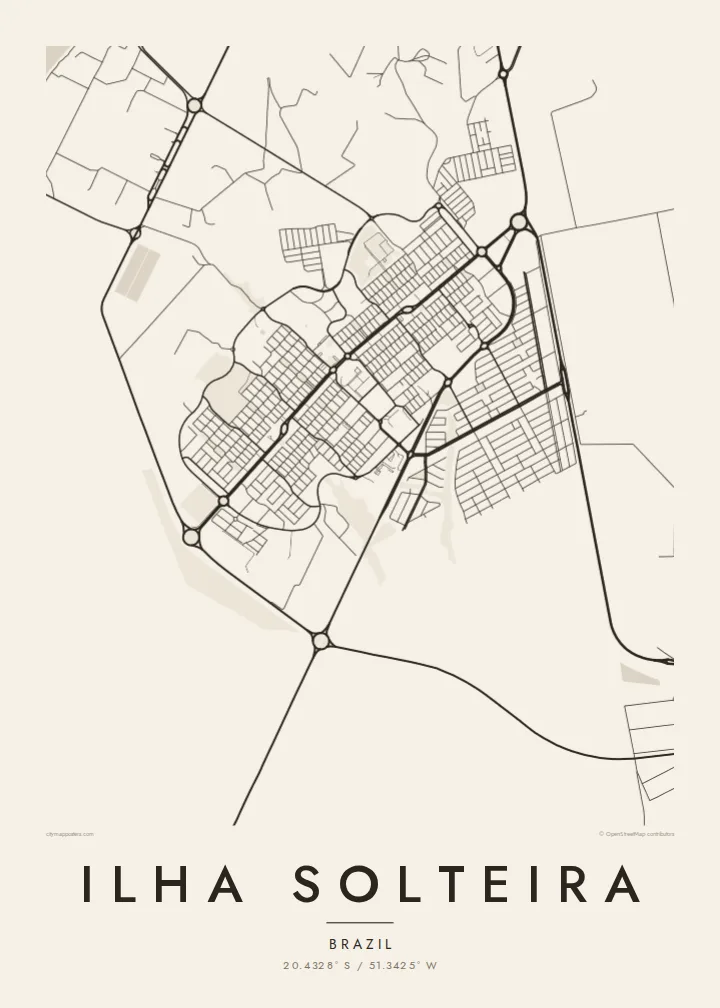
Laid out as a complete scheme, the town has sweeping avenues and curved residential streets arranged into distinct neighbourhoods, a pattern rarely seen in Brazilian towns that grew up organically.
Fakatino mape mukamuka · Brazil
20.4328° S / 51.3425° W
A planned town above a vast reservoir on the Paraná River, laid out for the builders of a major hydroelectric dam.




Taha e taone, lima e onoonoaga
Tapaki e taha puhala ke kitia ai ki luga he puipui. Kua tatai e totogi he tau puhala oti — pete he lolomi, poloka, po ke faila HD.
 Tau pikselo mooli · faila lolomi 24 × 36″
Maama mitaki ke lolomi
Ko e 100% e fahi mooli mai he faila lolomi. Ko e tau poster oti — pete kua lolomi, poloka, po ke utu hifo — kua taute ke he ha mautolu a tau tokoluga (server) ke he 300 DPI, hokotia ke he 7,200 × 10,800 piksela, ke maeke ai e tau ala ikiiki tote ke maaliali fakamitaki he lolomi 24 × 36″.
He Pā


Ko e mape
Ilha Solteira was created in the 1960s to house the workers building the Ilha Solteira hydroelectric plant on the Paraná River, on the border between São Paulo and Mato Grosso do Sul. The town was designed from scratch, and the map shows it: broad avenues, curving residential streets and clearly defined neighbourhood units, all set on high ground above the water.
The reservoir created by the dam dominates the surroundings. Long arms of water reach up the valleys of the Paraná and its tributaries, and their irregular outlines contrast with the town's deliberate plan. The state university UNESP has a campus here, known particularly for engineering, and students make up a large share of the town's life.
An Ilha Solteira map poster suits former students of the university, families whose history is tied to the building of the dam, and anyone who admires modernist town planning. Seen from above, the town looks almost like an architectural drawing set against the broad, uneven water of the reservoir.
Laid out as a complete scheme, the town has sweeping avenues and curved residential streets arranged into distinct neighbourhoods, a pattern rarely seen in Brazilian towns that grew up organically.
The large lake behind the dam wraps around the area in long, branching arms, giving the map a wide, irregular waterline on several sides.
A UNESP campus occupies part of the town, its buildings and grounds adding a distinct block of open space and institutional layout to the map.
Taute ke ha hau
Lafi e aho, taha higoa po ke taha kupu haau, hiki e fakatino, lahi po ke tuaga.
Ko e kitiaaga nakai totogi kua tote e maaliali mo e fakamailoga vai. Ko e tau lolomi mo e tau faila HD kua taute ke he 300 DPI, hokotia ke he 7,200 × 10,800 px, nakai fai fakamailoga vai.
Ko e ha Ilha Solteira
For many people, Ilha Solteira was a place of study or of a family's working life on the dam. A map poster keeps its unusual, carefully drawn plan on the wall, and its design-minded layout suits a clean, contemporary room.
Add a title, subtitle and coordinates of your choice, such as a graduation year, and pick Classic black & white, Noir, Paper, Blueprint or Sand. Buy the six-size HD files for $9, or order a matte print with an optional wooden frame.
Talaage e poster Ilha Solteira| Lahi he lolomi | Maama | Tau faila |
|---|---|---|
| 30 × 40 cm11.8 × 15.7″ | 3,543 × 4,724 px | PNG · PDF |
| 29.7 × 42 cm (A3)11.7 × 16.5″ | 3,508 × 4,961 px | PNG · PDF |
| 42 × 59.4 cm (A2)16.5 × 23.4″ | 4,961 × 7,016 px | PNG · PDF |
| 45.7 × 61 cm18 × 24″ | 5,400 × 7,200 px | PNG · PDF |
| 50 × 70 cm19.7 × 27.6″ | 5,906 × 8,268 px | PNG · PDF |
| 61 × 91.4 cm24 × 36″ | 7,200 × 10,800 px | PNG · PDF |
Ke fakatatai, ko e fakatino noa kua 900 px e laulahi, fai fakamailoga mo e mo e tau mata komipiuta ni. Ko e tau faila HD kua ato hoko ke he 8× e maama ke he tau faahi takitaha mo e lolomi mitaki he lahi katoa he fakatino.
Fifili e taha puhala i luga he kupega, ti fifili e Poster Lolomi — e lahi mo e, kaeke ke manako ai koe, taha poloka — po ke Tau Faila HD Fakaeletonika. Ko e fakaotiaga totogi ko e taha gahua ni, ti ko e kupega he hau a talaaga ka fakafou fakahaga i mua he fakaotiaga e totogi.
Kua lolomi ai ke he pepa mitaki 200 gsm matte he taha he tau lahi ono, mai he 30 × 40 cm ke hoko ke he 24 × 36″. Kamata e tau poster lolomi mai he $39, kua putoia ai e utaaga.
E. Fifili e poloka akau malolō ke he lanu uli, tea, akau oki mooli, po ke akau pouli. Kua fakalataha mo e sioga malolō nakai malepe ti kua mautali ke tautau. Kamata e tau poster poloka mai he $99, kua putoia ai e utaaga.
Nakai totogi e fakafano ke he motu 60+. Ko e fakatino taha kua lolomi he fenoga lolomi ha mautolu kua tata mo e tau motu 30+, kua hoko mai he tau aho gahua 3–7. Maeke ia koe ke kikite e tuaga mo e fakamuitua he lalo he Haku Tau Fakatonu. Ke he falu motu kua 2–5 e tau tapu, ti ka nakai fakafano a mautolu ki ai, to fakaha he api tupe ia ki mua he totogi.
Fakafano mai e taha ata ki a mautolu he loto he 14 e tau aho tali mai he hokoaga, ti to lolomi foki e mautolu nakai totogi po ke liu atu e totogi ki a koe.
E. He editor i luga he kupega nei, hikihiki e matakupu, e matakupu lalo mo e laini coordinates ke he taha mena kua manako a koe ki ai, ti fifili e puhala mo e lahi. Ko e tau talaaga lolomi, poloka mo e fakaeletonika oti kua fakaaoga tonu e hau a fakatino.
Ma e $9 ka moua e koe e tau faila PNG 300 DPI mo e PDF kua mautali ke lolomi he tau lahi ono oti, nakai fai fakamailoga vai, ke lolomi i fe mena. Nakai maopoopo agaia? Utu hifo fakamua e kitiaaga nakai totogi ne fai fakamailoga vai.
Tata mai
