Parasio quarter
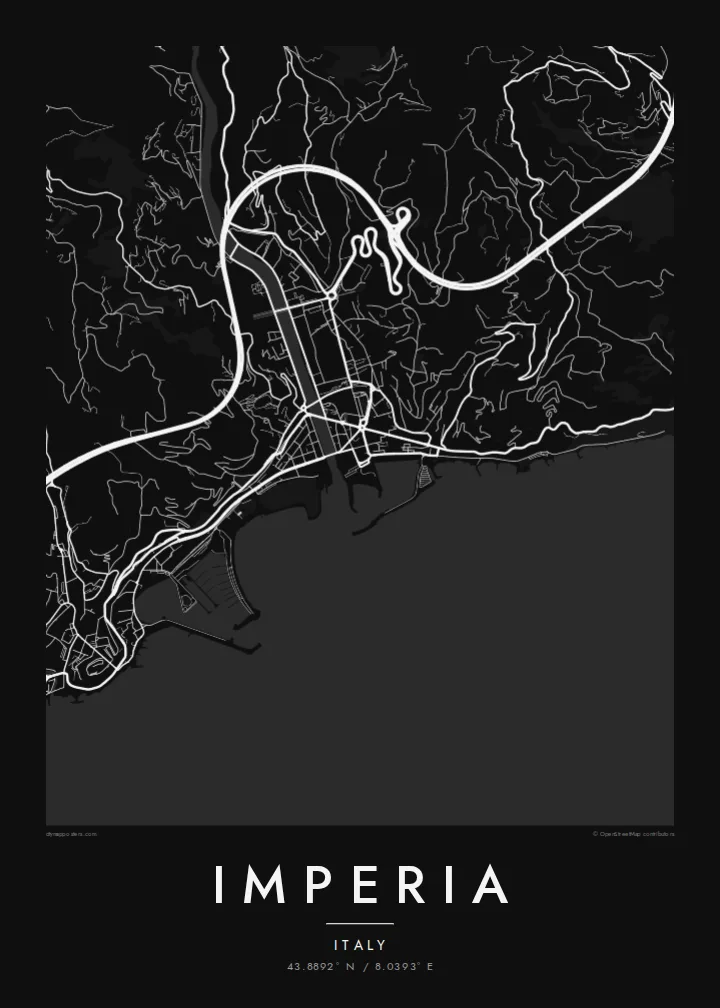
Porto Maurizio's old quarter crowns its promontory with a dense tangle of stepped lanes and alleys, one of the most intricate patches of streets on the whole poster.
Fakatino mape mukamuka · Italy
43.8892° N / 8.0393° E
Two old towns on the Ligurian coast, Porto Maurizio and Oneglia, joined across the mouth of the Impero river.



Taha e taone, lima e onoonoaga
Tapaki e taha puhala ke kitia ai ki luga he puipui. Kua tatai e totogi he tau puhala oti — pete he lolomi, poloka, po ke faila HD.
 Tau pikselo mooli · faila lolomi 24 × 36″
Maama mitaki ke lolomi
Ko e 100% e fahi mooli mai he faila lolomi. Ko e tau poster oti — pete kua lolomi, poloka, po ke utu hifo — kua taute ke he ha mautolu a tau tokoluga (server) ke he 300 DPI, hokotia ke he 7,200 × 10,800 piksela, ke maeke ai e tau ala ikiiki tote ke maaliali fakamitaki he lolomi 24 × 36″.
He Pā


Ko e mape
Imperia was created in 1923 by joining two separate towns on the western Riviera, Porto Maurizio and Oneglia, together with several smaller villages. The Impero river, which gave the new city its name, flows between them to the sea. A century later the two halves still have distinct characters, and on a map they read as two centres rather than one.
Porto Maurizio climbs a rocky promontory. Its old quarter, the Parasio, is a knot of steep lanes around the hilltop, and the large neoclassical Basilica of San Maurizio stands close by. Oneglia, to the east, is flatter and more regular, with an arcaded street, a working harbour and a history tied to olive oil and pasta-making. Terraced olive groves cover the hills above both.
An Imperia map poster brings out that double structure very clearly. Two harbours, two old centres and a river mouth between them sit along a curving stretch of Mediterranean coast, with steep hinterland behind. It is a thoughtful choice for anyone who has spent summers on the Riviera di Ponente or has family roots in either town.
Porto Maurizio's old quarter crowns its promontory with a dense tangle of stepped lanes and alleys, one of the most intricate patches of streets on the whole poster.
Oneglia's port and the arcaded streets behind it form a flatter, more orderly pattern, historically linked to the olive oil trade that shaped the town's economy.
The short river that gave the city its name reaches the sea between the two towns. It is a clear dividing line that explains Imperia's unusual two-centred shape.
Taute ke ha hau
Lafi e aho, taha higoa po ke taha kupu haau, hiki e fakatino, lahi po ke tuaga.
Ko e kitiaaga nakai totogi kua tote e maaliali mo e fakamailoga vai. Ko e tau lolomi mo e tau faila HD kua taute ke he 300 DPI, hokotia ke he 7,200 × 10,800 px, nakai fai fakamailoga vai.
Ko e ha Imperia
Imperia rewards people who know it well: the walk between the two harbours, the climb into the Parasio, the olive terraces above the coast. A map poster keeps all of those places together in one clean, legible image.
You can title it Imperia or name one of its two halves, add a date or a line of your own, and choose from five styles. The digital files come in six sizes, including 50×70 cm, A2 and 24×36″, with no watermark.
Talaage e poster Imperia| Lahi he lolomi | Maama | Tau faila |
|---|---|---|
| 30 × 40 cm11.8 × 15.7″ | 3,543 × 4,724 px | PNG · PDF |
| 29.7 × 42 cm (A3)11.7 × 16.5″ | 3,508 × 4,961 px | PNG · PDF |
| 42 × 59.4 cm (A2)16.5 × 23.4″ | 4,961 × 7,016 px | PNG · PDF |
| 45.7 × 61 cm18 × 24″ | 5,400 × 7,200 px | PNG · PDF |
| 50 × 70 cm19.7 × 27.6″ | 5,906 × 8,268 px | PNG · PDF |
| 61 × 91.4 cm24 × 36″ | 7,200 × 10,800 px | PNG · PDF |
Ke fakatatai, ko e fakatino noa kua 900 px e laulahi, fai fakamailoga mo e mo e tau mata komipiuta ni. Ko e tau faila HD kua ato hoko ke he 8× e maama ke he tau faahi takitaha mo e lolomi mitaki he lahi katoa he fakatino.
Fifili e taha puhala i luga he kupega, ti fifili e Poster Lolomi — e lahi mo e, kaeke ke manako ai koe, taha poloka — po ke Tau Faila HD Fakaeletonika. Ko e fakaotiaga totogi ko e taha gahua ni, ti ko e kupega he hau a talaaga ka fakafou fakahaga i mua he fakaotiaga e totogi.
Kua lolomi ai ke he pepa mitaki 200 gsm matte he taha he tau lahi ono, mai he 30 × 40 cm ke hoko ke he 24 × 36″. Kamata e tau poster lolomi mai he $39, kua putoia ai e utaaga.
E. Fifili e poloka akau malolō ke he lanu uli, tea, akau oki mooli, po ke akau pouli. Kua fakalataha mo e sioga malolō nakai malepe ti kua mautali ke tautau. Kamata e tau poster poloka mai he $99, kua putoia ai e utaaga.
Nakai totogi e fakafano ke he motu 60+. Ko e fakatino taha kua lolomi he fenoga lolomi ha mautolu kua tata mo e tau motu 30+, kua hoko mai he tau aho gahua 3–7. Maeke ia koe ke kikite e tuaga mo e fakamuitua he lalo he Haku Tau Fakatonu. Ke he falu motu kua 2–5 e tau tapu, ti ka nakai fakafano a mautolu ki ai, to fakaha he api tupe ia ki mua he totogi.
Fakafano mai e taha ata ki a mautolu he loto he 14 e tau aho tali mai he hokoaga, ti to lolomi foki e mautolu nakai totogi po ke liu atu e totogi ki a koe.
E. He editor i luga he kupega nei, hikihiki e matakupu, e matakupu lalo mo e laini coordinates ke he taha mena kua manako a koe ki ai, ti fifili e puhala mo e lahi. Ko e tau talaaga lolomi, poloka mo e fakaeletonika oti kua fakaaoga tonu e hau a fakatino.
Ma e $9 ka moua e koe e tau faila PNG 300 DPI mo e PDF kua mautali ke lolomi he tau lahi ono oti, nakai fai fakamailoga vai, ke lolomi i fe mena. Nakai maopoopo agaia? Utu hifo fakamua e kitiaaga nakai totogi ne fai fakamailoga vai.
