Shrine bay
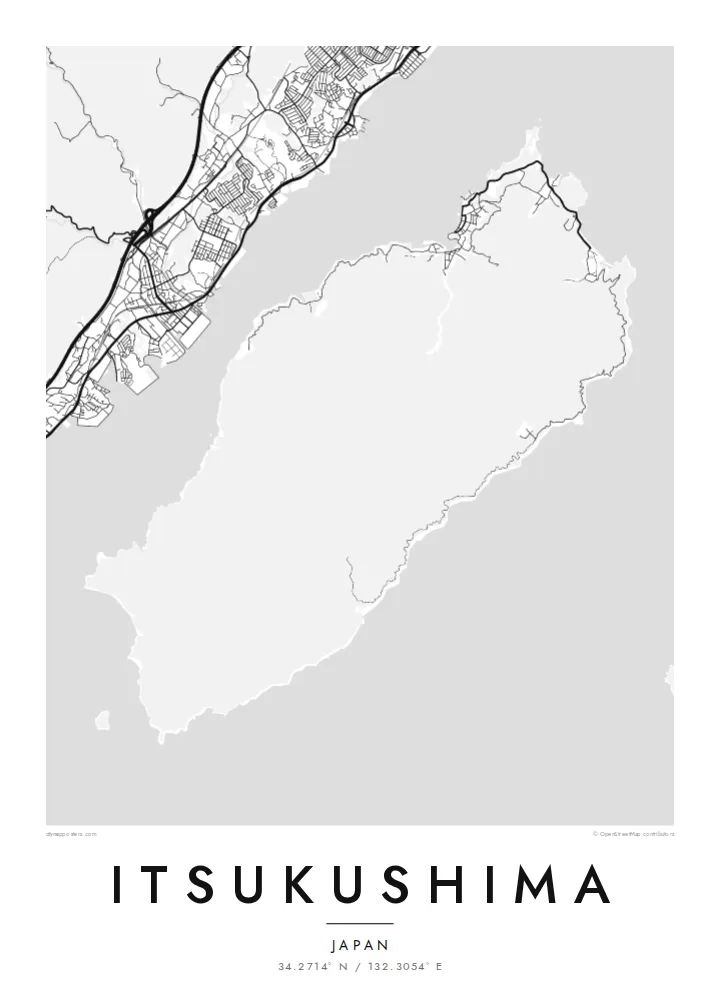
Itsukushima Shrine occupies a small inlet on the north coast, its buildings set on piers over the water. It is a distinctive shape where land and sea overlap.
Fakatino mape mukamuka · Japan
34.2714° N / 132.3054° E
A mountainous, forested island in Hiroshima Bay, with a small shrine town gathered along its northern shore facing the mainland.


Taha e taone, lima e onoonoaga
Tapaki e taha puhala ke kitia ai ki luga he puipui. Kua tatai e totogi he tau puhala oti — pete he lolomi, poloka, po ke faila HD.
 Tau pikselo mooli · faila lolomi 24 × 36″
Maama mitaki ke lolomi
Ko e 100% e fahi mooli mai he faila lolomi. Ko e tau poster oti — pete kua lolomi, poloka, po ke utu hifo — kua taute ke he ha mautolu a tau tokoluga (server) ke he 300 DPI, hokotia ke he 7,200 × 10,800 piksela, ke maeke ai e tau ala ikiiki tote ke maaliali fakamitaki he lolomi 24 × 36″.
He Pā


Ko e mape
Itsukushima, widely known as Miyajima, lies in the northwest of Hiroshima Bay, a short ferry ride from the mainland. It is a steep, heavily wooded island that rises to the summit of Mount Misen, and most of its interior has no roads at all. Settlement is mostly confined to a narrow strip on the northern coast, where the town, the shrine and the ferry pier sit side by side.
Itsukushima Shrine is built over the tidal flats of a small bay, so at high tide its halls and corridors appear to float on the sea. Its great vermilion torii gate stands offshore in the water. The shrine was listed as a UNESCO World Heritage site in 1996, and the island has long been regarded as sacred, with Mount Misen at its spiritual heart.
Tame sika deer wander the streets of the town, and a ropeway climbs from a forested valley toward the summit. An Itsukushima map poster shows the contrast that makes the island special. On one shore there is a tiny, dense cluster of lanes and temples, and behind it a large, wild, roadless mountain slope stretches away to the south.
Itsukushima Shrine occupies a small inlet on the north coast, its buildings set on piers over the water. It is a distinctive shape where land and sea overlap.
The island's sacred peak rises behind the town. Only hiking trails and the ropeway cross its forested slopes, which leaves a wide, quiet space on the map.
A compact cluster of lanes, shops and temples lines the shore between the ferry pier and the shrine. It is the only dense street pattern on the island.
Taute ke ha hau
Lafi e aho, taha higoa po ke taha kupu haau, hiki e fakatino, lahi po ke tuaga.
Ko e kitiaaga nakai totogi kua tote e maaliali mo e fakamailoga vai. Ko e tau lolomi mo e tau faila HD kua taute ke he 300 DPI, hokotia ke he 7,200 × 10,800 px, nakai fai fakamailoga vai.
Ko e ha Itsukushima
Itsukushima is often the calmest memory of a trip to Japan: the torii at dusk, the deer, the climb up Misen. Its map balances a delicate cluster of lanes against broad, empty slopes, and it suits a quiet room, a study or anywhere you want a restful image that means something.
Set your own title, add the date of your visit to the subtitle and adjust the coordinates line. Choose among five styles; Paper feels close to traditional printmaking. Download the HD files for $9 in six sizes, or order a printed matte poster with an optional wooden frame.
Talaage e poster Itsukushima| Lahi he lolomi | Maama | Tau faila |
|---|---|---|
| 30 × 40 cm11.8 × 15.7″ | 3,543 × 4,724 px | PNG · PDF |
| 29.7 × 42 cm (A3)11.7 × 16.5″ | 3,508 × 4,961 px | PNG · PDF |
| 42 × 59.4 cm (A2)16.5 × 23.4″ | 4,961 × 7,016 px | PNG · PDF |
| 45.7 × 61 cm18 × 24″ | 5,400 × 7,200 px | PNG · PDF |
| 50 × 70 cm19.7 × 27.6″ | 5,906 × 8,268 px | PNG · PDF |
| 61 × 91.4 cm24 × 36″ | 7,200 × 10,800 px | PNG · PDF |
Ke fakatatai, ko e fakatino noa kua 900 px e laulahi, fai fakamailoga mo e mo e tau mata komipiuta ni. Ko e tau faila HD kua ato hoko ke he 8× e maama ke he tau faahi takitaha mo e lolomi mitaki he lahi katoa he fakatino.
Fifili e taha puhala i luga he kupega, ti fifili e Poster Lolomi — e lahi mo e, kaeke ke manako ai koe, taha poloka — po ke Tau Faila HD Fakaeletonika. Ko e fakaotiaga totogi ko e taha gahua ni, ti ko e kupega he hau a talaaga ka fakafou fakahaga i mua he fakaotiaga e totogi.
Kua lolomi ai ke he pepa mitaki 200 gsm matte he taha he tau lahi ono, mai he 30 × 40 cm ke hoko ke he 24 × 36″. Kamata e tau poster lolomi mai he $39, kua putoia ai e utaaga.
E. Fifili e poloka akau malolō ke he lanu uli, tea, akau oki mooli, po ke akau pouli. Kua fakalataha mo e sioga malolō nakai malepe ti kua mautali ke tautau. Kamata e tau poster poloka mai he $99, kua putoia ai e utaaga.
Nakai totogi e fakafano ke he motu 60+. Ko e fakatino taha kua lolomi he fenoga lolomi ha mautolu kua tata mo e tau motu 30+, kua hoko mai he tau aho gahua 3–7. Maeke ia koe ke kikite e tuaga mo e fakamuitua he lalo he Haku Tau Fakatonu. Ke he falu motu kua 2–5 e tau tapu, ti ka nakai fakafano a mautolu ki ai, to fakaha he api tupe ia ki mua he totogi.
Fakafano mai e taha ata ki a mautolu he loto he 14 e tau aho tali mai he hokoaga, ti to lolomi foki e mautolu nakai totogi po ke liu atu e totogi ki a koe.
E. He editor i luga he kupega nei, hikihiki e matakupu, e matakupu lalo mo e laini coordinates ke he taha mena kua manako a koe ki ai, ti fifili e puhala mo e lahi. Ko e tau talaaga lolomi, poloka mo e fakaeletonika oti kua fakaaoga tonu e hau a fakatino.
Ma e $9 ka moua e koe e tau faila PNG 300 DPI mo e PDF kua mautali ke lolomi he tau lahi ono oti, nakai fai fakamailoga vai, ke lolomi i fe mena. Nakai maopoopo agaia? Utu hifo fakamua e kitiaaga nakai totogi ne fai fakamailoga vai.
Tata mai
