Colonial grid
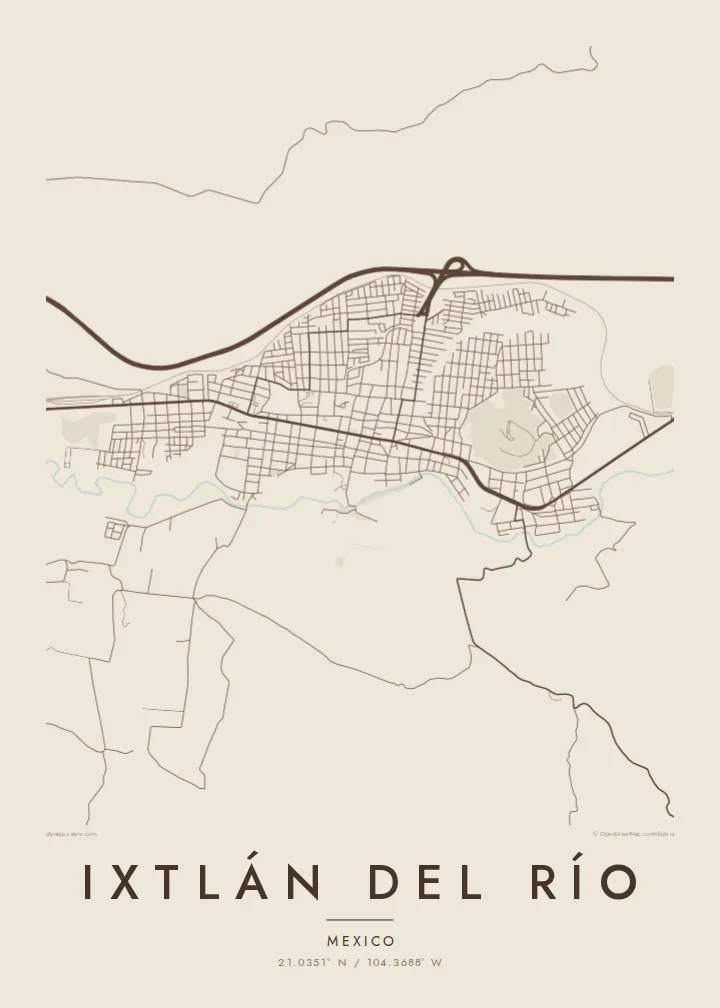
The town centre is laid out in straight blocks around a main plaza, a clear, regular pattern that reads well at every poster size.
Fakatino mape mukamuka · Mexico
21.0351° N / 104.3688° W
A Nayarit highway town in a green valley, with a grid of streets and a round pre-Hispanic temple at its edge.


Taha e taone, lima e onoonoaga
Tapaki e taha puhala ke kitia ai ki luga he puipui. Kua tatai e totogi he tau puhala oti — pete he lolomi, poloka, po ke faila HD.
 Tau pikselo mooli · faila lolomi 24 × 36″
Maama mitaki ke lolomi
Ko e 100% e fahi mooli mai he faila lolomi. Ko e tau poster oti — pete kua lolomi, poloka, po ke utu hifo — kua taute ke he ha mautolu a tau tokoluga (server) ke he 300 DPI, hokotia ke he 7,200 × 10,800 piksela, ke maeke ai e tau ala ikiiki tote ke maaliali fakamitaki he lolomi 24 × 36″.
He Pā


Ko e mape
Ixtlán del Río lies in the southeastern part of Nayarit, in western Mexico, on the main route between Guadalajara and Tepic. It sits in a valley surrounded by the hills of the Sierra Madre Occidental foothills. On a map the town appears as an orderly grid of streets, with the highway running through it as its most important line and farmland spreading across the valley floor.
Just outside the town lies the archaeological site of Los Toriles, known for its circular temple, generally associated with Ehécatl-Quetzalcóatl, the wind god. Round temples are rare in Mesoamerica, and this one makes the site distinctive. An Ixtlán del Río map poster places the ruins beside the modern town, two layers of settlement in the same valley.
The town centre follows the Spanish colonial pattern, with a main plaza, a church and straight streets arranged in blocks. As the town reaches its edges, the grid meets fields and hillsides, and roads lead off toward neighbouring communities. In print this gives a balanced composition, with regular streets, the long diagonal of the highway, and open land around them.
The town centre is laid out in straight blocks around a main plaza, a clear, regular pattern that reads well at every poster size.
The main road between the two state capitals passes through town, making a strong line that ties Ixtlán del Río to western Mexico.
Close to town, the archaeological zone with its circular temple adds a trace of pre-Hispanic settlement to the map's otherwise modern street pattern.
Taute ke ha hau
Lafi e aho, taha higoa po ke taha kupu haau, hiki e fakatino, lahi po ke tuaga.
Ko e kitiaaga nakai totogi kua tote e maaliali mo e fakamailoga vai. Ko e tau lolomi mo e tau faila HD kua taute ke he 300 DPI, hokotia ke he 7,200 × 10,800 px, nakai fai fakamailoga vai.
Ko e ha Ixtlán del Río
For families from Nayarit living in Guadalajara, Mexico City or the United States, a map of Ixtlán del Río brings the town's streets home. It is also a fine souvenir for travellers who stopped to see Los Toriles.
Add a title, a subtitle in Spanish or English and the coordinates, then choose Classic black & white, Noir, Paper, Blueprint or Sand. HD files cost $9, and printed posters on matte paper can be ordered with a wooden frame.
Talaage e poster Ixtlán del Río| Lahi he lolomi | Maama | Tau faila |
|---|---|---|
| 30 × 40 cm11.8 × 15.7″ | 3,543 × 4,724 px | PNG · PDF |
| 29.7 × 42 cm (A3)11.7 × 16.5″ | 3,508 × 4,961 px | PNG · PDF |
| 42 × 59.4 cm (A2)16.5 × 23.4″ | 4,961 × 7,016 px | PNG · PDF |
| 45.7 × 61 cm18 × 24″ | 5,400 × 7,200 px | PNG · PDF |
| 50 × 70 cm19.7 × 27.6″ | 5,906 × 8,268 px | PNG · PDF |
| 61 × 91.4 cm24 × 36″ | 7,200 × 10,800 px | PNG · PDF |
Ke fakatatai, ko e fakatino noa kua 900 px e laulahi, fai fakamailoga mo e mo e tau mata komipiuta ni. Ko e tau faila HD kua ato hoko ke he 8× e maama ke he tau faahi takitaha mo e lolomi mitaki he lahi katoa he fakatino.
Fifili e taha puhala i luga he kupega, ti fifili e Poster Lolomi — e lahi mo e, kaeke ke manako ai koe, taha poloka — po ke Tau Faila HD Fakaeletonika. Ko e fakaotiaga totogi ko e taha gahua ni, ti ko e kupega he hau a talaaga ka fakafou fakahaga i mua he fakaotiaga e totogi.
Kua lolomi ai ke he pepa mitaki 200 gsm matte he taha he tau lahi ono, mai he 30 × 40 cm ke hoko ke he 24 × 36″. Kamata e tau poster lolomi mai he $39, kua putoia ai e utaaga.
E. Fifili e poloka akau malolō ke he lanu uli, tea, akau oki mooli, po ke akau pouli. Kua fakalataha mo e sioga malolō nakai malepe ti kua mautali ke tautau. Kamata e tau poster poloka mai he $99, kua putoia ai e utaaga.
Nakai totogi e fakafano ke he motu 60+. Ko e fakatino taha kua lolomi he fenoga lolomi ha mautolu kua tata mo e tau motu 30+, kua hoko mai he tau aho gahua 3–7. Maeke ia koe ke kikite e tuaga mo e fakamuitua he lalo he Haku Tau Fakatonu. Ke he falu motu kua 2–5 e tau tapu, ti ka nakai fakafano a mautolu ki ai, to fakaha he api tupe ia ki mua he totogi.
Fakafano mai e taha ata ki a mautolu he loto he 14 e tau aho tali mai he hokoaga, ti to lolomi foki e mautolu nakai totogi po ke liu atu e totogi ki a koe.
E. He editor i luga he kupega nei, hikihiki e matakupu, e matakupu lalo mo e laini coordinates ke he taha mena kua manako a koe ki ai, ti fifili e puhala mo e lahi. Ko e tau talaaga lolomi, poloka mo e fakaeletonika oti kua fakaaoga tonu e hau a fakatino.
Ma e $9 ka moua e koe e tau faila PNG 300 DPI mo e PDF kua mautali ke lolomi he tau lahi ono oti, nakai fai fakamailoga vai, ke lolomi i fe mena. Nakai maopoopo agaia? Utu hifo fakamua e kitiaaga nakai totogi ne fai fakamailoga vai.
Tata mai
