Walled city grid
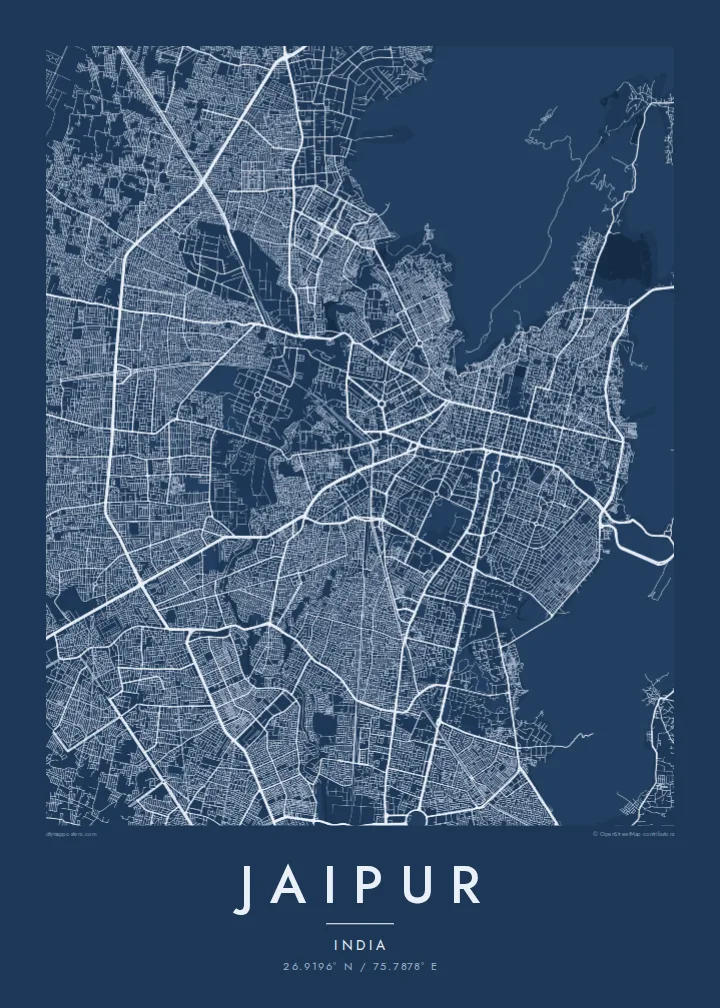
Straight, wide streets cross the old town at right angles and divide it into large blocks. It is one of the clearest planned patterns of any historic city.
Fakatino mape mukamuka · India
26.9196° N / 75.7878° E
An eighteenth-century grid city, walled and pink, set against the Aravalli ridges with forts along the skyline.



Taha e taone, lima e onoonoaga
Tapaki e taha puhala ke kitia ai ki luga he puipui. Kua tatai e totogi he tau puhala oti — pete he lolomi, poloka, po ke faila HD.
 Tau pikselo mooli · faila lolomi 24 × 36″
Maama mitaki ke lolomi
Ko e 100% e fahi mooli mai he faila lolomi. Ko e tau poster oti — pete kua lolomi, poloka, po ke utu hifo — kua taute ke he ha mautolu a tau tokoluga (server) ke he 300 DPI, hokotia ke he 7,200 × 10,800 piksela, ke maeke ai e tau ala ikiiki tote ke maaliali fakamitaki he lolomi 24 × 36″.
He Pā


Ko e mape
Jaipur was founded in 1727 by Maharaja Sawai Jai Singh II and built to a deliberate plan, one of the earliest of its kind in India. From above, the walled city is unmistakable. Wide, straight bazaar streets divide the old town into large rectangular blocks, an order rarely found in historic Indian cities, and the walled city is now a UNESCO World Heritage Site.
Its buildings are painted the terracotta pink that gives Jaipur its nickname, the Pink City. The City Palace occupies the centre. Beside it stands the Jantar Mantar, an eighteenth-century astronomical observatory and another UNESCO site, and the honeycombed facade of the Hawa Mahal faces onto one of the main streets.
To the north, the Aravalli hills close in. Nahargarh Fort runs along the ridge above the walled city, the Jal Mahal stands in Man Sagar Lake, and the road continues toward Amer Fort. A Jaipur map poster sets the grid of the old town against these hills, with the modern city spreading south and west.
Straight, wide streets cross the old town at right angles and divide it into large blocks. It is one of the clearest planned patterns of any historic city.
At the heart of the grid, the palace, its courtyards and the neighbouring Jantar Mantar form a large, distinct precinct that anchors the centre of the map.
Hills and forts rise along the north of the city, with Nahargarh on the ridge and Man Sagar Lake below. They form a natural frame for the regular streets.
Taute ke ha hau
Lafi e aho, taha higoa po ke taha kupu haau, hiki e fakatino, lahi po ke tuaga.
Ko e kitiaaga nakai totogi kua tote e maaliali mo e fakamailoga vai. Ko e tau lolomi mo e tau faila HD kua taute ke he 300 DPI, hokotia ke he 7,200 × 10,800 px, nakai fai fakamailoga vai.
Ko e ha Jaipur
Jaipur is hung by people who love its design as much as its history: architects, travellers and families with roots in Rajasthan. The grid of the walled city looks remarkably modern on a wall, almost like a planning drawing.
Personalise the title and subtitle, perhaps with a wedding date or a family name, and edit the coordinates. Sand and Paper suit the Pink City, while Noir, Blueprint and Classic black & white give crisper contrast. Printed posters ship from partners in 30+ countries.
Talaage e poster Jaipur| Lahi he lolomi | Maama | Tau faila |
|---|---|---|
| 30 × 40 cm11.8 × 15.7″ | 3,543 × 4,724 px | PNG · PDF |
| 29.7 × 42 cm (A3)11.7 × 16.5″ | 3,508 × 4,961 px | PNG · PDF |
| 42 × 59.4 cm (A2)16.5 × 23.4″ | 4,961 × 7,016 px | PNG · PDF |
| 45.7 × 61 cm18 × 24″ | 5,400 × 7,200 px | PNG · PDF |
| 50 × 70 cm19.7 × 27.6″ | 5,906 × 8,268 px | PNG · PDF |
| 61 × 91.4 cm24 × 36″ | 7,200 × 10,800 px | PNG · PDF |
Ke fakatatai, ko e fakatino noa kua 900 px e laulahi, fai fakamailoga mo e mo e tau mata komipiuta ni. Ko e tau faila HD kua ato hoko ke he 8× e maama ke he tau faahi takitaha mo e lolomi mitaki he lahi katoa he fakatino.
Fifili e taha puhala i luga he kupega, ti fifili e Poster Lolomi — e lahi mo e, kaeke ke manako ai koe, taha poloka — po ke Tau Faila HD Fakaeletonika. Ko e fakaotiaga totogi ko e taha gahua ni, ti ko e kupega he hau a talaaga ka fakafou fakahaga i mua he fakaotiaga e totogi.
Kua lolomi ai ke he pepa mitaki 200 gsm matte he taha he tau lahi ono, mai he 30 × 40 cm ke hoko ke he 24 × 36″. Kamata e tau poster lolomi mai he $39, kua putoia ai e utaaga.
E. Fifili e poloka akau malolō ke he lanu uli, tea, akau oki mooli, po ke akau pouli. Kua fakalataha mo e sioga malolō nakai malepe ti kua mautali ke tautau. Kamata e tau poster poloka mai he $99, kua putoia ai e utaaga.
Nakai totogi e fakafano ke he motu 60+. Ko e fakatino taha kua lolomi he fenoga lolomi ha mautolu kua tata mo e tau motu 30+, kua hoko mai he tau aho gahua 3–7. Maeke ia koe ke kikite e tuaga mo e fakamuitua he lalo he Haku Tau Fakatonu. Ke he falu motu kua 2–5 e tau tapu, ti ka nakai fakafano a mautolu ki ai, to fakaha he api tupe ia ki mua he totogi.
Fakafano mai e taha ata ki a mautolu he loto he 14 e tau aho tali mai he hokoaga, ti to lolomi foki e mautolu nakai totogi po ke liu atu e totogi ki a koe.
E. He editor i luga he kupega nei, hikihiki e matakupu, e matakupu lalo mo e laini coordinates ke he taha mena kua manako a koe ki ai, ti fifili e puhala mo e lahi. Ko e tau talaaga lolomi, poloka mo e fakaeletonika oti kua fakaaoga tonu e hau a fakatino.
Ma e $9 ka moua e koe e tau faila PNG 300 DPI mo e PDF kua mautali ke lolomi he tau lahi ono oti, nakai fai fakamailoga vai, ke lolomi i fe mena. Nakai maopoopo agaia? Utu hifo fakamua e kitiaaga nakai totogi ne fai fakamailoga vai.
Tata mai
