Tell es-Sultan
The ancient mound on the north side of town holds layers of settlement going back more than ten millennia and is now a UNESCO World Heritage Site.
Fakatino mape mukamuka · Palestinian Territories
31.8667° N / 35.4500° E
A green oasis town far below sea level in the Jordan Valley, where irrigated gardens meet open desert


Taha e taone, lima e onoonoaga
Tapaki e taha puhala ke kitia ai ki luga he puipui. Kua tatai e totogi he tau puhala oti — pete he lolomi, poloka, po ke faila HD.
 Tau pikselo mooli · faila lolomi 24 × 36″
Maama mitaki ke lolomi
Ko e 100% e fahi mooli mai he faila lolomi. Ko e tau poster oti — pete kua lolomi, poloka, po ke utu hifo — kua taute ke he ha mautolu a tau tokoluga (server) ke he 300 DPI, hokotia ke he 7,200 × 10,800 piksela, ke maeke ai e tau ala ikiiki tote ke maaliali fakamitaki he lolomi 24 × 36″.
He Pā


Ko e mape
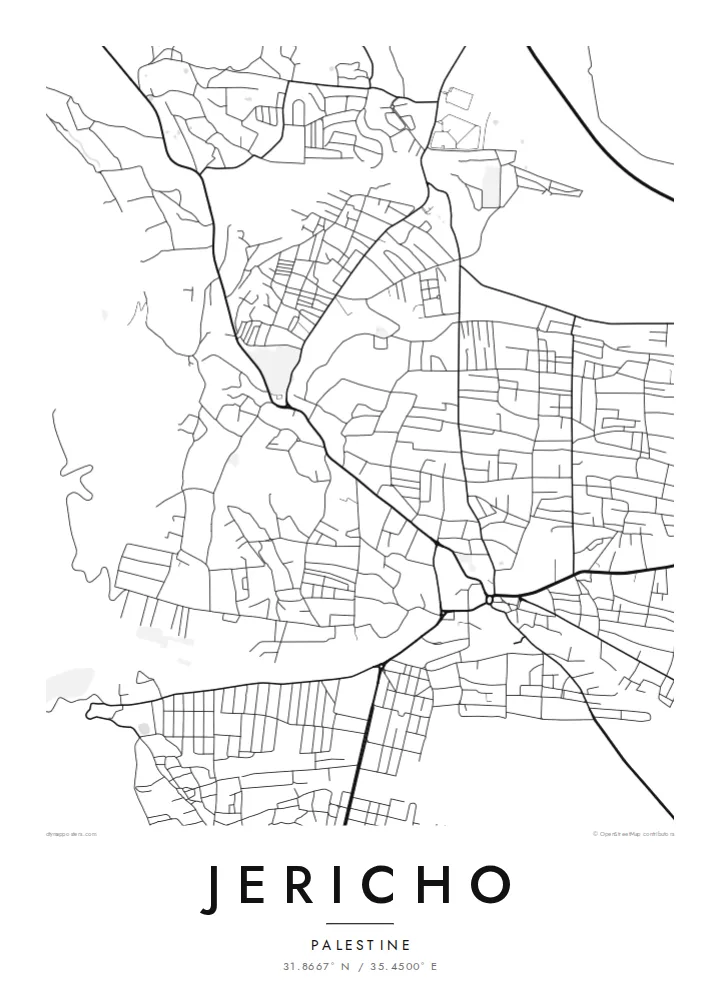
Jericho lies in the Jordan Valley, north of the Dead Sea and roughly 250 metres below sea level, which makes it the lowest city in the world. From above, the town appears as a spread of low-density streets and plots surrounded by irrigated farms and palm groves. Around this green patch lies bare desert, with the steep escarpment of the Judean hills rising to the west.
Jericho is also among the oldest continuously inhabited places on earth. The ancient mound of Tell es-Sultan, on the northern side of town, holds remains going back more than ten thousand years and was inscribed as a UNESCO World Heritage Site in 2023. Nearby are the spring of Ein es-Sultan, which has fed the oasis for millennia, and the Umayyad ruins known as Hisham's Palace.
A Jericho map poster shows a town defined by water in a dry place. The irregular grid of streets and farm plots stands out against the empty surroundings, and the roads towards Jerusalem, the Dead Sea and the Jordan River cut long lines across the valley. It is a strong image for anyone who has visited, studied its history or has family ties to the oasis.
The ancient mound on the north side of town holds layers of settlement going back more than ten millennia and is now a UNESCO World Heritage Site.
Irrigated gardens and palm groves divide the land around the town into small plots, forming a textured patch set against the surrounding desert.
Long, straight roads cross the Jordan Valley towards the Dead Sea, the river and the climb west to Jerusalem, framing the town from every side.
Taute ke ha hau
Lafi e aho, taha higoa po ke taha kupu haau, hiki e fakatino, lahi po ke tuaga.
Ko e kitiaaga nakai totogi kua tote e maaliali mo e fakamailoga vai. Ko e tau lolomi mo e tau faila HD kua taute ke he 300 DPI, hokotia ke he 7,200 × 10,800 px, nakai fai fakamailoga vai.
Ko e ha Jericho
Jericho carries a deep human story in a small, legible map. It suits history lovers, pilgrims and travellers, and it is especially meaningful for families from the town who want its streets and gardens close at hand.
Add your own title, a subtitle such as a date or family name, and keep or edit the coordinates line. Choose Classic black & white, Noir, Paper, Blueprint or Sand. Sand reflects the desert light around the oasis.
Talaage e poster Jericho| Lahi he lolomi | Maama | Tau faila |
|---|---|---|
| 30 × 40 cm11.8 × 15.7″ | 3,543 × 4,724 px | PNG · PDF |
| 29.7 × 42 cm (A3)11.7 × 16.5″ | 3,508 × 4,961 px | PNG · PDF |
| 42 × 59.4 cm (A2)16.5 × 23.4″ | 4,961 × 7,016 px | PNG · PDF |
| 45.7 × 61 cm18 × 24″ | 5,400 × 7,200 px | PNG · PDF |
| 50 × 70 cm19.7 × 27.6″ | 5,906 × 8,268 px | PNG · PDF |
| 61 × 91.4 cm24 × 36″ | 7,200 × 10,800 px | PNG · PDF |
Ke fakatatai, ko e fakatino noa kua 900 px e laulahi, fai fakamailoga mo e mo e tau mata komipiuta ni. Ko e tau faila HD kua ato hoko ke he 8× e maama ke he tau faahi takitaha mo e lolomi mitaki he lahi katoa he fakatino.
Fifili e taha puhala i luga he kupega, ti fifili e Poster Lolomi — e lahi mo e, kaeke ke manako ai koe, taha poloka — po ke Tau Faila HD Fakaeletonika. Ko e fakaotiaga totogi ko e taha gahua ni, ti ko e kupega he hau a talaaga ka fakafou fakahaga i mua he fakaotiaga e totogi.
Kua lolomi ai ke he pepa mitaki 200 gsm matte he taha he tau lahi ono, mai he 30 × 40 cm ke hoko ke he 24 × 36″. Kamata e tau poster lolomi mai he $39, kua putoia ai e utaaga.
E. Fifili e poloka akau malolō ke he lanu uli, tea, akau oki mooli, po ke akau pouli. Kua fakalataha mo e sioga malolō nakai malepe ti kua mautali ke tautau. Kamata e tau poster poloka mai he $99, kua putoia ai e utaaga.
Nakai totogi e fakafano ke he motu 60+. Ko e fakatino taha kua lolomi he fenoga lolomi ha mautolu kua tata mo e tau motu 30+, kua hoko mai he tau aho gahua 3–7. Maeke ia koe ke kikite e tuaga mo e fakamuitua he lalo he Haku Tau Fakatonu. Ke he falu motu kua 2–5 e tau tapu, ti ka nakai fakafano a mautolu ki ai, to fakaha he api tupe ia ki mua he totogi.
Fakafano mai e taha ata ki a mautolu he loto he 14 e tau aho tali mai he hokoaga, ti to lolomi foki e mautolu nakai totogi po ke liu atu e totogi ki a koe.
E. He editor i luga he kupega nei, hikihiki e matakupu, e matakupu lalo mo e laini coordinates ke he taha mena kua manako a koe ki ai, ti fifili e puhala mo e lahi. Ko e tau talaaga lolomi, poloka mo e fakaeletonika oti kua fakaaoga tonu e hau a fakatino.
Ma e $9 ka moua e koe e tau faila PNG 300 DPI mo e PDF kua mautali ke lolomi he tau lahi ono oti, nakai fai fakamailoga vai, ke lolomi i fe mena. Nakai maopoopo agaia? Utu hifo fakamua e kitiaaga nakai totogi ne fai fakamailoga vai.
Tata mai
