The great square
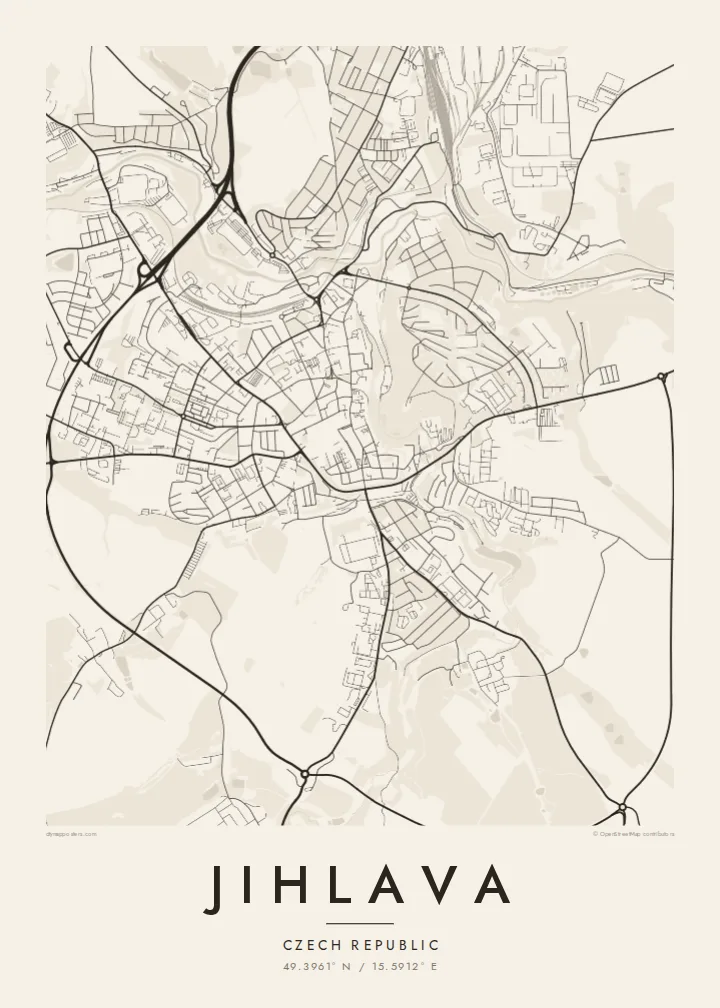
Masarykovo náměstí forms a large, clean rectangle at the heart of the old town, one of the most distinctive open shapes found on any Czech town map.
Fakatino mape mukamuka · Czechia
49.3961° N / 15.5912° E
A Bohemian-Moravian silver town where medieval lanes run out from one vast square toward the green valley of the Jihlava river.




Taha e taone, lima e onoonoaga
Tapaki e taha puhala ke kitia ai ki luga he puipui. Kua tatai e totogi he tau puhala oti — pete he lolomi, poloka, po ke faila HD.
 Tau pikselo mooli · faila lolomi 24 × 36″
Maama mitaki ke lolomi
Ko e 100% e fahi mooli mai he faila lolomi. Ko e tau poster oti — pete kua lolomi, poloka, po ke utu hifo — kua taute ke he ha mautolu a tau tokoluga (server) ke he 300 DPI, hokotia ke he 7,200 × 10,800 piksela, ke maeke ai e tau ala ikiiki tote ke maaliali fakamitaki he lolomi 24 × 36″.
He Pā


Ko e mape
Jihlava grew rich in the thirteenth century on silver mining, and its plan still shows a town laid out with ambition. At the centre is Masarykovo náměstí, one of the largest town squares in the Czech Republic, a long rectangle that appears on a map as a clear open shape among the dense blocks of historic houses around it.
Around the old town, traces of the fortifications survive, including the Gate of the Mother of God, and the river Jihlava winds through a green valley below the centre. Beneath the streets runs a network of medieval cellars and passages, the Jihlava catacombs, invisible on the map but part of why the centre feels so solid and deliberate.
The composer Gustav Mahler spent his childhood here, and the town keeps the connection alive. A Jihlava map poster suits anyone who knows the square, studied or worked in Vysočina, or simply likes a medieval plan with a strong centre. The composition is balanced: a tight historic core, wider residential districts, and the river's line running past.
Masarykovo náměstí forms a large, clean rectangle at the heart of the old town, one of the most distinctive open shapes found on any Czech town map.
The medieval core is still readable as a compact cluster of tight blocks, with surviving stretches of wall and the Gate of the Mother of God on its edge.
The river that gives the town its name draws a soft, winding line through greenery below the centre, a gentle counterpoint to the ordered historic street pattern.
Taute ke ha hau
Lafi e aho, taha higoa po ke taha kupu haau, hiki e fakatino, lahi po ke tuaga.
Ko e kitiaaga nakai totogi kua tote e maaliali mo e fakamailoga vai. Ko e tau lolomi mo e tau faila HD kua taute ke he 300 DPI, hokotia ke he 7,200 × 10,800 px, nakai fai fakamailoga vai.
Ko e ha Jihlava
Jihlava rewards a map more than most towns its size, because its plan is so clearly legible: one great square, a ring of old streets, a river valley. It makes a thoughtful piece for a study or hallway, especially for someone with Vysočina roots or a love of Mahler.
Add a title, subtitle and your own coordinates or date, then choose Classic black & white, Noir, Paper, Blueprint or Sand. For $9 you get 300 DPI PNG and print-ready PDF files in six sizes, or you can order a printed poster shipped from a local partner.
Talaage e poster Jihlava| Lahi he lolomi | Maama | Tau faila |
|---|---|---|
| 30 × 40 cm11.8 × 15.7″ | 3,543 × 4,724 px | PNG · PDF |
| 29.7 × 42 cm (A3)11.7 × 16.5″ | 3,508 × 4,961 px | PNG · PDF |
| 42 × 59.4 cm (A2)16.5 × 23.4″ | 4,961 × 7,016 px | PNG · PDF |
| 45.7 × 61 cm18 × 24″ | 5,400 × 7,200 px | PNG · PDF |
| 50 × 70 cm19.7 × 27.6″ | 5,906 × 8,268 px | PNG · PDF |
| 61 × 91.4 cm24 × 36″ | 7,200 × 10,800 px | PNG · PDF |
Ke fakatatai, ko e fakatino noa kua 900 px e laulahi, fai fakamailoga mo e mo e tau mata komipiuta ni. Ko e tau faila HD kua ato hoko ke he 8× e maama ke he tau faahi takitaha mo e lolomi mitaki he lahi katoa he fakatino.
Fifili e taha puhala i luga he kupega, ti fifili e Poster Lolomi — e lahi mo e, kaeke ke manako ai koe, taha poloka — po ke Tau Faila HD Fakaeletonika. Ko e fakaotiaga totogi ko e taha gahua ni, ti ko e kupega he hau a talaaga ka fakafou fakahaga i mua he fakaotiaga e totogi.
Kua lolomi ai ke he pepa mitaki 200 gsm matte he taha he tau lahi ono, mai he 30 × 40 cm ke hoko ke he 24 × 36″. Kamata e tau poster lolomi mai he $39, kua putoia ai e utaaga.
E. Fifili e poloka akau malolō ke he lanu uli, tea, akau oki mooli, po ke akau pouli. Kua fakalataha mo e sioga malolō nakai malepe ti kua mautali ke tautau. Kamata e tau poster poloka mai he $99, kua putoia ai e utaaga.
Nakai totogi e fakafano ke he motu 60+. Ko e fakatino taha kua lolomi he fenoga lolomi ha mautolu kua tata mo e tau motu 30+, kua hoko mai he tau aho gahua 3–7. Maeke ia koe ke kikite e tuaga mo e fakamuitua he lalo he Haku Tau Fakatonu. Ke he falu motu kua 2–5 e tau tapu, ti ka nakai fakafano a mautolu ki ai, to fakaha he api tupe ia ki mua he totogi.
Fakafano mai e taha ata ki a mautolu he loto he 14 e tau aho tali mai he hokoaga, ti to lolomi foki e mautolu nakai totogi po ke liu atu e totogi ki a koe.
E. He editor i luga he kupega nei, hikihiki e matakupu, e matakupu lalo mo e laini coordinates ke he taha mena kua manako a koe ki ai, ti fifili e puhala mo e lahi. Ko e tau talaaga lolomi, poloka mo e fakaeletonika oti kua fakaaoga tonu e hau a fakatino.
Ma e $9 ka moua e koe e tau faila PNG 300 DPI mo e PDF kua mautali ke lolomi he tau lahi ono oti, nakai fai fakamailoga vai, ke lolomi i fe mena. Nakai maopoopo agaia? Utu hifo fakamua e kitiaaga nakai totogi ne fai fakamailoga vai.
