Railway junction
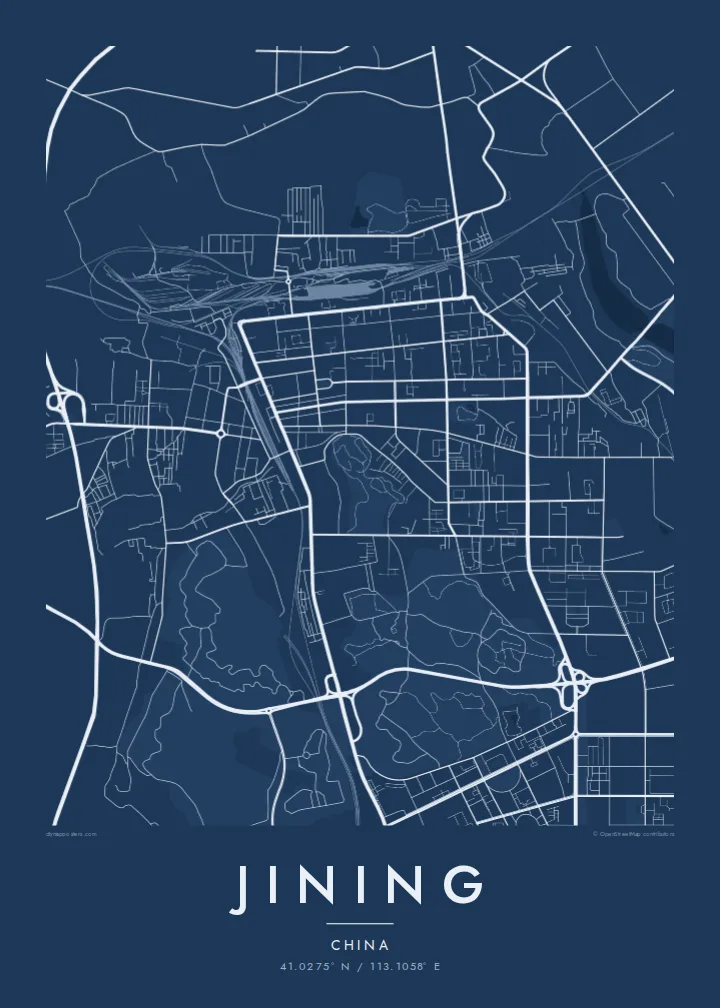
Main lines toward Beijing, Baotou and the Mongolian border converge on Jining, their long, gently curving tracks slicing through the grid and fanning out across the plateau.
Fakatino mape mukamuka · China
41.0275° N / 113.1058° E
A high-plateau railway town in Inner Mongolia, laid out in a spacious grid and surrounded by open, thinly settled land.



Taha e taone, lima e onoonoaga
Tapaki e taha puhala ke kitia ai ki luga he puipui. Kua tatai e totogi he tau puhala oti — pete he lolomi, poloka, po ke faila HD.
 Tau pikselo mooli · faila lolomi 24 × 36″
Maama mitaki ke lolomi
Ko e 100% e fahi mooli mai he faila lolomi. Ko e tau poster oti — pete kua lolomi, poloka, po ke utu hifo — kua taute ke he ha mautolu a tau tokoluga (server) ke he 300 DPI, hokotia ke he 7,200 × 10,800 piksela, ke maeke ai e tau ala ikiiki tote ke maaliali fakamitaki he lolomi 24 × 36″.
He Pā


Ko e mape
Jining is the central district and seat of Ulanqab, a prefecture-level city in central Inner Mongolia, on a plateau well over a kilometre above sea level. The town grew as a railway junction, where the line from Beijing toward Baotou meets the route heading north to Erenhot and the Mongolian border, and those tracks are still the strongest lines on its map.
The streets follow a spacious grid of wide avenues, typical of newer northern Chinese cities, and the built-up area ends abruptly where open land begins. On a Jining map poster that sharp edge is the defining feature: an ordered block of streets surrounded by near-empty ground, crossed by rail lines and highways running off toward distant horizons.
Ulanqab is known across China for potatoes, grown widely in the cool, dry climate of the region, and more recently for large data centres drawn by the same conditions. Neither shows up in the line work, but both help explain the town's scale and its steady growth outward from its railway origins into the surrounding plateau.
Main lines toward Beijing, Baotou and the Mongolian border converge on Jining, their long, gently curving tracks slicing through the grid and fanning out across the plateau.
Wide, evenly spaced avenues divide the town into large blocks, a clean and legible pattern that suits both close crops and a wider regional view.
Where the streets stop, open land begins almost at once, giving the poster a crisp boundary between dense urban lines and the empty space around them.
Taute ke ha hau
Lafi e aho, taha higoa po ke taha kupu haau, hiki e fakatino, lahi po ke tuaga.
Ko e kitiaaga nakai totogi kua tote e maaliali mo e fakamailoga vai. Ko e tau lolomi mo e tau faila HD kua taute ke he 300 DPI, hokotia ke he 7,200 × 10,800 px, nakai fai fakamailoga vai.
Ko e ha Jining
For anyone from Ulanqab, this map captures a place defined by distance: a compact grid set down on a wide plateau, tied to the rest of the country by rail. The clean composition works as understated art in a hallway or study.
Add a title, subtitle and coordinates of your choosing, and select Classic black & white, Noir, Paper, Blueprint or Sand. The $9 digital package includes six print sizes, each as a 300 DPI PNG and a print-ready PDF, with no watermark.
Talaage e poster Jining| Lahi he lolomi | Maama | Tau faila |
|---|---|---|
| 30 × 40 cm11.8 × 15.7″ | 3,543 × 4,724 px | PNG · PDF |
| 29.7 × 42 cm (A3)11.7 × 16.5″ | 3,508 × 4,961 px | PNG · PDF |
| 42 × 59.4 cm (A2)16.5 × 23.4″ | 4,961 × 7,016 px | PNG · PDF |
| 45.7 × 61 cm18 × 24″ | 5,400 × 7,200 px | PNG · PDF |
| 50 × 70 cm19.7 × 27.6″ | 5,906 × 8,268 px | PNG · PDF |
| 61 × 91.4 cm24 × 36″ | 7,200 × 10,800 px | PNG · PDF |
Ke fakatatai, ko e fakatino noa kua 900 px e laulahi, fai fakamailoga mo e mo e tau mata komipiuta ni. Ko e tau faila HD kua ato hoko ke he 8× e maama ke he tau faahi takitaha mo e lolomi mitaki he lahi katoa he fakatino.
Fifili e taha puhala i luga he kupega, ti fifili e Poster Lolomi — e lahi mo e, kaeke ke manako ai koe, taha poloka — po ke Tau Faila HD Fakaeletonika. Ko e fakaotiaga totogi ko e taha gahua ni, ti ko e kupega he hau a talaaga ka fakafou fakahaga i mua he fakaotiaga e totogi.
Kua lolomi ai ke he pepa mitaki 200 gsm matte he taha he tau lahi ono, mai he 30 × 40 cm ke hoko ke he 24 × 36″. Kamata e tau poster lolomi mai he $39, kua putoia ai e utaaga.
E. Fifili e poloka akau malolō ke he lanu uli, tea, akau oki mooli, po ke akau pouli. Kua fakalataha mo e sioga malolō nakai malepe ti kua mautali ke tautau. Kamata e tau poster poloka mai he $99, kua putoia ai e utaaga.
Nakai totogi e fakafano ke he motu 60+. Ko e fakatino taha kua lolomi he fenoga lolomi ha mautolu kua tata mo e tau motu 30+, kua hoko mai he tau aho gahua 3–7. Maeke ia koe ke kikite e tuaga mo e fakamuitua he lalo he Haku Tau Fakatonu. Ke he falu motu kua 2–5 e tau tapu, ti ka nakai fakafano a mautolu ki ai, to fakaha he api tupe ia ki mua he totogi.
Fakafano mai e taha ata ki a mautolu he loto he 14 e tau aho tali mai he hokoaga, ti to lolomi foki e mautolu nakai totogi po ke liu atu e totogi ki a koe.
E. He editor i luga he kupega nei, hikihiki e matakupu, e matakupu lalo mo e laini coordinates ke he taha mena kua manako a koe ki ai, ti fifili e puhala mo e lahi. Ko e tau talaaga lolomi, poloka mo e fakaeletonika oti kua fakaaoga tonu e hau a fakatino.
Ma e $9 ka moua e koe e tau faila PNG 300 DPI mo e PDF kua mautali ke lolomi he tau lahi ono oti, nakai fai fakamailoga vai, ke lolomi i fe mena. Nakai maopoopo agaia? Utu hifo fakamua e kitiaaga nakai totogi ne fai fakamailoga vai.
Tata mai
