Old town core
Near the centre, narrow streets and small blocks follow the older pattern of the village, forming a dense cluster that stands out against the wider layout around it.
Fakatino mape mukamuka · Mexico
18.8814° N / 99.1778° W
A warm-valley city east of Cuernavaca, where an old village core meets a planned industrial zone and new housing.




Taha e taone, lima e onoonoaga
Tapaki e taha puhala ke kitia ai ki luga he puipui. Kua tatai e totogi he tau puhala oti — pete he lolomi, poloka, po ke faila HD.
 Tau pikselo mooli · faila lolomi 24 × 36″
Maama mitaki ke lolomi
Ko e 100% e fahi mooli mai he faila lolomi. Ko e tau poster oti — pete kua lolomi, poloka, po ke utu hifo — kua taute ke he ha mautolu a tau tokoluga (server) ke he 300 DPI, hokotia ke he 7,200 × 10,800 piksela, ke maeke ai e tau ala ikiiki tote ke maaliali fakamitaki he lolomi 24 × 36″.
He Pā


Ko e mape
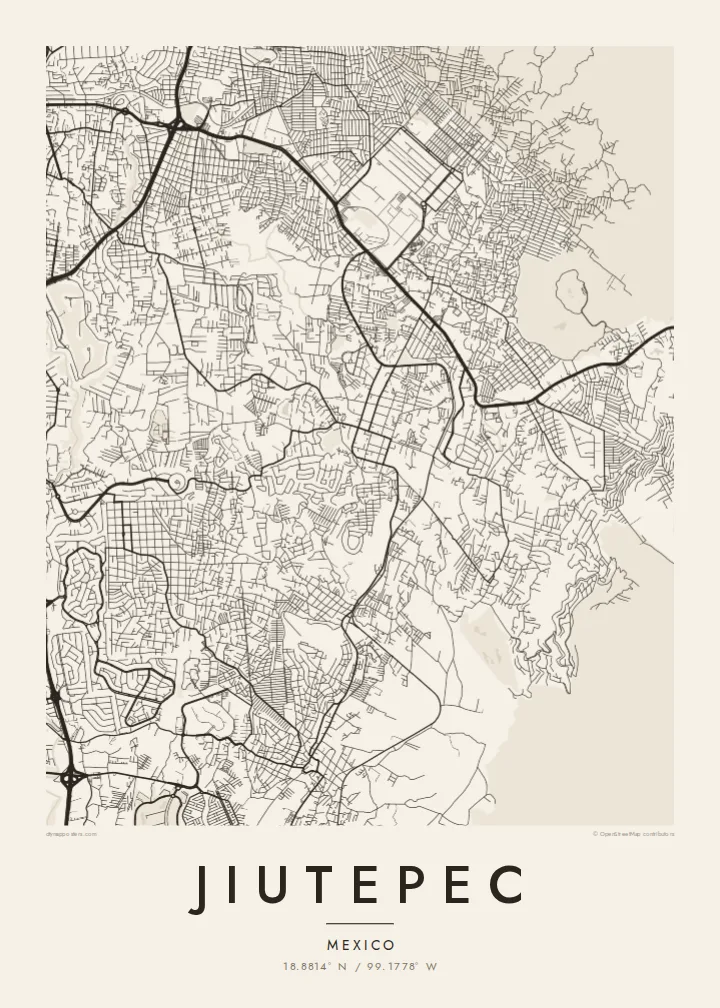
Jiutepec lies in the state of Morelos in central Mexico, directly east of Cuernavaca and now part of its wider metropolitan area. On a map the city spreads across gently sloping land in the Cuernavaca valley, with the streets of the older centre surrounded by newer residential districts and an extensive industrial zone. The boundaries between Jiutepec and its neighbours are hard to see, as the built-up area runs continuously.
In the 1960s the Ciudad Industrial del Valle de Cuernavaca, known as CIVAC, was established here, and it drove Jiutepec's growth into one of the most populous municipalities in Morelos. Before that the area was mainly agricultural, and traces of the older village layout remain near the centre. The mild climate of the valley has also drawn steady residential development.
A Jiutepec map poster shows a city in transition: an older core with irregular streets, the broad, regular blocks of the industrial zone and neighbourhoods that curve around ravines and slopes. It is a varied map, full of texture, and a fitting picture of how cities in central Mexico have grown outward from their older towns.
Near the centre, narrow streets and small blocks follow the older pattern of the village, forming a dense cluster that stands out against the wider layout around it.
The planned industrial city occupies a large area with long, straight roads and wide plots, giving part of the map a clear geometric order.
Barrancas and changes in elevation shape the outer neighbourhoods, where streets curve and branch to follow the land instead of forming a straight grid.
Taute ke ha hau
Lafi e aho, taha higoa po ke taha kupu haau, hiki e fakatino, lahi po ke tuaga.
Ko e kitiaaga nakai totogi kua tote e maaliali mo e fakamailoga vai. Ko e tau lolomi mo e tau faila HD kua taute ke he 300 DPI, hokotia ke he 7,200 × 10,800 px, nakai fai fakamailoga vai.
Ko e ha Jiutepec
Jiutepec is hung by families who have lived in Morelos for generations, people who worked in CIVAC and residents who moved to the valley for its climate. The map records a place that is home to many but rarely pictured.
Change the title, subtitle and coordinates line to include your colonia or a date, and choose one of five styles: Classic black & white, Noir, Paper, Blueprint or Sand. Printed posters ship from partners in more than 30 countries.
Talaage e poster Jiutepec| Lahi he lolomi | Maama | Tau faila |
|---|---|---|
| 30 × 40 cm11.8 × 15.7″ | 3,543 × 4,724 px | PNG · PDF |
| 29.7 × 42 cm (A3)11.7 × 16.5″ | 3,508 × 4,961 px | PNG · PDF |
| 42 × 59.4 cm (A2)16.5 × 23.4″ | 4,961 × 7,016 px | PNG · PDF |
| 45.7 × 61 cm18 × 24″ | 5,400 × 7,200 px | PNG · PDF |
| 50 × 70 cm19.7 × 27.6″ | 5,906 × 8,268 px | PNG · PDF |
| 61 × 91.4 cm24 × 36″ | 7,200 × 10,800 px | PNG · PDF |
Ke fakatatai, ko e fakatino noa kua 900 px e laulahi, fai fakamailoga mo e mo e tau mata komipiuta ni. Ko e tau faila HD kua ato hoko ke he 8× e maama ke he tau faahi takitaha mo e lolomi mitaki he lahi katoa he fakatino.
Fifili e taha puhala i luga he kupega, ti fifili e Poster Lolomi — e lahi mo e, kaeke ke manako ai koe, taha poloka — po ke Tau Faila HD Fakaeletonika. Ko e fakaotiaga totogi ko e taha gahua ni, ti ko e kupega he hau a talaaga ka fakafou fakahaga i mua he fakaotiaga e totogi.
Kua lolomi ai ke he pepa mitaki 200 gsm matte he taha he tau lahi ono, mai he 30 × 40 cm ke hoko ke he 24 × 36″. Kamata e tau poster lolomi mai he $39, kua putoia ai e utaaga.
E. Fifili e poloka akau malolō ke he lanu uli, tea, akau oki mooli, po ke akau pouli. Kua fakalataha mo e sioga malolō nakai malepe ti kua mautali ke tautau. Kamata e tau poster poloka mai he $99, kua putoia ai e utaaga.
Nakai totogi e fakafano ke he motu 60+. Ko e fakatino taha kua lolomi he fenoga lolomi ha mautolu kua tata mo e tau motu 30+, kua hoko mai he tau aho gahua 3–7. Maeke ia koe ke kikite e tuaga mo e fakamuitua he lalo he Haku Tau Fakatonu. Ke he falu motu kua 2–5 e tau tapu, ti ka nakai fakafano a mautolu ki ai, to fakaha he api tupe ia ki mua he totogi.
Fakafano mai e taha ata ki a mautolu he loto he 14 e tau aho tali mai he hokoaga, ti to lolomi foki e mautolu nakai totogi po ke liu atu e totogi ki a koe.
E. He editor i luga he kupega nei, hikihiki e matakupu, e matakupu lalo mo e laini coordinates ke he taha mena kua manako a koe ki ai, ti fifili e puhala mo e lahi. Ko e tau talaaga lolomi, poloka mo e fakaeletonika oti kua fakaaoga tonu e hau a fakatino.
Ma e $9 ka moua e koe e tau faila PNG 300 DPI mo e PDF kua mautali ke lolomi he tau lahi ono oti, nakai fai fakamailoga vai, ke lolomi i fe mena. Nakai maopoopo agaia? Utu hifo fakamua e kitiaaga nakai totogi ne fai fakamailoga vai.
