Old town core
The oldest part of the city shows a dense pattern of narrow streets and irregular blocks, the section of the map with the finest grain and the most visible history.
Fakatino mape mukamuka · India
14.4800° N / 78.8235° E
A Rayalaseema city set among dry hills and river plains, with an old core, a railway and roads fanning out


Taha e taone, lima e onoonoaga
Tapaki e taha puhala ke kitia ai ki luga he puipui. Kua tatai e totogi he tau puhala oti — pete he lolomi, poloka, po ke faila HD.
 Tau pikselo mooli · faila lolomi 24 × 36″
Maama mitaki ke lolomi
Ko e 100% e fahi mooli mai he faila lolomi. Ko e tau poster oti — pete kua lolomi, poloka, po ke utu hifo — kua taute ke he ha mautolu a tau tokoluga (server) ke he 300 DPI, hokotia ke he 7,200 × 10,800 piksela, ke maeke ai e tau ala ikiiki tote ke maaliali fakamitaki he lolomi 24 × 36″.
He Pā


Ko e mape
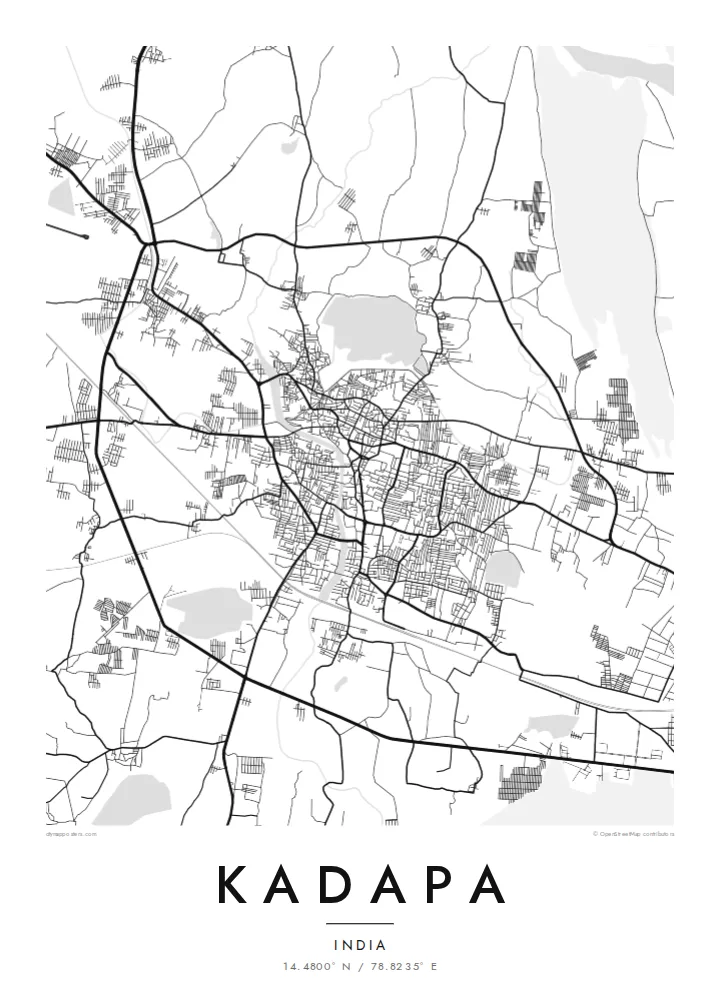
Kadapa lies in the Rayalaseema region of southern Andhra Pradesh, on a broad plain framed by low, rocky hills. The Penna River and its tributaries run through the wider district, and the city itself spreads across fairly level ground, its older centre giving way to newer residential areas along the main roads leading out of town.
The name is often linked to the Telugu word for threshold, since Kadapa was traditionally seen as a gateway for pilgrims travelling to Tirumala. The city is also known for the Ameen Peer Dargah, a Sufi shrine that draws visitors of many faiths, and it serves as the administrative centre of a district with a long regional history.
On a map Kadapa reads as a compact, closely built core surrounded by expanding districts and crossed by the railway and national highways. A Kadapa map poster keeps that pattern simple and clear, with the surrounding hills giving a quiet edge to the composition and the roads recording how the city connects to the rest of Andhra Pradesh.
The oldest part of the city shows a dense pattern of narrow streets and irregular blocks, the section of the map with the finest grain and the most visible history.
National highways and the railway line cross the city as long, confident strokes, linking Kadapa with the wider Rayalaseema region and the larger cities beyond it.
Low, rocky hills rise around the plain, and the edges of the map are defined by open ground and slopes where the city's growth gradually thins out.
Taute ke ha hau
Lafi e aho, taha higoa po ke taha kupu haau, hiki e fakatino, lahi po ke tuaga.
Ko e kitiaaga nakai totogi kua tote e maaliali mo e fakamailoga vai. Ko e tau lolomi mo e tau faila HD kua taute ke he 300 DPI, hokotia ke he 7,200 × 10,800 px, nakai fai fakamailoga vai.
Ko e ha Kadapa
For families from Kadapa, and for those who have moved to other cities or abroad, the map is a steady reminder of home streets, schools and places of worship. It also marks a meaningful stop for anyone who has passed through on pilgrimage.
You can add a title, a subtitle such as a family name or year, and a coordinates line, then choose Classic black & white, Noir, Paper, Blueprint or Sand. A free 900 px watermarked preview lets you check the composition before downloading the HD files.
Talaage e poster Kadapa| Lahi he lolomi | Maama | Tau faila |
|---|---|---|
| 30 × 40 cm11.8 × 15.7″ | 3,543 × 4,724 px | PNG · PDF |
| 29.7 × 42 cm (A3)11.7 × 16.5″ | 3,508 × 4,961 px | PNG · PDF |
| 42 × 59.4 cm (A2)16.5 × 23.4″ | 4,961 × 7,016 px | PNG · PDF |
| 45.7 × 61 cm18 × 24″ | 5,400 × 7,200 px | PNG · PDF |
| 50 × 70 cm19.7 × 27.6″ | 5,906 × 8,268 px | PNG · PDF |
| 61 × 91.4 cm24 × 36″ | 7,200 × 10,800 px | PNG · PDF |
Ke fakatatai, ko e fakatino noa kua 900 px e laulahi, fai fakamailoga mo e mo e tau mata komipiuta ni. Ko e tau faila HD kua ato hoko ke he 8× e maama ke he tau faahi takitaha mo e lolomi mitaki he lahi katoa he fakatino.
Fifili e taha puhala i luga he kupega, ti fifili e Poster Lolomi — e lahi mo e, kaeke ke manako ai koe, taha poloka — po ke Tau Faila HD Fakaeletonika. Ko e fakaotiaga totogi ko e taha gahua ni, ti ko e kupega he hau a talaaga ka fakafou fakahaga i mua he fakaotiaga e totogi.
Kua lolomi ai ke he pepa mitaki 200 gsm matte he taha he tau lahi ono, mai he 30 × 40 cm ke hoko ke he 24 × 36″. Kamata e tau poster lolomi mai he $39, kua putoia ai e utaaga.
E. Fifili e poloka akau malolō ke he lanu uli, tea, akau oki mooli, po ke akau pouli. Kua fakalataha mo e sioga malolō nakai malepe ti kua mautali ke tautau. Kamata e tau poster poloka mai he $99, kua putoia ai e utaaga.
Nakai totogi e fakafano ke he motu 60+. Ko e fakatino taha kua lolomi he fenoga lolomi ha mautolu kua tata mo e tau motu 30+, kua hoko mai he tau aho gahua 3–7. Maeke ia koe ke kikite e tuaga mo e fakamuitua he lalo he Haku Tau Fakatonu. Ke he falu motu kua 2–5 e tau tapu, ti ka nakai fakafano a mautolu ki ai, to fakaha he api tupe ia ki mua he totogi.
Fakafano mai e taha ata ki a mautolu he loto he 14 e tau aho tali mai he hokoaga, ti to lolomi foki e mautolu nakai totogi po ke liu atu e totogi ki a koe.
E. He editor i luga he kupega nei, hikihiki e matakupu, e matakupu lalo mo e laini coordinates ke he taha mena kua manako a koe ki ai, ti fifili e puhala mo e lahi. Ko e tau talaaga lolomi, poloka mo e fakaeletonika oti kua fakaaoga tonu e hau a fakatino.
Ma e $9 ka moua e koe e tau faila PNG 300 DPI mo e PDF kua mautali ke lolomi he tau lahi ono oti, nakai fai fakamailoga vai, ke lolomi i fe mena. Nakai maopoopo agaia? Utu hifo fakamua e kitiaaga nakai totogi ne fai fakamailoga vai.
Tata mai
