Tunnelled road
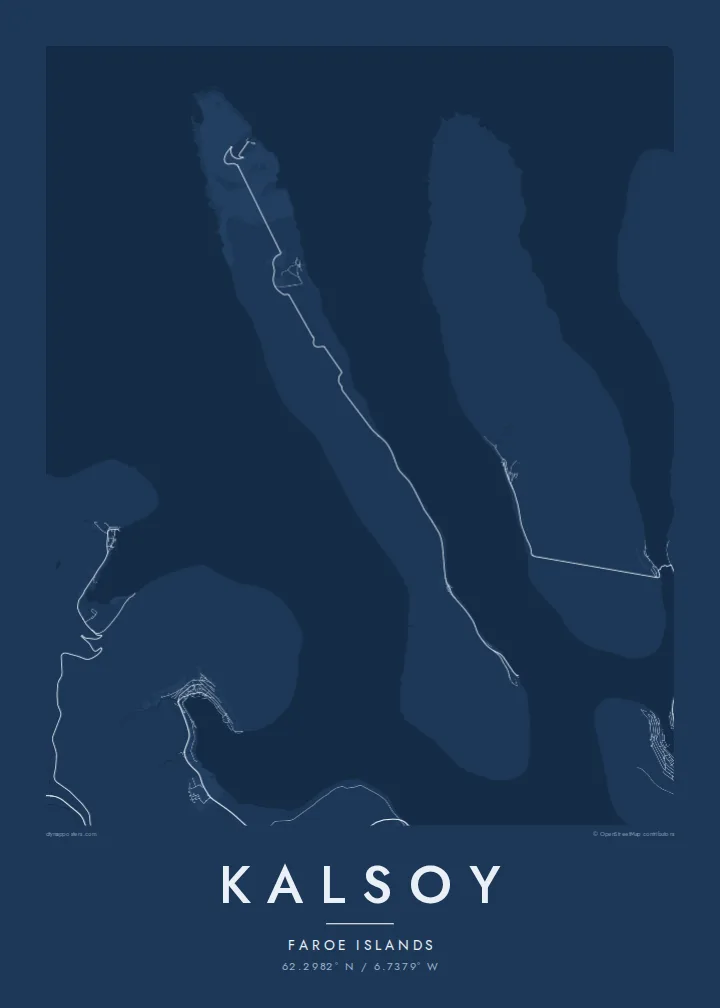
One road runs the length of the island and passes through tunnels beneath the mountains. The breaks give the line on the map an interrupted rhythm.
Fakatino mape mukamuka · Faroe Islands
62.2982° N / 6.7379° W
A long, thin ridge of an island in the northern Faroes, running north to south with villages set along its eastern bays.



Taha e taone, lima e onoonoaga
Tapaki e taha puhala ke kitia ai ki luga he puipui. Kua tatai e totogi he tau puhala oti — pete he lolomi, poloka, po ke faila HD.
 Tau pikselo mooli · faila lolomi 24 × 36″
Maama mitaki ke lolomi
Ko e 100% e fahi mooli mai he faila lolomi. Ko e tau poster oti — pete kua lolomi, poloka, po ke utu hifo — kua taute ke he ha mautolu a tau tokoluga (server) ke he 300 DPI, hokotia ke he 7,200 × 10,800 piksela, ke maeke ai e tau ala ikiiki tote ke maaliali fakamitaki he lolomi 24 × 36″.
He Pā


Ko e mape
Kalsoy is one of the northern islands of the Faroes. It is a narrow strip of land that runs roughly north to south for close to twenty kilometres but is only a few kilometres wide. Its shape has earned it a local nickname, the flute. The name refers to the road tunnels that pierce its mountain spine and link the villages from one end to the other.
On a map the island is a single thin line of mountain. Steep cliffs run along the west side, and the small settlements stand on the gentler eastern coast. One road follows that eastern side, disappearing into tunnels and emerging again at each village. At the northern tip, Kallur lighthouse stands on a grassy headland above the sea, one of the most photographed viewpoints in the islands.
The village of Mikladalur has a bronze statue of Kópakonan, the seal woman of Faroese legend, standing on the rocks by the shore. A Kalsoy map poster keeps all of this in a single elegant strip: a mountain ridge, a thread of road and a scatter of villages along the water. The neighbouring islands lie close on either side.
One road runs the length of the island and passes through tunnels beneath the mountains. The breaks give the line on the map an interrupted rhythm.
The northern tip narrows to a headland with a small lighthouse. Here the land ends in cliffs, and the long outline of the island comes to a sharp point.
The west coast is almost continuous cliff, a clean, unbroken edge. It contrasts with the small bays and landings along the eastern shore.
Taute ke ha hau
Lafi e aho, taha higoa po ke taha kupu haau, hiki e fakatino, lahi po ke tuaga.
Ko e kitiaaga nakai totogi kua tote e maaliali mo e fakamailoga vai. Ko e tau lolomi mo e tau faila HD kua taute ke he 300 DPI, hokotia ke he 7,200 × 10,800 px, nakai fai fakamailoga vai.
Ko e ha Kalsoy
Kalsoy has become one of the best-known walks in the Faroes. Many visitors remember the ferry from Klaksvík, the tunnels and the path to the lighthouse. The island’s long, narrow form suits a portrait poster, filling the frame from top to bottom.
Set a title and subtitle, perhaps with the date of your visit, and adjust the coordinates line. Five styles are on offer: Classic black & white, Noir, Paper, Blueprint and Sand. Noir works well with the dark cliffs, and Paper gives the island the feel of an old survey sheet.
Talaage e poster Kalsoy| Lahi he lolomi | Maama | Tau faila |
|---|---|---|
| 30 × 40 cm11.8 × 15.7″ | 3,543 × 4,724 px | PNG · PDF |
| 29.7 × 42 cm (A3)11.7 × 16.5″ | 3,508 × 4,961 px | PNG · PDF |
| 42 × 59.4 cm (A2)16.5 × 23.4″ | 4,961 × 7,016 px | PNG · PDF |
| 45.7 × 61 cm18 × 24″ | 5,400 × 7,200 px | PNG · PDF |
| 50 × 70 cm19.7 × 27.6″ | 5,906 × 8,268 px | PNG · PDF |
| 61 × 91.4 cm24 × 36″ | 7,200 × 10,800 px | PNG · PDF |
Ke fakatatai, ko e fakatino noa kua 900 px e laulahi, fai fakamailoga mo e mo e tau mata komipiuta ni. Ko e tau faila HD kua ato hoko ke he 8× e maama ke he tau faahi takitaha mo e lolomi mitaki he lahi katoa he fakatino.
Fifili e taha puhala i luga he kupega, ti fifili e Poster Lolomi — e lahi mo e, kaeke ke manako ai koe, taha poloka — po ke Tau Faila HD Fakaeletonika. Ko e fakaotiaga totogi ko e taha gahua ni, ti ko e kupega he hau a talaaga ka fakafou fakahaga i mua he fakaotiaga e totogi.
Kua lolomi ai ke he pepa mitaki 200 gsm matte he taha he tau lahi ono, mai he 30 × 40 cm ke hoko ke he 24 × 36″. Kamata e tau poster lolomi mai he $39, kua putoia ai e utaaga.
E. Fifili e poloka akau malolō ke he lanu uli, tea, akau oki mooli, po ke akau pouli. Kua fakalataha mo e sioga malolō nakai malepe ti kua mautali ke tautau. Kamata e tau poster poloka mai he $99, kua putoia ai e utaaga.
Nakai totogi e fakafano ke he motu 60+. Ko e fakatino taha kua lolomi he fenoga lolomi ha mautolu kua tata mo e tau motu 30+, kua hoko mai he tau aho gahua 3–7. Maeke ia koe ke kikite e tuaga mo e fakamuitua he lalo he Haku Tau Fakatonu. Ke he falu motu kua 2–5 e tau tapu, ti ka nakai fakafano a mautolu ki ai, to fakaha he api tupe ia ki mua he totogi.
Fakafano mai e taha ata ki a mautolu he loto he 14 e tau aho tali mai he hokoaga, ti to lolomi foki e mautolu nakai totogi po ke liu atu e totogi ki a koe.
E. He editor i luga he kupega nei, hikihiki e matakupu, e matakupu lalo mo e laini coordinates ke he taha mena kua manako a koe ki ai, ti fifili e puhala mo e lahi. Ko e tau talaaga lolomi, poloka mo e fakaeletonika oti kua fakaaoga tonu e hau a fakatino.
Ma e $9 ka moua e koe e tau faila PNG 300 DPI mo e PDF kua mautali ke lolomi he tau lahi ono oti, nakai fai fakamailoga vai, ke lolomi i fe mena. Nakai maopoopo agaia? Utu hifo fakamua e kitiaaga nakai totogi ne fai fakamailoga vai.
Tata mai
