The Vecht's meanders
The river winds gently through the old village. The buildings, bridges and estate gardens along its banks follow each bend, which gives the historic side a delicate, winding outline.
Fakatino mape mukamuka · Netherlands
52.1392° N / 5.0417° E
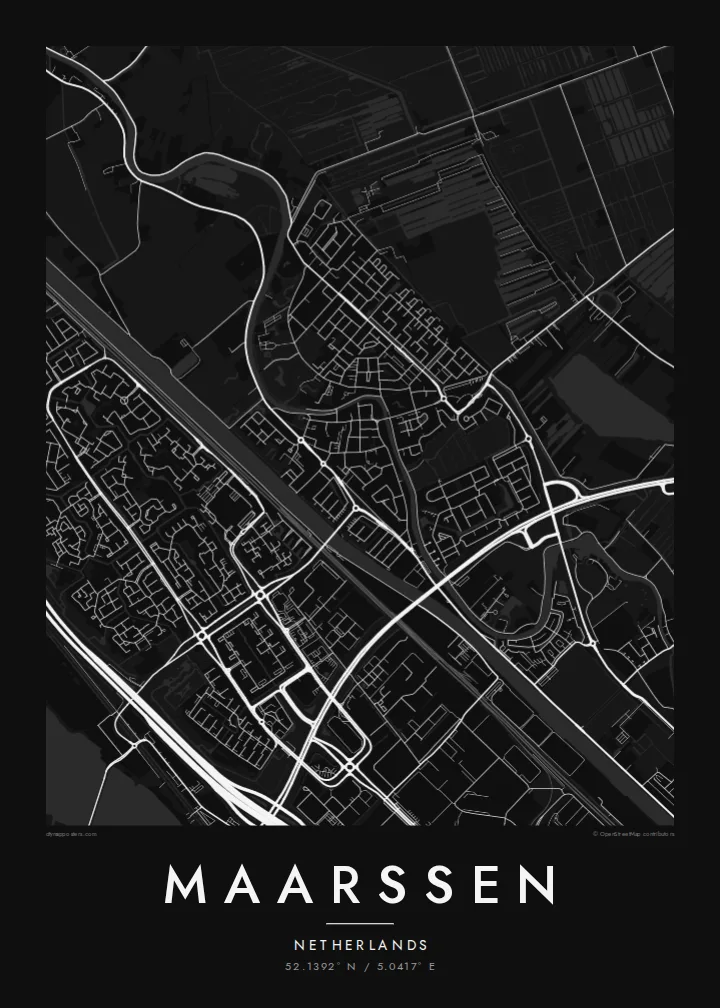
An old village along the winding Vecht, with riverside country estates on one side and a planned modern district across the canal



Taha e taone, lima e onoonoaga
Tapaki e taha puhala ke kitia ai ki luga he puipui. Kua tatai e totogi he tau puhala oti — pete he lolomi, poloka, po ke faila HD.
 Tau pikselo mooli · faila lolomi 24 × 36″
Maama mitaki ke lolomi
Ko e 100% e fahi mooli mai he faila lolomi. Ko e tau poster oti — pete kua lolomi, poloka, po ke utu hifo — kua taute ke he ha mautolu a tau tokoluga (server) ke he 300 DPI, hokotia ke he 7,200 × 10,800 piksela, ke maeke ai e tau ala ikiiki tote ke maaliali fakamitaki he lolomi 24 × 36″.
He Pā


Ko e mape
Maarssen lies just north-west of Utrecht on the River Vecht, and its map is organised by water. The old village follows the river's slow curves, with houses and gardens facing the Vecht. To the west, the straight Amsterdam-Rhine Canal cuts through the landscape and separates the historic core from Maarssenbroek, the large residential district built from the 1970s onward.
In the seventeenth and eighteenth centuries, wealthy Amsterdam merchants built country houses along the Vecht. Several of those estates still line the river near Maarssen, with long gardens running back from the water. Since 2011 the town has been part of the municipality of Stichtse Vecht, named after the river that has shaped it for centuries.
A Maarssen map poster puts both halves of the place side by side. On one side, the irregular old streets hug the Vecht. On the other, Maarssenbroek's curving residential loops, ponds and green strips show a later approach to planning. The canal runs between them as a single ruler-straight line, and all around, the flat polder is divided by drainage ditches.
The river winds gently through the old village. The buildings, bridges and estate gardens along its banks follow each bend, which gives the historic side a delicate, winding outline.
The broad shipping canal runs past the town in an almost perfectly straight line. This strong graphic stroke separates old Maarssen from its newer districts to the west.
The planned district is laid out with curving streets, cul-de-sacs and ponds typical of later Dutch suburban planning. The pattern is quite unlike the river village next to it.
Taute ke ha hau
Lafi e aho, taha higoa po ke taha kupu haau, hiki e fakatino, lahi po ke tuaga.
Ko e kitiaaga nakai totogi kua tote e maaliali mo e fakamailoga vai. Ko e tau lolomi mo e tau faila HD kua taute ke he 300 DPI, hokotia ke he 7,200 × 10,800 px, nakai fai fakamailoga vai.
Ko e ha Maarssen
Maarssen is a place people move to for the river and the quiet, and many stay for decades. Its map makes a thoughtful gift for a new home, for a family that grew up in Maarssenbroek or for anyone who cycles along the Vecht at weekends.
Set the title, subtitle and coordinates line yourself, and choose Classic black & white, Noir, Paper, Blueprint or Sand. The $9 download covers six sizes, including A3, A2 and 24×36″, each as a 300 DPI PNG and a print-ready PDF without a watermark.
Talaage e poster Maarssen| Lahi he lolomi | Maama | Tau faila |
|---|---|---|
| 30 × 40 cm11.8 × 15.7″ | 3,543 × 4,724 px | PNG · PDF |
| 29.7 × 42 cm (A3)11.7 × 16.5″ | 3,508 × 4,961 px | PNG · PDF |
| 42 × 59.4 cm (A2)16.5 × 23.4″ | 4,961 × 7,016 px | PNG · PDF |
| 45.7 × 61 cm18 × 24″ | 5,400 × 7,200 px | PNG · PDF |
| 50 × 70 cm19.7 × 27.6″ | 5,906 × 8,268 px | PNG · PDF |
| 61 × 91.4 cm24 × 36″ | 7,200 × 10,800 px | PNG · PDF |
Ke fakatatai, ko e fakatino noa kua 900 px e laulahi, fai fakamailoga mo e mo e tau mata komipiuta ni. Ko e tau faila HD kua ato hoko ke he 8× e maama ke he tau faahi takitaha mo e lolomi mitaki he lahi katoa he fakatino.
Fifili e taha puhala i luga he kupega, ti fifili e Poster Lolomi — e lahi mo e, kaeke ke manako ai koe, taha poloka — po ke Tau Faila HD Fakaeletonika. Ko e fakaotiaga totogi ko e taha gahua ni, ti ko e kupega he hau a talaaga ka fakafou fakahaga i mua he fakaotiaga e totogi.
Kua lolomi ai ke he pepa mitaki 200 gsm matte he taha he tau lahi ono, mai he 30 × 40 cm ke hoko ke he 24 × 36″. Kamata e tau poster lolomi mai he $39, kua putoia ai e utaaga.
E. Fifili e poloka akau malolō ke he lanu uli, tea, akau oki mooli, po ke akau pouli. Kua fakalataha mo e sioga malolō nakai malepe ti kua mautali ke tautau. Kamata e tau poster poloka mai he $99, kua putoia ai e utaaga.
Nakai totogi e fakafano ke he motu 60+. Ko e fakatino taha kua lolomi he fenoga lolomi ha mautolu kua tata mo e tau motu 30+, kua hoko mai he tau aho gahua 3–7. Maeke ia koe ke kikite e tuaga mo e fakamuitua he lalo he Haku Tau Fakatonu. Ke he falu motu kua 2–5 e tau tapu, ti ka nakai fakafano a mautolu ki ai, to fakaha he api tupe ia ki mua he totogi.
Fakafano mai e taha ata ki a mautolu he loto he 14 e tau aho tali mai he hokoaga, ti to lolomi foki e mautolu nakai totogi po ke liu atu e totogi ki a koe.
E. He editor i luga he kupega nei, hikihiki e matakupu, e matakupu lalo mo e laini coordinates ke he taha mena kua manako a koe ki ai, ti fifili e puhala mo e lahi. Ko e tau talaaga lolomi, poloka mo e fakaeletonika oti kua fakaaoga tonu e hau a fakatino.
Ma e $9 ka moua e koe e tau faila PNG 300 DPI mo e PDF kua mautali ke lolomi he tau lahi ono oti, nakai fai fakamailoga vai, ke lolomi i fe mena. Nakai maopoopo agaia? Utu hifo fakamua e kitiaaga nakai totogi ne fai fakamailoga vai.
Tata mai
