The old core
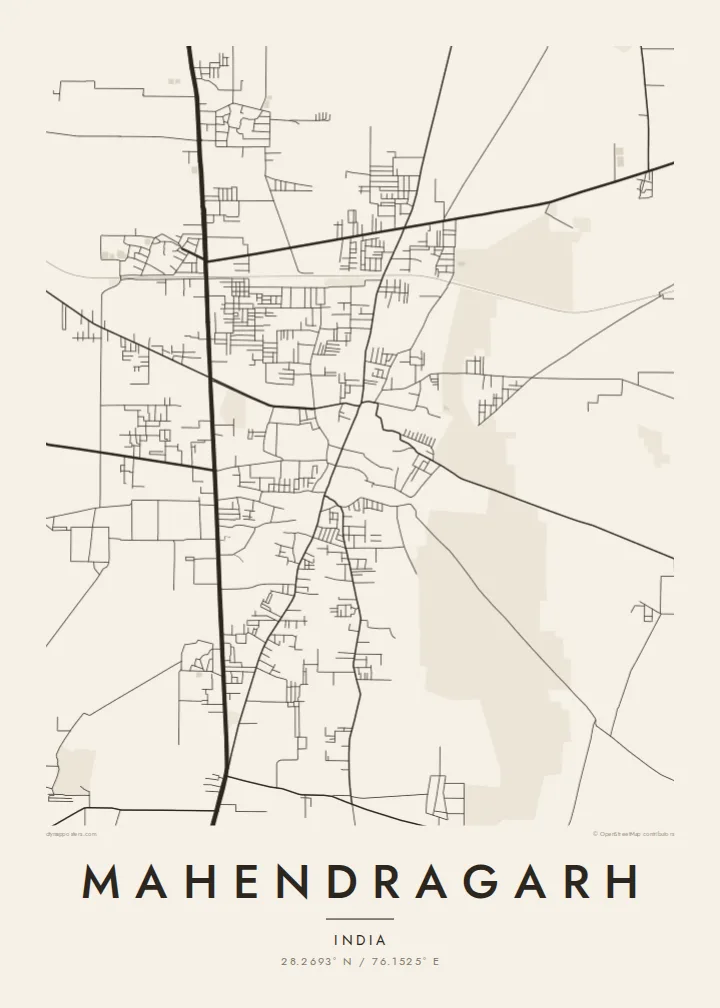
The historic centre is a close web of short, irregular lanes. It is the darkest, most detailed area on the map, and newer streets spread outward from it.
Fakatino mape mukamuka · India
28.2693° N / 76.1525° E
A district town on the dry plains of southern Haryana, dense lanes around its core opening onto farmland and low ridges




Taha e taone, lima e onoonoaga
Tapaki e taha puhala ke kitia ai ki luga he puipui. Kua tatai e totogi he tau puhala oti — pete he lolomi, poloka, po ke faila HD.
 Tau pikselo mooli · faila lolomi 24 × 36″
Maama mitaki ke lolomi
Ko e 100% e fahi mooli mai he faila lolomi. Ko e tau poster oti — pete kua lolomi, poloka, po ke utu hifo — kua taute ke he ha mautolu a tau tokoluga (server) ke he 300 DPI, hokotia ke he 7,200 × 10,800 piksela, ke maeke ai e tau ala ikiiki tote ke maaliali fakamitaki he lolomi 24 × 36″.
He Pā


Ko e mape
Mahendragarh is the headquarters of the district of the same name in southern Haryana, a semi-arid region near the Rajasthan border. From above the town shows a compact, irregular centre of narrow lanes. Around it are wider roads and newer blocks that extend into flat agricultural land. The surroundings are mostly open, with a few low rocky outcrops.
The town was earlier known as Kanaud. It took its present name in the nineteenth century, after Maharaja Mahendra Singh of Patiala, and its fort gave the name its form. On the map, the old settlement is the tightest part of the street pattern. Roads leading to neighbouring towns radiate from it in long, fairly straight lines across the plain.
A Mahendragarh map poster places a dense core against a lot of empty ground, which suits a monochrome print well. Beyond the town, the Central University of Haryana has its campus in the district. It is part of a newer layer of institutions and roads that now sits alongside the older market town and its surrounding farming villages.
The historic centre is a close web of short, irregular lanes. It is the darkest, most detailed area on the map, and newer streets spread outward from it.
Main roads leave the town in long, straight lines across the flat plain, connecting it to neighbouring towns and villages and giving the composition a clear sense of direction.
Farmland and dry, open ground surround the built-up area on every side. On paper this leaves generous white space that frames the town as a distinct, self-contained shape.
Taute ke ha hau
Lafi e aho, taha higoa po ke taha kupu haau, hiki e fakatino, lahi po ke tuaga.
Ko e kitiaaga nakai totogi kua tote e maaliali mo e fakamailoga vai. Ko e tau lolomi mo e tau faila HD kua taute ke he 300 DPI, hokotia ke he 7,200 × 10,800 px, nakai fai fakamailoga vai.
Ko e ha Mahendragarh
This poster is for people who grew up in Mahendragarh, studied in the district or keep family ties here while living elsewhere. It records the town's shape simply, from its crowded centre to the roads that lead out across the plains.
Add your own title, subtitle and coordinates line, such as a family name, a graduation year or a wedding date. Choose Classic black & white, Noir, Paper, Blueprint or Sand. A free watermarked preview lets you check the layout before you buy the HD files or a printed poster.
Talaage e poster Mahendragarh| Lahi he lolomi | Maama | Tau faila |
|---|---|---|
| 30 × 40 cm11.8 × 15.7″ | 3,543 × 4,724 px | PNG · PDF |
| 29.7 × 42 cm (A3)11.7 × 16.5″ | 3,508 × 4,961 px | PNG · PDF |
| 42 × 59.4 cm (A2)16.5 × 23.4″ | 4,961 × 7,016 px | PNG · PDF |
| 45.7 × 61 cm18 × 24″ | 5,400 × 7,200 px | PNG · PDF |
| 50 × 70 cm19.7 × 27.6″ | 5,906 × 8,268 px | PNG · PDF |
| 61 × 91.4 cm24 × 36″ | 7,200 × 10,800 px | PNG · PDF |
Ke fakatatai, ko e fakatino noa kua 900 px e laulahi, fai fakamailoga mo e mo e tau mata komipiuta ni. Ko e tau faila HD kua ato hoko ke he 8× e maama ke he tau faahi takitaha mo e lolomi mitaki he lahi katoa he fakatino.
Fifili e taha puhala i luga he kupega, ti fifili e Poster Lolomi — e lahi mo e, kaeke ke manako ai koe, taha poloka — po ke Tau Faila HD Fakaeletonika. Ko e fakaotiaga totogi ko e taha gahua ni, ti ko e kupega he hau a talaaga ka fakafou fakahaga i mua he fakaotiaga e totogi.
Kua lolomi ai ke he pepa mitaki 200 gsm matte he taha he tau lahi ono, mai he 30 × 40 cm ke hoko ke he 24 × 36″. Kamata e tau poster lolomi mai he $39, kua putoia ai e utaaga.
E. Fifili e poloka akau malolō ke he lanu uli, tea, akau oki mooli, po ke akau pouli. Kua fakalataha mo e sioga malolō nakai malepe ti kua mautali ke tautau. Kamata e tau poster poloka mai he $99, kua putoia ai e utaaga.
Nakai totogi e fakafano ke he motu 60+. Ko e fakatino taha kua lolomi he fenoga lolomi ha mautolu kua tata mo e tau motu 30+, kua hoko mai he tau aho gahua 3–7. Maeke ia koe ke kikite e tuaga mo e fakamuitua he lalo he Haku Tau Fakatonu. Ke he falu motu kua 2–5 e tau tapu, ti ka nakai fakafano a mautolu ki ai, to fakaha he api tupe ia ki mua he totogi.
Fakafano mai e taha ata ki a mautolu he loto he 14 e tau aho tali mai he hokoaga, ti to lolomi foki e mautolu nakai totogi po ke liu atu e totogi ki a koe.
E. He editor i luga he kupega nei, hikihiki e matakupu, e matakupu lalo mo e laini coordinates ke he taha mena kua manako a koe ki ai, ti fifili e puhala mo e lahi. Ko e tau talaaga lolomi, poloka mo e fakaeletonika oti kua fakaaoga tonu e hau a fakatino.
Ma e $9 ka moua e koe e tau faila PNG 300 DPI mo e PDF kua mautali ke lolomi he tau lahi ono oti, nakai fai fakamailoga vai, ke lolomi i fe mena. Nakai maopoopo agaia? Utu hifo fakamua e kitiaaga nakai totogi ne fai fakamailoga vai.
Tata mai
