Rhine and Main
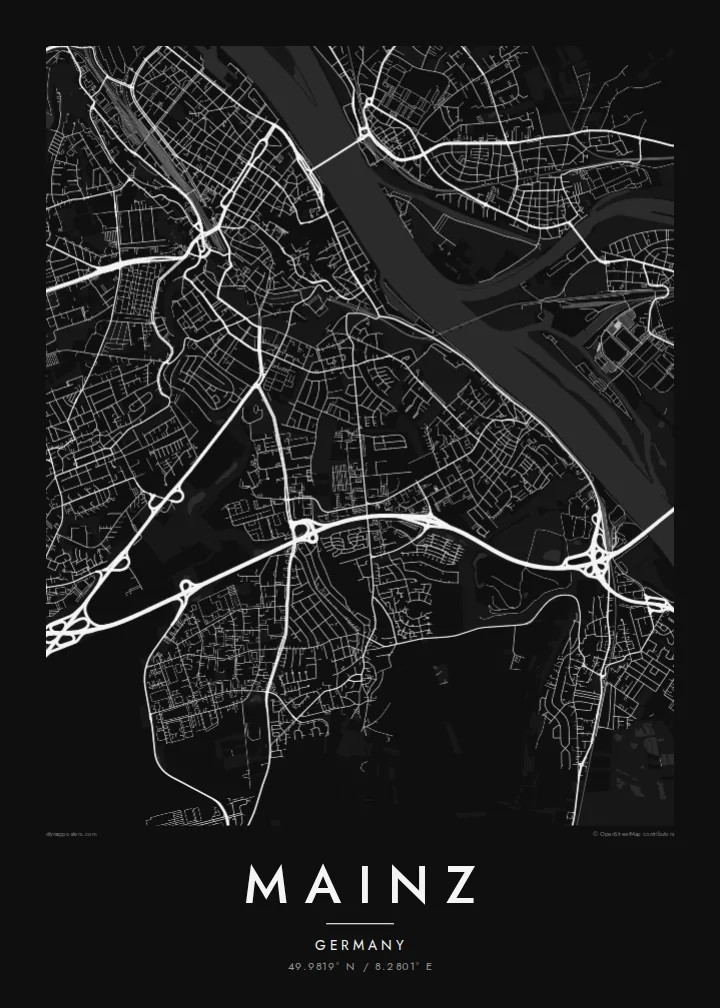
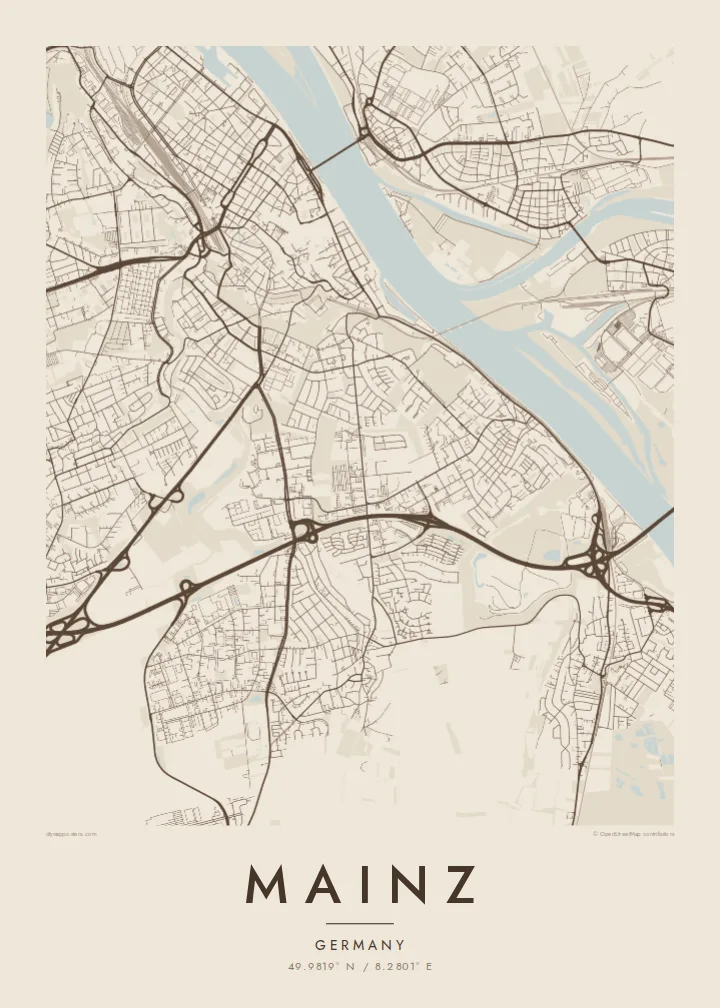
The Main joins the Rhine just opposite the city. On the map the two broad bands of water meet in a wide junction that frames Mainz on its eastern side.
Fakatino mape mukamuka · Germany
49.9819° N / 8.2801° E
An old Rhine city facing the mouth of the Main, with a cathedral core and a planned Neustadt to the north



Taha e taone, lima e onoonoaga
Tapaki e taha puhala ke kitia ai ki luga he puipui. Kua tatai e totogi he tau puhala oti — pete he lolomi, poloka, po ke faila HD.
 Tau pikselo mooli · faila lolomi 24 × 36″
Maama mitaki ke lolomi
Ko e 100% e fahi mooli mai he faila lolomi. Ko e tau poster oti — pete kua lolomi, poloka, po ke utu hifo — kua taute ke he ha mautolu a tau tokoluga (server) ke he 300 DPI, hokotia ke he 7,200 × 10,800 piksela, ke maeke ai e tau ala ikiiki tote ke maaliali fakamitaki he lolomi 24 × 36″.
He Pā


Ko e mape
Mainz stands on the left bank of the Rhine, directly opposite the point where the Main flows in from the east. That confluence is the key to the map: two rivers meet, bridges cross toward Wiesbaden and Kastel, and the city lines up along the western bank. The capital of Rhineland-Palatinate began as the Roman camp of Mogontiacum and has faced the river ever since.
The old town is a tight cluster of lanes around the red sandstone Cathedral of St Martin, with the market square beside it. North of the centre, the Neustadt follows a very different pattern: a planned grid of long, straight streets laid out in the late nineteenth century. Around both, the railway, the university campus and residential quarters spread toward the higher ground to the west.
Johannes Gutenberg developed printing with movable type in Mainz in the fifteenth century, and the university and a museum carry his name. A Mainz map poster, itself a printed sheet, suits that history. The city also takes its carnival season very seriously. On paper, though, what stands out is the river front and the contrast between the old lanes and the newer grid.
The Main joins the Rhine just opposite the city. On the map the two broad bands of water meet in a wide junction that frames Mainz on its eastern side.
The cathedral, begun more than a thousand years ago, sits at the centre of the old town. Irregular squares and narrow streets surround it, unlike the regular blocks further out.
A planned district north of the centre, built on a regular grid of long, parallel streets running toward the river. It is the most orderly part of the city and reads clearly from above.
Taute ke ha hau
Lafi e aho, taha higoa po ke taha kupu haau, hiki e fakatino, lahi po ke tuaga.
Ko e kitiaaga nakai totogi kua tote e maaliali mo e fakamailoga vai. Ko e tau lolomi mo e tau faila HD kua taute ke he 300 DPI, hokotia ke he 7,200 × 10,800 px, nakai fai fakamailoga vai.
Ko e ha Mainz
Students of the Johannes Gutenberg University, people who moved to the Rhine-Main area for work and those born in Mainz all have reasons to keep this map. It shows the whole city, from the riverbank to the outer districts, in a form that suits any room.
Add your own title and subtitle, perhaps a year of study or a wedding date, and adjust the coordinates line. The five styles run from Classic black & white and Noir to the warmer Paper and Sand and the cool Blueprint. Download the files or order a print.
Talaage e poster Mainz| Lahi he lolomi | Maama | Tau faila |
|---|---|---|
| 30 × 40 cm11.8 × 15.7″ | 3,543 × 4,724 px | PNG · PDF |
| 29.7 × 42 cm (A3)11.7 × 16.5″ | 3,508 × 4,961 px | PNG · PDF |
| 42 × 59.4 cm (A2)16.5 × 23.4″ | 4,961 × 7,016 px | PNG · PDF |
| 45.7 × 61 cm18 × 24″ | 5,400 × 7,200 px | PNG · PDF |
| 50 × 70 cm19.7 × 27.6″ | 5,906 × 8,268 px | PNG · PDF |
| 61 × 91.4 cm24 × 36″ | 7,200 × 10,800 px | PNG · PDF |
Ke fakatatai, ko e fakatino noa kua 900 px e laulahi, fai fakamailoga mo e mo e tau mata komipiuta ni. Ko e tau faila HD kua ato hoko ke he 8× e maama ke he tau faahi takitaha mo e lolomi mitaki he lahi katoa he fakatino.
Fifili e taha puhala i luga he kupega, ti fifili e Poster Lolomi — e lahi mo e, kaeke ke manako ai koe, taha poloka — po ke Tau Faila HD Fakaeletonika. Ko e fakaotiaga totogi ko e taha gahua ni, ti ko e kupega he hau a talaaga ka fakafou fakahaga i mua he fakaotiaga e totogi.
Kua lolomi ai ke he pepa mitaki 200 gsm matte he taha he tau lahi ono, mai he 30 × 40 cm ke hoko ke he 24 × 36″. Kamata e tau poster lolomi mai he $39, kua putoia ai e utaaga.
E. Fifili e poloka akau malolō ke he lanu uli, tea, akau oki mooli, po ke akau pouli. Kua fakalataha mo e sioga malolō nakai malepe ti kua mautali ke tautau. Kamata e tau poster poloka mai he $99, kua putoia ai e utaaga.
Nakai totogi e fakafano ke he motu 60+. Ko e fakatino taha kua lolomi he fenoga lolomi ha mautolu kua tata mo e tau motu 30+, kua hoko mai he tau aho gahua 3–7. Maeke ia koe ke kikite e tuaga mo e fakamuitua he lalo he Haku Tau Fakatonu. Ke he falu motu kua 2–5 e tau tapu, ti ka nakai fakafano a mautolu ki ai, to fakaha he api tupe ia ki mua he totogi.
Fakafano mai e taha ata ki a mautolu he loto he 14 e tau aho tali mai he hokoaga, ti to lolomi foki e mautolu nakai totogi po ke liu atu e totogi ki a koe.
E. He editor i luga he kupega nei, hikihiki e matakupu, e matakupu lalo mo e laini coordinates ke he taha mena kua manako a koe ki ai, ti fifili e puhala mo e lahi. Ko e tau talaaga lolomi, poloka mo e fakaeletonika oti kua fakaaoga tonu e hau a fakatino.
Ma e $9 ka moua e koe e tau faila PNG 300 DPI mo e PDF kua mautali ke lolomi he tau lahi ono oti, nakai fai fakamailoga vai, ke lolomi i fe mena. Nakai maopoopo agaia? Utu hifo fakamua e kitiaaga nakai totogi ne fai fakamailoga vai.
