Historic grid
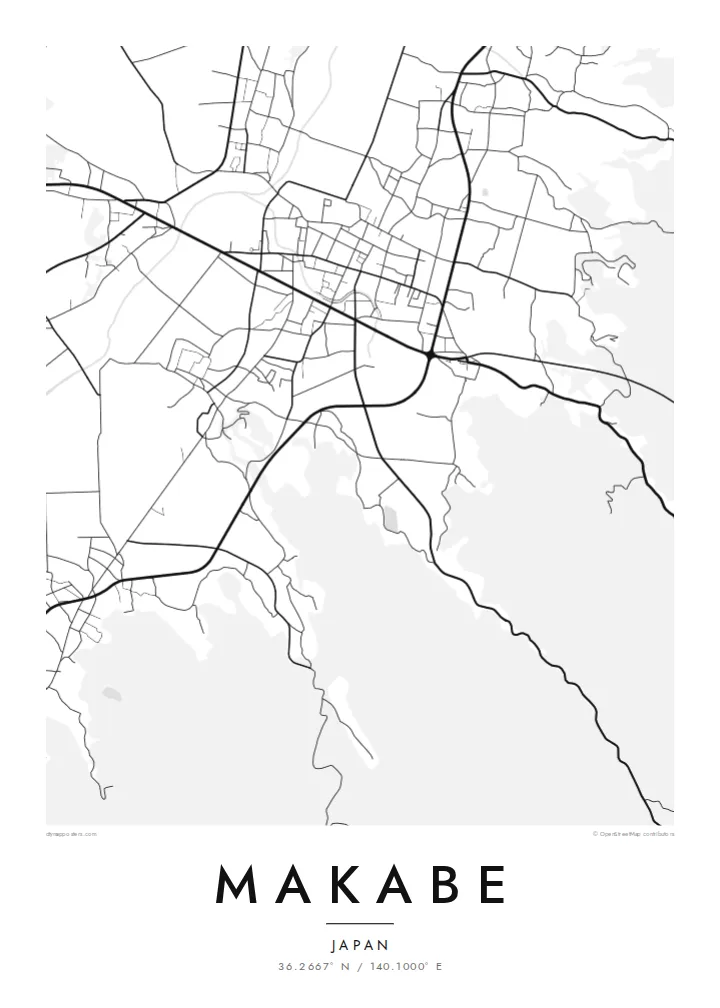
The old centre follows a compact, rectangular layout inherited from its castle-town past, lined with storehouses and traditional shop houses.
Fakatino mape mukamuka · Japan
36.2667° N / 140.1000° E
An old merchant town at the foot of Mount Tsukuba, its lanes of storehouses set among the rice fields of Ibaraki.


Taha e taone, lima e onoonoaga
Tapaki e taha puhala ke kitia ai ki luga he puipui. Kua tatai e totogi he tau puhala oti — pete he lolomi, poloka, po ke faila HD.
 Tau pikselo mooli · faila lolomi 24 × 36″
Maama mitaki ke lolomi
Ko e 100% e fahi mooli mai he faila lolomi. Ko e tau poster oti — pete kua lolomi, poloka, po ke utu hifo — kua taute ke he ha mautolu a tau tokoluga (server) ke he 300 DPI, hokotia ke he 7,200 × 10,800 piksela, ke maeke ai e tau ala ikiiki tote ke maaliali fakamitaki he lolomi 24 × 36″.
He Pā


Ko e mape
Makabe was a town in Ibaraki Prefecture until 2005, when it merged into the city of Sakuragawa, and it remains a distinct district with its own character. It lies on the northern side of Mount Tsukuba, where the Kanto Plain begins to meet the hills. From above the old centre is a compact grid of streets surrounded by rice paddies, farmhouses and the slopes rising to the south.
The town developed as a castle town and later as a merchant centre, and many traditional buildings survive, including storehouses and shop houses. The area is also known for its granite and stone carving. The historic district is protected as a preservation area for groups of traditional buildings, and on a map it reads as a tidy, rectangular pattern set within open fields.
Each year in late winter the district holds a Hina doll festival, when residents display dolls in the windows of old houses and shops and visitors walk the preserved streets. A Makabe map poster frames the historic centre with the fields and the northern slopes of Tsukuba around it, capturing both the town and its setting.
The old centre follows a compact, rectangular layout inherited from its castle-town past, lined with storehouses and traditional shop houses.
Flat fields surround the town in small rectangular plots, giving the map a fine, regular texture that frames the built-up area.
To the south the land rises toward Mount Tsukuba, one of the best-known mountains of the Kanto region, adding contour and depth to a wider view.
Taute ke ha hau
Lafi e aho, taha higoa po ke taha kupu haau, hiki e fakatino, lahi po ke tuaga.
Ko e kitiaaga nakai totogi kua tote e maaliali mo e fakamailoga vai. Ko e tau lolomi mo e tau faila HD kua taute ke he 300 DPI, hokotia ke he 7,200 × 10,800 px, nakai fai fakamailoga vai.
Ko e ha Makabe
Makabe suits anyone who has walked its old streets during the doll festival, grew up in the district or has family in Sakuragawa. Its compact centre and the fields around it make an elegant, balanced composition on any wall.
Set the title and subtitle, perhaps 'Makabe, Sakuragawa' or a family name and date, and edit the coordinates line. All five styles, Classic black & white, Noir, Paper, Blueprint and Sand, suit the fine grid, and Paper gives it a quiet, printed-book feel.
Talaage e poster Makabe| Lahi he lolomi | Maama | Tau faila |
|---|---|---|
| 30 × 40 cm11.8 × 15.7″ | 3,543 × 4,724 px | PNG · PDF |
| 29.7 × 42 cm (A3)11.7 × 16.5″ | 3,508 × 4,961 px | PNG · PDF |
| 42 × 59.4 cm (A2)16.5 × 23.4″ | 4,961 × 7,016 px | PNG · PDF |
| 45.7 × 61 cm18 × 24″ | 5,400 × 7,200 px | PNG · PDF |
| 50 × 70 cm19.7 × 27.6″ | 5,906 × 8,268 px | PNG · PDF |
| 61 × 91.4 cm24 × 36″ | 7,200 × 10,800 px | PNG · PDF |
Ke fakatatai, ko e fakatino noa kua 900 px e laulahi, fai fakamailoga mo e mo e tau mata komipiuta ni. Ko e tau faila HD kua ato hoko ke he 8× e maama ke he tau faahi takitaha mo e lolomi mitaki he lahi katoa he fakatino.
Fifili e taha puhala i luga he kupega, ti fifili e Poster Lolomi — e lahi mo e, kaeke ke manako ai koe, taha poloka — po ke Tau Faila HD Fakaeletonika. Ko e fakaotiaga totogi ko e taha gahua ni, ti ko e kupega he hau a talaaga ka fakafou fakahaga i mua he fakaotiaga e totogi.
Kua lolomi ai ke he pepa mitaki 200 gsm matte he taha he tau lahi ono, mai he 30 × 40 cm ke hoko ke he 24 × 36″. Kamata e tau poster lolomi mai he $39, kua putoia ai e utaaga.
E. Fifili e poloka akau malolō ke he lanu uli, tea, akau oki mooli, po ke akau pouli. Kua fakalataha mo e sioga malolō nakai malepe ti kua mautali ke tautau. Kamata e tau poster poloka mai he $99, kua putoia ai e utaaga.
Nakai totogi e fakafano ke he motu 60+. Ko e fakatino taha kua lolomi he fenoga lolomi ha mautolu kua tata mo e tau motu 30+, kua hoko mai he tau aho gahua 3–7. Maeke ia koe ke kikite e tuaga mo e fakamuitua he lalo he Haku Tau Fakatonu. Ke he falu motu kua 2–5 e tau tapu, ti ka nakai fakafano a mautolu ki ai, to fakaha he api tupe ia ki mua he totogi.
Fakafano mai e taha ata ki a mautolu he loto he 14 e tau aho tali mai he hokoaga, ti to lolomi foki e mautolu nakai totogi po ke liu atu e totogi ki a koe.
E. He editor i luga he kupega nei, hikihiki e matakupu, e matakupu lalo mo e laini coordinates ke he taha mena kua manako a koe ki ai, ti fifili e puhala mo e lahi. Ko e tau talaaga lolomi, poloka mo e fakaeletonika oti kua fakaaoga tonu e hau a fakatino.
Ma e $9 ka moua e koe e tau faila PNG 300 DPI mo e PDF kua mautali ke lolomi he tau lahi ono oti, nakai fai fakamailoga vai, ke lolomi i fe mena. Nakai maopoopo agaia? Utu hifo fakamua e kitiaaga nakai totogi ne fai fakamailoga vai.
Tata mai
