Rail corridor
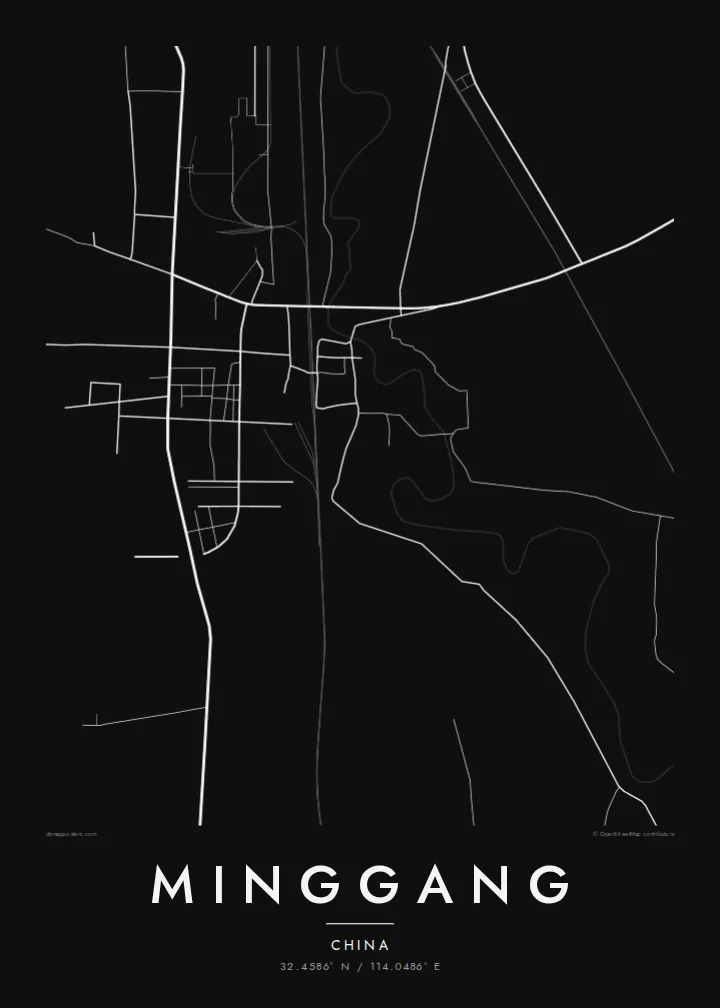
The main north–south railway cuts cleanly through the town, and most streets line up with it. This gives the map a strong vertical axis that anchors the whole composition.
Fakatino mape mukamuka · China
32.4586° N / 114.0486° E
A compact railway town in southern Henan, its streets pressed between a rail line, watercourses and a patchwork of paddies.



Taha e taone, lima e onoonoaga
Tapaki e taha puhala ke kitia ai ki luga he puipui. Kua tatai e totogi he tau puhala oti — pete he lolomi, poloka, po ke faila HD.
 Tau pikselo mooli · faila lolomi 24 × 36″
Maama mitaki ke lolomi
Ko e 100% e fahi mooli mai he faila lolomi. Ko e tau poster oti — pete kua lolomi, poloka, po ke utu hifo — kua taute ke he ha mautolu a tau tokoluga (server) ke he 300 DPI, hokotia ke he 7,200 × 10,800 piksela, ke maeke ai e tau ala ikiiki tote ke maaliali fakamitaki he lolomi 24 × 36″.
He Pā


Ko e mape
Minggang sits in the south of Henan province, within the prefecture of Xinyang, where the North China Plain begins to give way to the low country of the Huai River basin. On a map the town reads as a tight core of blocks along a north–south rail corridor. Roads fan out from it into farmland dotted with ponds, small reservoirs and scattered villages.
The railway is the clearest line on the sheet. It runs straight through the town and sets the direction of the street pattern. The older lanes cluster near the station, and newer, wider avenues are laid out in longer rectangles beyond them. At the edges the built area thins into field boundaries and irrigation channels, a texture that prints well in fine black lines.
A Minggang map poster is a portrait of a place shaped by movement and agriculture rather than by monuments. The composition is centred on the dense grid and lets the fields and water fill the rest of the frame, so the print has both detail and breathing room. It suits a hallway or study where a quieter, more graphic map is wanted.
The main north–south railway cuts cleanly through the town, and most streets line up with it. This gives the map a strong vertical axis that anchors the whole composition.
Small bodies of water are scattered across the surrounding countryside. They show up as irregular solid shapes that contrast with the straight lines of roads and field edges.
The edge of the built-up area is soft, with blocks dissolving into village clusters and farm tracks. The gradual transition shows how the town grew out of its agricultural setting.
Taute ke ha hau
Lafi e aho, taha higoa po ke taha kupu haau, hiki e fakatino, lahi po ke tuaga.
Ko e kitiaaga nakai totogi kua tote e maaliali mo e fakamailoga vai. Ko e tau lolomi mo e tau faila HD kua taute ke he 300 DPI, hokotia ke he 7,200 × 10,800 px, nakai fai fakamailoga vai.
Ko e ha Minggang
People hang a map of Minggang because it was home, a stop on a long journey or the place a family came from. Seen from above, the railway and the grid become a personal landmark that is familiar yet abstract enough to fit any interior.
You can personalise the title, subtitle and coordinates line, for example with a family name or a date, and choose from five styles: Classic black & white, Noir, Paper, Blueprint or Sand. The HD files cost $9, or you can order a printed poster with an optional wooden frame.
Talaage e poster Minggang| Lahi he lolomi | Maama | Tau faila |
|---|---|---|
| 30 × 40 cm11.8 × 15.7″ | 3,543 × 4,724 px | PNG · PDF |
| 29.7 × 42 cm (A3)11.7 × 16.5″ | 3,508 × 4,961 px | PNG · PDF |
| 42 × 59.4 cm (A2)16.5 × 23.4″ | 4,961 × 7,016 px | PNG · PDF |
| 45.7 × 61 cm18 × 24″ | 5,400 × 7,200 px | PNG · PDF |
| 50 × 70 cm19.7 × 27.6″ | 5,906 × 8,268 px | PNG · PDF |
| 61 × 91.4 cm24 × 36″ | 7,200 × 10,800 px | PNG · PDF |
Ke fakatatai, ko e fakatino noa kua 900 px e laulahi, fai fakamailoga mo e mo e tau mata komipiuta ni. Ko e tau faila HD kua ato hoko ke he 8× e maama ke he tau faahi takitaha mo e lolomi mitaki he lahi katoa he fakatino.
Fifili e taha puhala i luga he kupega, ti fifili e Poster Lolomi — e lahi mo e, kaeke ke manako ai koe, taha poloka — po ke Tau Faila HD Fakaeletonika. Ko e fakaotiaga totogi ko e taha gahua ni, ti ko e kupega he hau a talaaga ka fakafou fakahaga i mua he fakaotiaga e totogi.
Kua lolomi ai ke he pepa mitaki 200 gsm matte he taha he tau lahi ono, mai he 30 × 40 cm ke hoko ke he 24 × 36″. Kamata e tau poster lolomi mai he $39, kua putoia ai e utaaga.
E. Fifili e poloka akau malolō ke he lanu uli, tea, akau oki mooli, po ke akau pouli. Kua fakalataha mo e sioga malolō nakai malepe ti kua mautali ke tautau. Kamata e tau poster poloka mai he $99, kua putoia ai e utaaga.
Nakai totogi e fakafano ke he motu 60+. Ko e fakatino taha kua lolomi he fenoga lolomi ha mautolu kua tata mo e tau motu 30+, kua hoko mai he tau aho gahua 3–7. Maeke ia koe ke kikite e tuaga mo e fakamuitua he lalo he Haku Tau Fakatonu. Ke he falu motu kua 2–5 e tau tapu, ti ka nakai fakafano a mautolu ki ai, to fakaha he api tupe ia ki mua he totogi.
Fakafano mai e taha ata ki a mautolu he loto he 14 e tau aho tali mai he hokoaga, ti to lolomi foki e mautolu nakai totogi po ke liu atu e totogi ki a koe.
E. He editor i luga he kupega nei, hikihiki e matakupu, e matakupu lalo mo e laini coordinates ke he taha mena kua manako a koe ki ai, ti fifili e puhala mo e lahi. Ko e tau talaaga lolomi, poloka mo e fakaeletonika oti kua fakaaoga tonu e hau a fakatino.
Ma e $9 ka moua e koe e tau faila PNG 300 DPI mo e PDF kua mautali ke lolomi he tau lahi ono oti, nakai fai fakamailoga vai, ke lolomi i fe mena. Nakai maopoopo agaia? Utu hifo fakamua e kitiaaga nakai totogi ne fai fakamailoga vai.
Tata mai
