Diagonal avenues
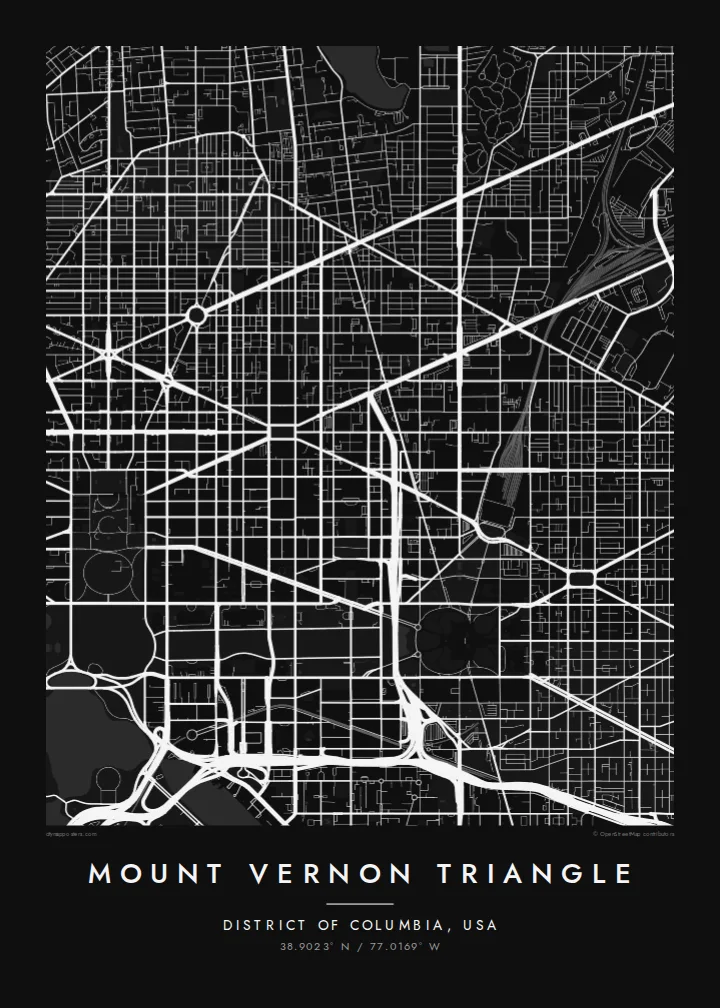
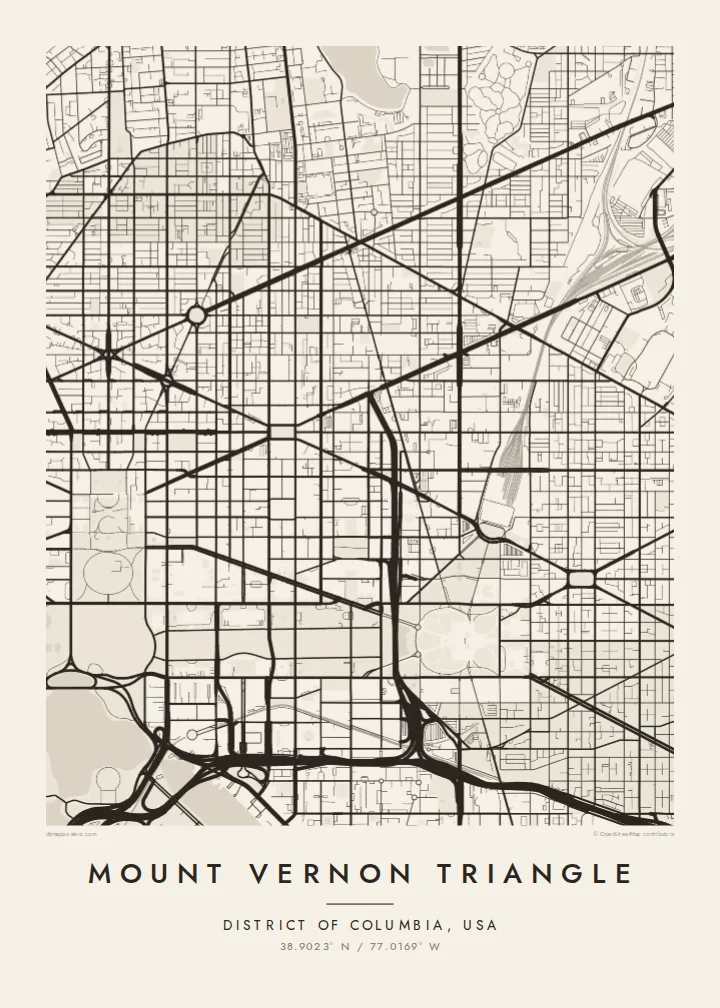
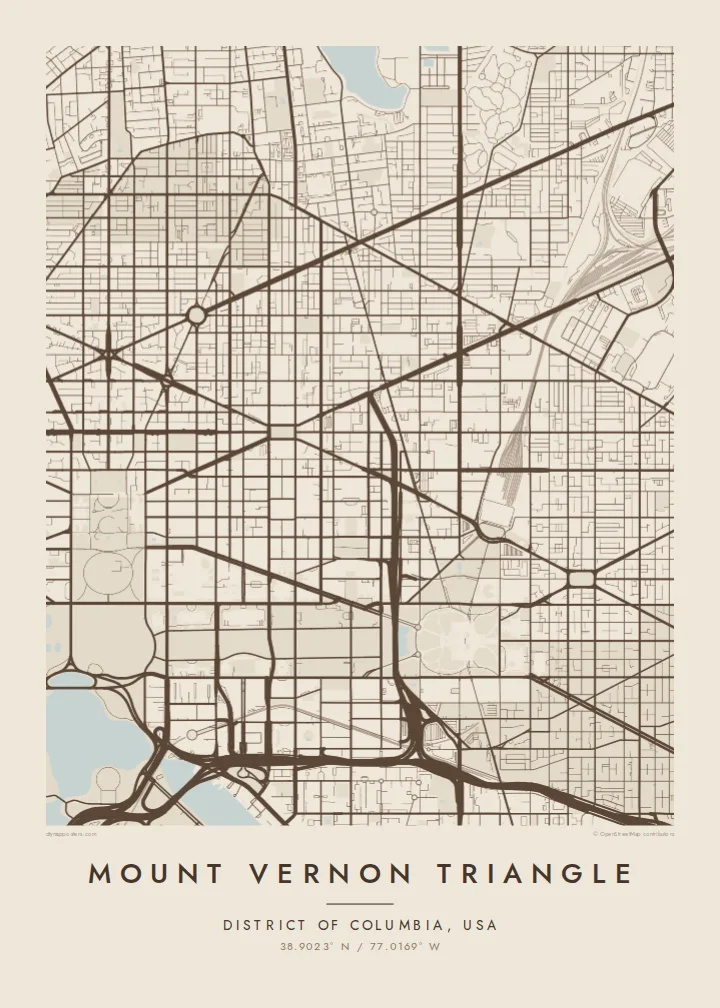
Massachusetts and New York Avenues slice across the grid at an angle, framing the neighbourhood and giving the map its strong triangular outline.
Fakatino mape mukamuka · United States
38.9023° N / 77.0169° W
A wedge of downtown Washington carved out by L'Enfant's diagonal avenues cutting across the city's rectangular street grid


Taha e taone, lima e onoonoaga
Tapaki e taha puhala ke kitia ai ki luga he puipui. Kua tatai e totogi he tau puhala oti — pete he lolomi, poloka, po ke faila HD.
 Tau pikselo mooli · faila lolomi 24 × 36″
Maama mitaki ke lolomi
Ko e 100% e fahi mooli mai he faila lolomi. Ko e tau poster oti — pete kua lolomi, poloka, po ke utu hifo — kua taute ke he ha mautolu a tau tokoluga (server) ke he 300 DPI, hokotia ke he 7,200 × 10,800 piksela, ke maeke ai e tau ala ikiiki tote ke maaliali fakamitaki he lolomi 24 × 36″.
He Pā


Ko e mape
Mount Vernon Triangle is a small downtown neighbourhood in Washington, D.C., and its name describes its shape. The area is defined by the diagonal avenues of Pierre L'Enfant's plan, Massachusetts and New York among them, where they cross the lettered and numbered grid. On a map that meeting produces a sharp, wedge-shaped district with angled corners and unusual intersections.
The neighbourhood lies just east of Mount Vernon Square, the open space that holds the historic Carnegie Library, and the Walter E. Washington Convention Center stands nearby. Over the past two decades the triangle has filled with residential towers and new streets, but its geometry comes straight from the eighteenth-century plan. A Mount Vernon Triangle map poster makes that inheritance visible.
The blocks here are mostly large and angular, and their outlines combine the straight grid with the long diagonals running toward the Capitol and beyond. Just to the east, the I-395 corridor and its recent decking add another layer of city-building to the scene. In black and white the district reads as a precise piece of urban design.
Massachusetts and New York Avenues slice across the grid at an angle, framing the neighbourhood and giving the map its strong triangular outline.
To the west, the square and its Carnegie Library form an open, formal space where several of L'Enfant's lines converge on the historic plan.
Where straight streets meet angled avenues, the blocks become wedges and trapezoids, creating the distinctive shapes that make this part of Washington so graphic.
Taute ke ha hau
Lafi e aho, taha higoa po ke taha kupu haau, hiki e fakatino, lahi po ke tuaga.
Ko e kitiaaga nakai totogi kua tote e maaliali mo e fakamailoga vai. Ko e tau lolomi mo e tau faila HD kua taute ke he 300 DPI, hokotia ke he 7,200 × 10,800 px, nakai fai fakamailoga vai.
Ko e ha Mount Vernon Triangle
For people who live in one of the triangle's new buildings or worked nearby, the map is a precise souvenir of a very particular corner of the capital. Its geometry suits modern interiors and makes an apt gift for architects, planners or anyone who loves city plans.
You can title it with a building name, add a move-in date as the subtitle and keep the coordinates line, then choose Blueprint for a technical look or Noir for high contrast. Order a printed poster, with or without a frame, or download the six HD sizes for $9.
Talaage e poster Mount Vernon Triangle| Lahi he lolomi | Maama | Tau faila |
|---|---|---|
| 30 × 40 cm11.8 × 15.7″ | 3,543 × 4,724 px | PNG · PDF |
| 29.7 × 42 cm (A3)11.7 × 16.5″ | 3,508 × 4,961 px | PNG · PDF |
| 42 × 59.4 cm (A2)16.5 × 23.4″ | 4,961 × 7,016 px | PNG · PDF |
| 45.7 × 61 cm18 × 24″ | 5,400 × 7,200 px | PNG · PDF |
| 50 × 70 cm19.7 × 27.6″ | 5,906 × 8,268 px | PNG · PDF |
| 61 × 91.4 cm24 × 36″ | 7,200 × 10,800 px | PNG · PDF |
Ke fakatatai, ko e fakatino noa kua 900 px e laulahi, fai fakamailoga mo e mo e tau mata komipiuta ni. Ko e tau faila HD kua ato hoko ke he 8× e maama ke he tau faahi takitaha mo e lolomi mitaki he lahi katoa he fakatino.
Fifili e taha puhala i luga he kupega, ti fifili e Poster Lolomi — e lahi mo e, kaeke ke manako ai koe, taha poloka — po ke Tau Faila HD Fakaeletonika. Ko e fakaotiaga totogi ko e taha gahua ni, ti ko e kupega he hau a talaaga ka fakafou fakahaga i mua he fakaotiaga e totogi.
Kua lolomi ai ke he pepa mitaki 200 gsm matte he taha he tau lahi ono, mai he 30 × 40 cm ke hoko ke he 24 × 36″. Kamata e tau poster lolomi mai he $39, kua putoia ai e utaaga.
E. Fifili e poloka akau malolō ke he lanu uli, tea, akau oki mooli, po ke akau pouli. Kua fakalataha mo e sioga malolō nakai malepe ti kua mautali ke tautau. Kamata e tau poster poloka mai he $99, kua putoia ai e utaaga.
Nakai totogi e fakafano ke he motu 60+. Ko e fakatino taha kua lolomi he fenoga lolomi ha mautolu kua tata mo e tau motu 30+, kua hoko mai he tau aho gahua 3–7. Maeke ia koe ke kikite e tuaga mo e fakamuitua he lalo he Haku Tau Fakatonu. Ke he falu motu kua 2–5 e tau tapu, ti ka nakai fakafano a mautolu ki ai, to fakaha he api tupe ia ki mua he totogi.
Fakafano mai e taha ata ki a mautolu he loto he 14 e tau aho tali mai he hokoaga, ti to lolomi foki e mautolu nakai totogi po ke liu atu e totogi ki a koe.
E. He editor i luga he kupega nei, hikihiki e matakupu, e matakupu lalo mo e laini coordinates ke he taha mena kua manako a koe ki ai, ti fifili e puhala mo e lahi. Ko e tau talaaga lolomi, poloka mo e fakaeletonika oti kua fakaaoga tonu e hau a fakatino.
Ma e $9 ka moua e koe e tau faila PNG 300 DPI mo e PDF kua mautali ke lolomi he tau lahi ono oti, nakai fai fakamailoga vai, ke lolomi i fe mena. Nakai maopoopo agaia? Utu hifo fakamua e kitiaaga nakai totogi ne fai fakamailoga vai.
Tata mai
